Birdr

Yellow-rumped Tinkerbird vs Pied Barbet

Pogoniulus bilineatus versus Tricholaema leucomelas

Play a quiz with Yellow-rumped Tinkerbird and Pied Barbet
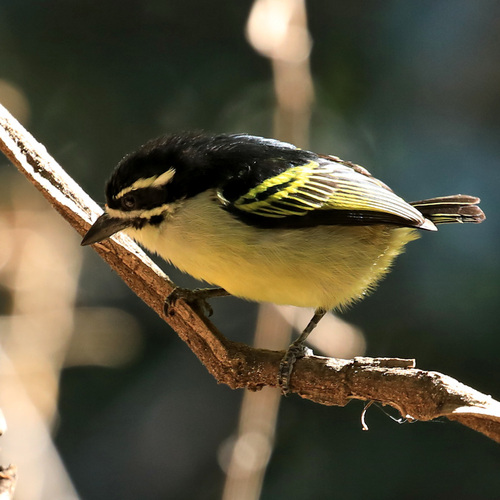
Yellow-rumped Tinkerbird (Pogoniulus bilineatus) Yellow-rumped Tinkerbird
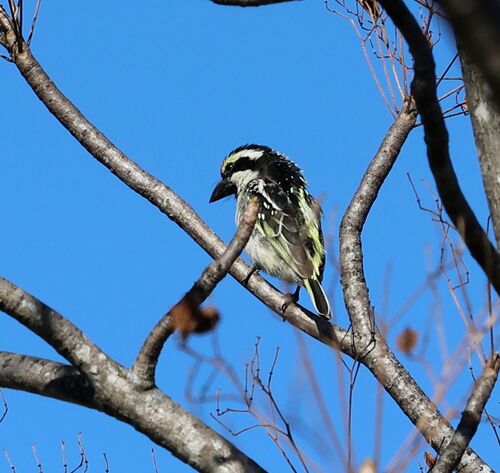
Pied Barbet (Tricholaema leucomelas) Pied Barbet

Media

Loading…

In short

The Yellow-rumped Tinkerbird and Pied Barbet are both small African barbets, but they can be distinguished by their plumage and vocalizations. The Yellow-rumped Tinkerbird is known for its distinctive yellow rump and more subtle plumage, while the Pied Barbet has a striking black and white pattern with a red forehead.

Identification tips

  1. Look for the yellow rump on the Yellow-rumped Tinkerbird. 2. Note the red forehead and bold black and white pattern on the Pied Barbet. 3. Listen for the high-pitched, repetitive call of the Yellow-rumped Tinkerbird versus the melodious series of the Pied Barbet. 4. Consider the habitat: forested areas for the Yellow-rumped Tinkerbird and open woodlands for the Pied Barbet.

Size

Both species are small, but the Pied Barbet is slightly larger and more robust than the Yellow-rumped Tinkerbird.

Plumage

The Yellow-rumped Tinkerbird has a yellow rump, olive upperparts, and a white throat, with a subtle black and white facial pattern. In contrast, the Pied Barbet features a bold black and white plumage with a distinctive red forehead and a white belly.

Behaviour

Both species are arboreal and often found in pairs or small groups. They are active and can be seen foraging for insects and fruit.

Habitat

The Yellow-rumped Tinkerbird is typically found in forested areas and woodland, while the Pied Barbet prefers drier, open woodlands and savannas.

Voice

The Yellow-rumped Tinkerbird has a repetitive, high-pitched 'tink-tink-tink' call, while the Pied Barbet's call is a more varied and melodious series of notes.

Submit a better description

Use the same sections as the comparison. Your text is published immediately.

The Yellow-rumped Tinkerbird and Pied Barbet are both small African barbets, but they can be distinguished by their plumage and vocalizations. The Yellow-rumped Tinkerbird is known for its distinctive yellow rump and more subtle plumage, while the Pied Barbet has a striking black and white pattern with a red forehead.

  1. Look for the yellow rump on the Yellow-rumped Tinkerbird. 2. Note the red forehead and bold black and white pattern on the Pied Barbet. 3. Listen for the high-pitched, repetitive call of the Yellow-rumped Tinkerbird versus the melodious series of the Pied Barbet. 4. Consider the habitat: forested areas for the Yellow-rumped Tinkerbird and open woodlands for the Pied Barbet.

Both species are small, but the Pied Barbet is slightly larger and more robust than the Yellow-rumped Tinkerbird.

The Yellow-rumped Tinkerbird has a yellow rump, olive upperparts, and a white throat, with a subtle black and white facial pattern. In contrast, the Pied Barbet features a bold black and white plumage with a distinctive red forehead and a white belly.

Both species are arboreal and often found in pairs or small groups. They are active and can be seen foraging for insects and fruit.

The Yellow-rumped Tinkerbird is typically found in forested areas and woodland, while the Pied Barbet prefers drier, open woodlands and savannas.

The Yellow-rumped Tinkerbird has a repetitive, high-pitched 'tink-tink-tink' call, while the Pied Barbet's call is a more varied and melodious series of notes.

Discard your changes?

You have unsaved edits. If you leave now, those changes will be lost.

Yellow-rumped Tinkerbird · Pied Barbet · My Tricky Birds