
Yellow-throated Warbler vs Grace's Warbler
Setophaga dominica versus Setophaga graciae
Play a quiz with Yellow-throated Warbler and Grace's Warbler
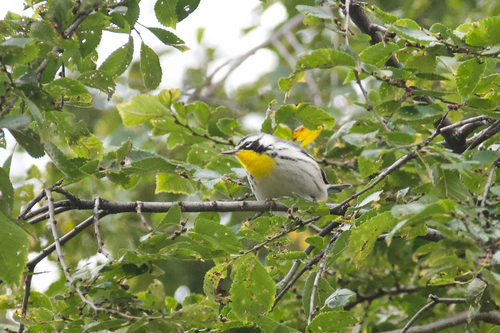 Yellow-throated Warbler
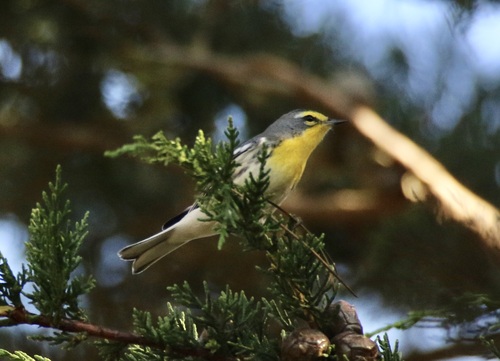 Grace's Warbler
In short
The most reliable field mark to separate Yellow-throated Warbler from Grace's Warbler is the bold, contrasting black-and-white head pattern of Yellow-throated, especially the strong supercilium and cheek patch, versus the softer, less crisply marked face of Grace's. Both species show gray upperparts, two white wingbars, and yellow throats, but Yellow-throated has a pure white belly and more extensive black streaking on the flanks, while Grace's has yellow extending onto the breast and a yellow half-eye ring. Structural differences are subtle, but context and face pattern are key. Immature and female Yellow-throated Warblers can be duller, but still show a more defined facial pattern than Grace's.
Identification tips
- Head pattern is the most decisive mark: Yellow-throated Warbler of all ages and sexes shows a bold black-and-white head with a long supercilium and black cheek patch; Grace's Warbler has a softer face with a yellow eyebrow and half-eye ring, lacking the strong black cheek.
- Supercilium color: Yellow-throated typically has a white supercilium, sometimes with yellow at the front (except S. d. albilora, which is all white); Grace's has a yellow supercilium that fades to white behind the eye.
- Throat and breast: Yellow-throated's yellow is sharply limited to the throat, with a crisp border to the white belly; Grace's yellow extends onto the upper breast, blending more gradually into the white belly.
- Flank streaking: Both have black streaks on the flanks, but Yellow-throated's are usually bolder and more extensive; Grace's streaks are broken and less prominent.
- Underpart color: Yellow-throated has pure white underparts below the throat; Grace's may show a slight yellow wash on the breast.
- Wingbars: Both species have two white wingbars; this is not a separator.
- Back and upperparts: Both are gray above, but Grace's may show more broken black streaks across the back.
- Eye ring: Grace's has a yellow half-eye ring under the eye; Yellow-throated lacks this feature.
- Bill shape: No strong difference is noted in field structure, though S. d. stoddardi (Yellow-throated) may have a slightly slenderer bill, not usually diagnostic in the field.
- Sex/age variation: Female and immature Yellow-throated Warblers are duller and less crisply marked, but still show a stronger facial pattern than any Grace's. Grace's does not show strong sexual dimorphism.
- Habitat context: In pine forests of the Southwest or Mexico, especially at higher elevations, expect Grace's; in swampy or mixed forests of the Southeast, especially with Spanish moss, expect Yellow-throated.
- Foraging behavior: If you see a warbler hovering at pine cones or needle clusters high in a pine, Grace's is more likely; Yellow-throated may forage in a wider variety of trees and is less strictly tied to pines.
- Geographic range: Yellow-throated is primarily southeastern US; Grace's is southwestern US to Nicaragua. Out-of-range records are rare but possible.
- Voice: If you hear a clear, descending whistle, suspect Yellow-throated, but do not rely on this alone without further details.
- Seasonal context: Both species are migratory, but Yellow-throated has a more southerly breeding and more northerly wintering range than most Setophaga warblers; Grace's winters mostly within its breeding range.
Size
Both species are small warblers and very close in size, but Yellow-throated Warbler is slightly larger (13–14 cm length, 8.5–11.3 g) compared to Grace's Warbler (11–13 cm, 8.0 g). In the field, this difference is rarely obvious unless seen side by side. Both have similar proportions and overall 'warbler' jizz, so size is not a primary separator.
Plumage
For all ages, Yellow-throated Warbler shows a striking black-and-white head pattern with a long supercilium (eyebrow), black cheek patch, and a bright yellow throat sharply demarcated from the pure white underparts. The flanks are streaked with black. Immatures and females are duller but retain the strong facial pattern, though less crisply. Some subspecies have a yellow front to the supercilium, but S. d. albilora has an all-white supercilium. Grace's Warbler also has gray upperparts and two white wingbars, but the face is less contrasting: it features a yellow eyebrow that fades to white behind the eye, a yellow half-eye ring below the eye, and lacks the strong black cheek patch. The yellow of the throat extends onto the upper breast, unlike the sharply limited yellow of Yellow-throated. Grace's has broken black streaks on the back and flanks, but the head pattern is always softer and less defined. No distinctive juvenile or immature upperwing pattern is described for either species, so focus is on head and underpart pattern for all ages.
Behaviour
Both species forage actively in trees, but Grace's Warbler is highly specialized for pine forests and often forages high in the canopy, frequently hovering to inspect pine cones and needle clusters. Yellow-throated Warbler also forages in trees, often in conifers or swamp trees, and may sally for insects, but is less strictly tied to pines. Both may be seen gleaning from branches, but Grace's is more likely to be seen hovering at pine cones.
Habitat
Habitat is a strong contextual clue. Grace's Warbler is almost always found in pine forests throughout its range, even in migration, and prefers open, parklike pine woods, often at higher elevations in the southwestern US and Mexico. Yellow-throated Warbler breeds in the southeastern US, favoring coniferous or swamp forests, and is less strictly tied to pines, sometimes using other mature trees with Spanish moss. If you are in a pine-dominated landscape in the Southwest, Grace's is far more likely; in the Southeast, especially in swampy or mixed woods, Yellow-throated is expected.
Voice
Yellow-throated Warbler's song is a series of clear, descending whistles, with calls that are high 'sees' or sharp chips. No detailed description of Grace's Warbler's vocalizations is provided here, so voice is not a primary separator based on these notes.