Birdr

Yellow Warbler vs Wilson's Warbler

Setophaga petechia versus Cardellina pusilla

Play a quiz with Yellow Warbler and Wilson's Warbler
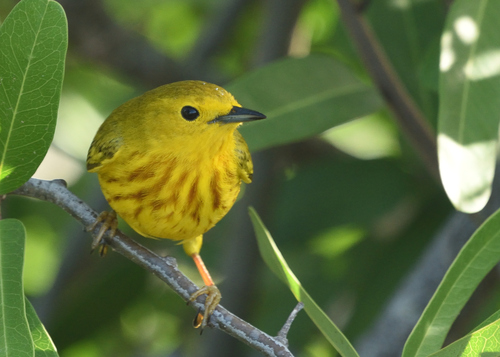
Yellow Warbler (Setophaga petechia) Yellow Warbler
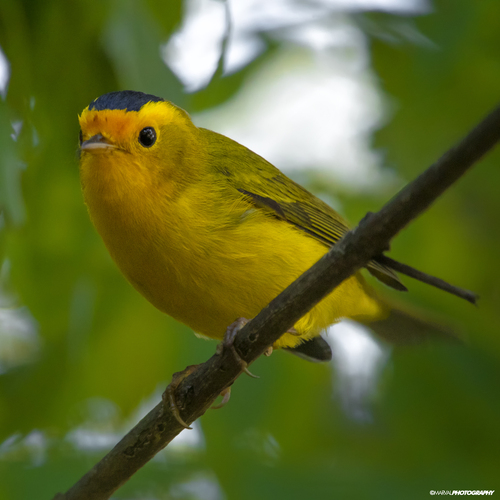
Wilson's Warbler (Cardellina pusilla) Wilson's Warbler

Media

Loading…

In short

The Yellow Warbler and Wilson's Warbler can be distinguished by the Yellow Warbler's overall bright yellow plumage and lack of a black cap, while Wilson's Warbler is notable for its distinctive black cap and more olive upperparts. Both species are small, active warblers, but their head markings are the most reliable field marks.

Identification tips

1. Look for the black cap on Wilson's Warbler, absent in Yellow Warbler. 2. Note the overall bright yellow of the Yellow Warbler compared to the olive upperparts of Wilson's Warbler. 3. Observe behavior: Wilson's Warbler often waves its tail. 4. Listen for vocalizations: Wilson's Warbler's song is short and chattering, while Yellow Warbler's is sweet and repetitive. 5. Consider habitat: Wilson's Warbler is more likely in dense, wet thickets, while Yellow Warbler prefers open, shrubby areas near water.

Size

Both species are small warblers, with similar body sizes and proportions.

Plumage

The Yellow Warbler is uniformly bright yellow with some subtle chestnut streaking on the breast in males, lacking any black on the head. In contrast, Wilson's Warbler has a distinctive black cap, especially in males, and more olive-green upperparts.

Behaviour

Wilson's Warbler is known for its characteristic tail-waving behavior and is often seen darting through shrub willows and undergrowth. The Yellow Warbler is similarly active but lacks the distinctive tail-waving.

Habitat

Yellow Warblers are often found in open, shrubby habitats near water, while Wilson's Warblers prefer wet habitats like riparian zones and wet meadows with dense shrub thickets.

Voice

Wilson's Warbler has a short, chattering song, while the Yellow Warbler's song is a sweet, repetitive series of notes. These vocal differences can be helpful in distinguishing the two species.

Submit a better description

Use the same sections as the comparison. Your text is published immediately.

The Yellow Warbler and Wilson's Warbler can be distinguished by the Yellow Warbler's overall bright yellow plumage and lack of a black cap, while Wilson's Warbler is notable for its distinctive black cap and more olive upperparts. Both species are small, active warblers, but their head markings are the most reliable field marks.

1. Look for the black cap on Wilson's Warbler, absent in Yellow Warbler. 2. Note the overall bright yellow of the Yellow Warbler compared to the olive upperparts of Wilson's Warbler. 3. Observe behavior: Wilson's Warbler often waves its tail. 4. Listen for vocalizations: Wilson's Warbler's song is short and chattering, while Yellow Warbler's is sweet and repetitive. 5. Consider habitat: Wilson's Warbler is more likely in dense, wet thickets, while Yellow Warbler prefers open, shrubby areas near water.

Both species are small warblers, with similar body sizes and proportions.

The Yellow Warbler is uniformly bright yellow with some subtle chestnut streaking on the breast in males, lacking any black on the head. In contrast, Wilson's Warbler has a distinctive black cap, especially in males, and more olive-green upperparts.

Wilson's Warbler is known for its characteristic tail-waving behavior and is often seen darting through shrub willows and undergrowth. The Yellow Warbler is similarly active but lacks the distinctive tail-waving.

Yellow Warblers are often found in open, shrubby habitats near water, while Wilson's Warblers prefer wet habitats like riparian zones and wet meadows with dense shrub thickets.

Wilson's Warbler has a short, chattering song, while the Yellow Warbler's song is a sweet, repetitive series of notes. These vocal differences can be helpful in distinguishing the two species.

Discard your changes?

You have unsaved edits. If you leave now, those changes will be lost.

Yellow Warbler · Wilson's Warbler · My Tricky Birds