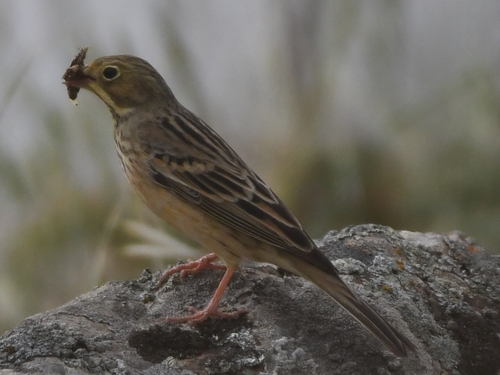
Yellowhammer vs Ortolan Bunting
Emberiza citrinella versus Emberiza hortulana
Play a quiz with Yellowhammer and Ortolan Bunting
Yellowhammer
Ortolan Bunting
In short
To distinguish a Yellowhammer from an Ortolan Bunting, focus on the head pattern and overall coloration. The Yellowhammer typically shows a brighter yellow head and underparts, while the Ortolan Bunting has a more subdued, olive-brown appearance with a distinct white eye-ring. Both species are similar in size and shape, but their vocalizations and habitats can also provide clues.
Identification tips
- Look for the bright yellow head and underparts of the Yellowhammer, especially in males. 2. Note the Ortolan Bunting's white eye-ring and more subdued coloration. 3. Listen for the Yellowhammer's distinctive song compared to the Ortolan's softer, melodic notes. 4. Consider the habitat: Yellowhammers prefer open fields, while Ortolans are more likely in shrubby areas.
Size
Both species are similar in size, typical of buntings, with no significant differences in structure.
Plumage
The Yellowhammer has a bright yellow head and underparts with a reddish-brown rump and streaked back. In contrast, the Ortolan Bunting has a more muted olive-brown head with a white eye-ring, and its underparts are less vividly colored, often with a subtle pinkish hue.
Behaviour
Both species exhibit similar feeding and perching behaviors typical of buntings, often seen foraging on the ground or perching in open areas.
Habitat
Yellowhammers are often found in open countryside with hedgerows and fields, while Ortolan Buntings prefer more wooded or shrubby areas, though there is overlap in their habitats.
Voice
The Yellowhammer's song is a distinctive 'little-bit-of-bread-and-no-cheese', while the Ortolan Bunting's song is softer and more melodic, often described as a series of sweet, whistled notes.