Birdr

American Coot vs Purple Gallinule

Fulica americana versus Porphyrio martinica

Play a quiz with American Coot and Purple Gallinule

American Coot (Fulica americana) American Coot
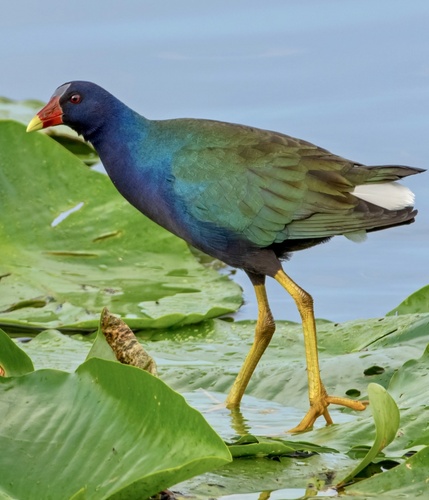
Purple Gallinule (Porphyrio martinica) Purple Gallinule

Media

Loading…

In short

The American Coot and Purple Gallinule can be differentiated by their bill color and overall plumage. The coot has a distinctive white bill and a dark gray body, while the gallinule is vividly colored with a red and yellow bill and a mix of blue, green, and purple plumage.

Identification tips

Bill color: Look for the white bill of the coot versus the red and yellow bill of the gallinule. Plumage: Note the coot's uniform dark gray and black versus the gallinule's vibrant multicolored plumage. Behavior: Observe flocking behavior and swimming style for coots; gallinules are more solitary and may be seen walking on vegetation. Habitat: Check location; coots are more widespread, while gallinules are more common in the southeast and tropical areas.

Size

Both species are similar in size, but the Purple Gallinule may appear slightly larger due to its longer legs and neck.

Plumage

The American Coot is primarily dark gray with a black head and neck, featuring a white bill and frontal shield. In contrast, the Purple Gallinule is brightly colored with a mix of deep blue, green, and purple, and has a red bill with a yellow tip.

Behaviour

The American Coot is an adept swimmer and diver, often seen in large flocks, whereas the Purple Gallinule is more solitary and known for its cooperative breeding behavior.

Habitat

Both species inhabit freshwater wetlands, but the American Coot is more widespread across North America, while the Purple Gallinule is more common in the southeastern U.S. and tropical regions.

Voice

The American Coot is known for its loud cackling, grunting, and croaking calls. The Purple Gallinule's vocalizations are less well-documented but are generally softer.

Submit a better description

Use the same sections as the comparison. Your text is published immediately.

The American Coot and Purple Gallinule can be differentiated by their bill color and overall plumage. The coot has a distinctive white bill and a dark gray body, while the gallinule is vividly colored with a red and yellow bill and a mix of blue, green, and purple plumage.

Bill color: Look for the white bill of the coot versus the red and yellow bill of the gallinule. Plumage: Note the coot's uniform dark gray and black versus the gallinule's vibrant multicolored plumage. Behavior: Observe flocking behavior and swimming style for coots; gallinules are more solitary and may be seen walking on vegetation. Habitat: Check location; coots are more widespread, while gallinules are more common in the southeast and tropical areas.

Both species are similar in size, but the Purple Gallinule may appear slightly larger due to its longer legs and neck.

The American Coot is primarily dark gray with a black head and neck, featuring a white bill and frontal shield. In contrast, the Purple Gallinule is brightly colored with a mix of deep blue, green, and purple, and has a red bill with a yellow tip.

The American Coot is an adept swimmer and diver, often seen in large flocks, whereas the Purple Gallinule is more solitary and known for its cooperative breeding behavior.

Both species inhabit freshwater wetlands, but the American Coot is more widespread across North America, while the Purple Gallinule is more common in the southeastern U.S. and tropical regions.

The American Coot is known for its loud cackling, grunting, and croaking calls. The Purple Gallinule's vocalizations are less well-documented but are generally softer.

Discard your changes?

You have unsaved edits. If you leave now, those changes will be lost.

American Coot · Purple Gallinule · My Tricky Birds