Birdr

American Pygmy Kingfisher vs Green-and-rufous Kingfisher

Chloroceryle aenea versus Chloroceryle inda

Play a quiz with American Pygmy Kingfisher and Green-and-rufous Kingfisher
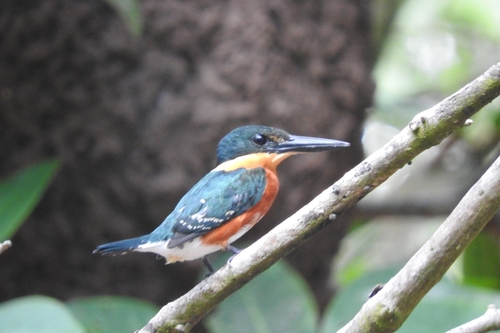
American Pygmy Kingfisher (Chloroceryle aenea) American Pygmy Kingfisher
Green-and-rufous Kingfisher (Chloroceryle inda) Green-and-rufous Kingfisher

Media

Loading…

In short

The American Pygmy Kingfisher is notably smaller and more compact than the Green-and-rufous Kingfisher, with a shorter bill and tail. Both species have green upperparts, but the American Pygmy Kingfisher has a more vibrant orange underbelly compared to the more rufous tone of the Green-and-rufous Kingfisher.

Identification tips

Size

The American Pygmy Kingfisher is significantly smaller than the Green-and-rufous Kingfisher, with a more compact body and shorter bill.

Plumage

Both species have green upperparts, but the American Pygmy Kingfisher displays a bright orange underbelly, whereas the Green-and-rufous Kingfisher has a more rufous-colored underbelly. The Green-and-rufous Kingfisher also tends to have a more pronounced white collar.

Behaviour

Both species are often found near water, perching quietly before diving for fish. The American Pygmy Kingfisher is more likely to be seen in dense, shaded areas.

Habitat

Both species inhabit areas near streams and rivers, but the American Pygmy Kingfisher is more frequently found in dense, shaded forested areas, while the Green-and-rufous Kingfisher can be found in more open areas.

Voice

The American Pygmy Kingfisher's call consists of quiet ticking notes and a series of high, rapid notes. The Green-and-rufous Kingfisher's vocalizations are not well-documented but are generally similar.

Submit a better description

Use the same sections as the comparison. Your text is published immediately.

The American Pygmy Kingfisher is notably smaller and more compact than the Green-and-rufous Kingfisher, with a shorter bill and tail. Both species have green upperparts, but the American Pygmy Kingfisher has a more vibrant orange underbelly compared to the more rufous tone of the Green-and-rufous Kingfisher.

  • Size and Structure: Look for the smaller size and shorter bill of the American Pygmy Kingfisher.
  • Plumage: Note the bright orange underbelly of the American Pygmy Kingfisher versus the rufous tone of the Green-and-rufous Kingfisher.
  • Habitat: American Pygmy Kingfishers prefer dense, shaded areas, while Green-and-rufous Kingfishers may be found in more open environments.
  • Vocalization: Listen for the quiet ticking notes of the American Pygmy Kingfisher.

The American Pygmy Kingfisher is significantly smaller than the Green-and-rufous Kingfisher, with a more compact body and shorter bill.

Both species have green upperparts, but the American Pygmy Kingfisher displays a bright orange underbelly, whereas the Green-and-rufous Kingfisher has a more rufous-colored underbelly. The Green-and-rufous Kingfisher also tends to have a more pronounced white collar.

Both species are often found near water, perching quietly before diving for fish. The American Pygmy Kingfisher is more likely to be seen in dense, shaded areas.

Both species inhabit areas near streams and rivers, but the American Pygmy Kingfisher is more frequently found in dense, shaded forested areas, while the Green-and-rufous Kingfisher can be found in more open areas.

The American Pygmy Kingfisher's call consists of quiet ticking notes and a series of high, rapid notes. The Green-and-rufous Kingfisher's vocalizations are not well-documented but are generally similar.

Discard your changes?

You have unsaved edits. If you leave now, those changes will be lost.

American Pygmy Kingfisher · Green-and-rufous Kingfisher · My Tricky Birds