
American Three-toed Woodpecker vs Black-backed Woodpecker
Picoides dorsalis versus Picoides arcticus
Play a quiz with American Three-toed Woodpecker and Black-backed Woodpecker
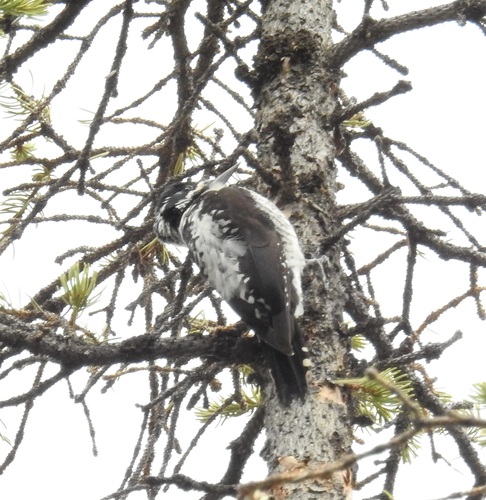 American Three-toed Woodpecker
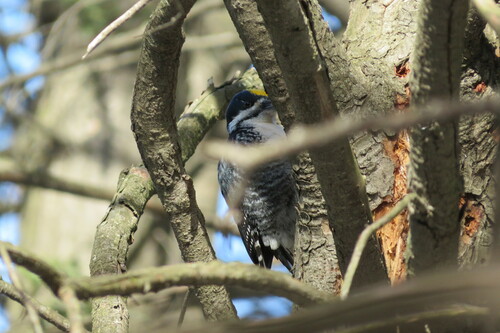 Black-backed Woodpecker
In short
American Three-toed and Black-backed Woodpeckers are extremely similar, especially in adult plumage, but careful attention to back color and subtle size differences can help. The most reliable field mark is the back: Black-backed Woodpecker shows a solid black back, while American Three-toed has a back with black and white barring. Both species have three toes and a yellow crown patch on adult males, so these features are not helpful for separation. Size is only slightly different, with Black-backed being marginally larger and heavier. In the field, expect confusion—especially with quick or distant views—so prioritize the back pattern when possible.
Identification tips
- Back pattern is the most reliable field mark: American Three-toed Woodpecker always shows black and white barring on the back, while Black-backed Woodpecker has a solid black back. This is true for all ages and sexes.
- Tail pattern is subtly different: American Three-toed's white outer tail feathers are barred with black, while Black-backed's are plain white. This can be hard to see unless the tail is spread.
- Crown patch is not useful: Both adult males have a yellow crown patch; females lack it in both species. Do not rely on crown color for separation.
- Underparts and flanks are similar: Both species have white underparts and flanks with black barring. This is not helpful for separation.
- Head, wings, and rump are black in both: These areas do not help distinguish the species.
- Size is only marginally different: Black-backed is slightly larger and heavier, but this is rarely obvious unless birds are side-by-side.
- Structure is similar: Both have three toes (unique among North American woodpeckers except for each other) and similar proportions.
- Juvenile and immature plumages: No distinctive juvenile or immature upperwing or flight pattern differences are described; back pattern remains the key mark at all ages.
- Habitat overlap: Both species occur in similar coniferous habitats, especially in recently burned or infested forests. Do not use habitat alone for identification.
- Behavior is not diagnostic: Foraging style and movements are nearly identical.
- Voice is not described as a separator: No distinctive vocal differences are noted in the sources provided.
- Sexual dimorphism is minimal: Only the yellow crown patch on males is different from females, but not between species.
- Maximum lifespan is similar: Not a field mark, but American Three-toed is noted to live up to 6 years.
- If in doubt, prioritize the back pattern: When views are brief or distant, do your best to see the back—this is the only consistently reliable field mark.
- When marks are not visible: If the back is not seen, identification may not be possible with confidence; avoid guessing based on size or habitat alone.
Size
Both species are medium-sized woodpeckers, but Black-backed Woodpecker is slightly larger overall. American Three-toed Woodpecker measures 21–23 cm in length and weighs 52–58.3 g, with a wingspan of 37–39 cm. Black-backed Woodpecker is about 23 cm long, weighs 60–88 g, and has a wingspan of 40–42 cm. The difference is subtle and rarely diagnostic in the field, but Black-backed may appear a bit bulkier and longer-winged if seen side-by-side.
Plumage
The single most useful plumage difference is the back pattern in all plumages: American Three-toed Woodpecker has a back with black and white barring, while Black-backed Woodpecker's back is solid black. Both species have black heads, wings, and rumps, white underparts, and white flanks with black bars. The tail pattern is similar, with black central feathers and white outer feathers (American Three-toed's outer tail feathers are barred with black, while Black-backed's are plain white). Adult males of both species have a yellow crown patch, so this is not useful for separation. No age-specific upperwing or flight pattern differences are described in the sources, so the back pattern is the key mark for all ages and seasons.
Behaviour
Both species forage by scaling bark on conifers for insects, especially in recently burned or insect-infested forests. Their foraging behavior and movements are very similar, and neither species is notably more arboreal or terrestrial. Both may move locally in response to food availability, but this is not a reliable field mark.
Habitat
Both species inhabit coniferous forests of North America, often overlapping in range and habitat. Both are attracted to areas with large numbers of dead or dying trees, such as after forest fires or flooding. American Three-toed Woodpecker may be displaced by Black-backed Woodpecker where their ranges overlap, but habitat alone is not a reliable separator.
American Three-toed Woodpecker · Black-backed Woodpecker · My Tricky Birds