Birdr

Bicknell's Thrush vs Hermit Thrush

Catharus bicknelli versus Catharus guttatus

Play a quiz with Bicknell's Thrush and Hermit Thrush
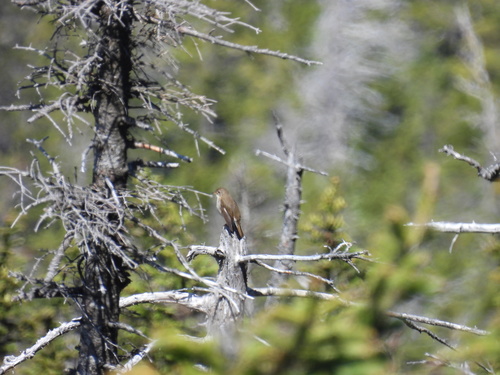
Bicknell's Thrush (Catharus bicknelli) Bicknell's Thrush
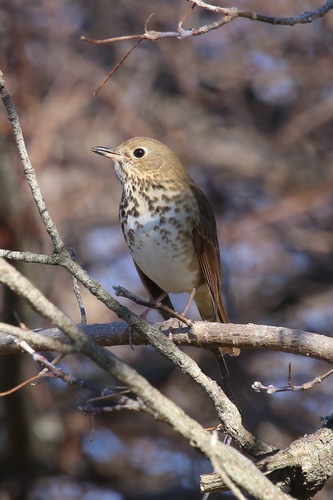
Hermit Thrush (Catharus guttatus) Hermit Thrush

Media

Loading…

In short

Hermit Thrush and Bicknell's Thrush are both medium-sized brown thrushes, but Hermit Thrush is best separated in the field by its distinct reddish tail that contrasts with browner upperparts, a feature visible in all ages and seasons. Bicknell's Thrush has a more uniformly olive-brown to brownish back with a chestnut-tinged tail, but the tail contrast is less pronounced and can be subtle, especially in worn plumage. Both species share pink legs and spotted breasts, but Hermit Thrush usually shows a bold white eye ring and more distinct breast spotting. Habitat and range are also helpful: Bicknell's is highly localized to northeastern mountain tops, while Hermit is widespread. Vocalizations differ, with Hermit Thrush's ethereal, fluted song standing apart from Bicknell's more jumbled phrases.

Identification tips

  1. Tail color and contrast: Hermit Thrush of all ages and seasons shows a bright reddish or rufous tail that contrasts strongly with its brown or olive-brown back, especially obvious when the bird flicks or fans its tail. Bicknell's Thrush has a chestnut-tinged tail, but the contrast is much less pronounced and can be subtle or even absent in worn plumage.
  2. Eye ring: Hermit Thrush has a bold, complete white eye ring, while Bicknell's Thrush has only a faint grayish ring, often hard to see in the field.
  3. Breast spotting: Hermit Thrush usually has darker, more distinct spots on the breast, while Bicknell's spots are dusky and become diffuse toward the sides and lower breast.
  4. Flank color: Hermit Thrush's flanks are gray or brownish, while Bicknell's are gray, but this is subtle and often not diagnostic without direct comparison.
  5. Bill color: Bicknell's Thrush has a mostly yellow lower mandible with a dark tip and blackish upper mandible; Hermit Thrush's bill is not described as distinctly bicolored, so a strongly yellow lower mandible may point to Bicknell's.
  6. Leg color: Both have pink legs, so this is not useful for separation.
  7. Structure: Hermit Thrush is more compact and stockier, with relatively longer wings, but this is subtle and best appreciated with experience or direct comparison.
  8. Behavior: Hermit Thrush often flicks or pumps its tail when perched, a behavior less typical of Bicknell's.
  9. Habitat and range: If you are in a high-elevation, dense coniferous forest in the northeastern US or southeastern Canada, consider Bicknell's. In most other wooded habitats, especially at lower elevations or outside the northeast, Hermit Thrush is much more likely.
  10. Song: Hermit Thrush's song is ethereal, flute-like, and structured with clear, spaced phrases; Bicknell's is a jumbled series of flute-like tones ending on a higher note. If you hear a pure, musical, descending song, Hermit is more likely.
  11. Season: Bicknell's is present in breeding habitat only in late spring and summer; Hermit Thrush can be found in a wider range of seasons and habitats.
  12. Plumage wear: In worn plumage, Bicknell's tail contrast may be even less evident, making separation harder—rely more on eye ring, song, and habitat.
  13. Jizz in flight: No distinctive flight marks are described for either species, but Hermit Thrush's tail may appear noticeably rufous in flight, while Bicknell's is more uniform.
  14. Abundance: Hermit Thrush is far more common and widespread; Bicknell's is rare and highly localized—consider the likelihood based on location.
  15. Sex and age: Both sexes are similar in both species; age-related differences are not strongly described, so rely on the above marks for all ages.

Size

Both species are similar in size, but Hermit Thrush is slightly more variable, measuring 15–18 cm in length and weighing 18–37 g, while Bicknell's Thrush averages about 17.5 cm and 28 g. Hermit Thrush can appear stockier and more compact, with relatively longer wings. In the field, size overlap is considerable, so size alone is not reliable for separation.

Plumage

Juvenile and immature plumages are not described in detail for either species, but adult and first-year Hermit Thrushes of all ages show a strong rufous or reddish tail that contrasts sharply with the browner or olive-brown back, a mark visible both perched and in flight. Bicknell's Thrush also has a chestnut-tinged tail, but the contrast with the back is much less pronounced, especially in worn birds, and the overall upperparts are more olive-brown. Both species have off-white underparts with dusky spots on the breast, but Hermit Thrush's spots are typically darker and more distinct, and its flanks are more likely to be gray or brownish. Hermit Thrush also shows a bolder white eye ring, while Bicknell's has only a faint gray ring. Both have pink legs, but bill color differs subtly: Bicknell's lower mandible is mostly yellow with a dark tip, while Hermit Thrush's bill is not described as distinctly bicolored.

Behaviour

Hermit Thrush often flicks its reddish tail and may pump or slowly raise and lower it when perched, a behavior less typical of Bicknell's Thrush. Both species forage on or near the ground and can be secretive, but Hermit Thrush is more likely to be seen in a wider variety of wooded habitats, sometimes in open areas, and often sings from a high, exposed perch. Bicknell's is more reclusive, sticking to dense, high-elevation conifer thickets.

Habitat

Habitat is a strong clue: Bicknell's Thrush is restricted to coniferous mountain tops and disturbed high-elevation forests in the northeastern US and southeastern Canada, making it one of the rarest and most localized songbirds in North America. Hermit Thrush is much more widespread, found in a broad range of wooded habitats across North America, including both lowland and upland forests, and is not restricted to mountaintops. If you are not in a high, dense, northeastern spruce-fir forest, Hermit Thrush is far more likely.

Voice

Hermit Thrush's song is a clear, ethereal, flute-like series of phrases, each beginning with a single note and followed by descending musical phrases, often described as the most beautiful of North American birds. Bicknell's Thrush song is also flute-like but is more jumbled and ends on a higher note, lacking the pure, spaced-out phrases of Hermit. Both can be difficult to separate by call alone for beginners, but Hermit's song is more musical and structured.

Submit a better description

Use the same sections as the comparison. Your text is published immediately.

Hermit Thrush and Bicknell's Thrush are both medium-sized brown thrushes, but Hermit Thrush is best separated in the field by its distinct reddish tail that contrasts with browner upperparts, a feature visible in all ages and seasons. Bicknell's Thrush has a more uniformly olive-brown to brownish back with a chestnut-tinged tail, but the tail contrast is less pronounced and can be subtle, especially in worn plumage. Both species share pink legs and spotted breasts, but Hermit Thrush usually shows a bold white eye ring and more distinct breast spotting. Habitat and range are also helpful: Bicknell's is highly localized to northeastern mountain tops, while Hermit is widespread. Vocalizations differ, with Hermit Thrush's ethereal, fluted song standing apart from Bicknell's more jumbled phrases.

  1. Tail color and contrast: Hermit Thrush of all ages and seasons shows a bright reddish or rufous tail that contrasts strongly with its brown or olive-brown back, especially obvious when the bird flicks or fans its tail. Bicknell's Thrush has a chestnut-tinged tail, but the contrast is much less pronounced and can be subtle or even absent in worn plumage.
  2. Eye ring: Hermit Thrush has a bold, complete white eye ring, while Bicknell's Thrush has only a faint grayish ring, often hard to see in the field.
  3. Breast spotting: Hermit Thrush usually has darker, more distinct spots on the breast, while Bicknell's spots are dusky and become diffuse toward the sides and lower breast.
  4. Flank color: Hermit Thrush's flanks are gray or brownish, while Bicknell's are gray, but this is subtle and often not diagnostic without direct comparison.
  5. Bill color: Bicknell's Thrush has a mostly yellow lower mandible with a dark tip and blackish upper mandible; Hermit Thrush's bill is not described as distinctly bicolored, so a strongly yellow lower mandible may point to Bicknell's.
  6. Leg color: Both have pink legs, so this is not useful for separation.
  7. Structure: Hermit Thrush is more compact and stockier, with relatively longer wings, but this is subtle and best appreciated with experience or direct comparison.
  8. Behavior: Hermit Thrush often flicks or pumps its tail when perched, a behavior less typical of Bicknell's.
  9. Habitat and range: If you are in a high-elevation, dense coniferous forest in the northeastern US or southeastern Canada, consider Bicknell's. In most other wooded habitats, especially at lower elevations or outside the northeast, Hermit Thrush is much more likely.
  10. Song: Hermit Thrush's song is ethereal, flute-like, and structured with clear, spaced phrases; Bicknell's is a jumbled series of flute-like tones ending on a higher note. If you hear a pure, musical, descending song, Hermit is more likely.
  11. Season: Bicknell's is present in breeding habitat only in late spring and summer; Hermit Thrush can be found in a wider range of seasons and habitats.
  12. Plumage wear: In worn plumage, Bicknell's tail contrast may be even less evident, making separation harder—rely more on eye ring, song, and habitat.
  13. Jizz in flight: No distinctive flight marks are described for either species, but Hermit Thrush's tail may appear noticeably rufous in flight, while Bicknell's is more uniform.
  14. Abundance: Hermit Thrush is far more common and widespread; Bicknell's is rare and highly localized—consider the likelihood based on location.
  15. Sex and age: Both sexes are similar in both species; age-related differences are not strongly described, so rely on the above marks for all ages.

Both species are similar in size, but Hermit Thrush is slightly more variable, measuring 15–18 cm in length and weighing 18–37 g, while Bicknell's Thrush averages about 17.5 cm and 28 g. Hermit Thrush can appear stockier and more compact, with relatively longer wings. In the field, size overlap is considerable, so size alone is not reliable for separation.

Juvenile and immature plumages are not described in detail for either species, but adult and first-year Hermit Thrushes of all ages show a strong rufous or reddish tail that contrasts sharply with the browner or olive-brown back, a mark visible both perched and in flight. Bicknell's Thrush also has a chestnut-tinged tail, but the contrast with the back is much less pronounced, especially in worn birds, and the overall upperparts are more olive-brown. Both species have off-white underparts with dusky spots on the breast, but Hermit Thrush's spots are typically darker and more distinct, and its flanks are more likely to be gray or brownish. Hermit Thrush also shows a bolder white eye ring, while Bicknell's has only a faint gray ring. Both have pink legs, but bill color differs subtly: Bicknell's lower mandible is mostly yellow with a dark tip, while Hermit Thrush's bill is not described as distinctly bicolored.

Hermit Thrush often flicks its reddish tail and may pump or slowly raise and lower it when perched, a behavior less typical of Bicknell's Thrush. Both species forage on or near the ground and can be secretive, but Hermit Thrush is more likely to be seen in a wider variety of wooded habitats, sometimes in open areas, and often sings from a high, exposed perch. Bicknell's is more reclusive, sticking to dense, high-elevation conifer thickets.

Habitat is a strong clue: Bicknell's Thrush is restricted to coniferous mountain tops and disturbed high-elevation forests in the northeastern US and southeastern Canada, making it one of the rarest and most localized songbirds in North America. Hermit Thrush is much more widespread, found in a broad range of wooded habitats across North America, including both lowland and upland forests, and is not restricted to mountaintops. If you are not in a high, dense, northeastern spruce-fir forest, Hermit Thrush is far more likely.

Hermit Thrush's song is a clear, ethereal, flute-like series of phrases, each beginning with a single note and followed by descending musical phrases, often described as the most beautiful of North American birds. Bicknell's Thrush song is also flute-like but is more jumbled and ends on a higher note, lacking the pure, spaced-out phrases of Hermit. Both can be difficult to separate by call alone for beginners, but Hermit's song is more musical and structured.

Discard your changes?

You have unsaved edits. If you leave now, those changes will be lost.

Bicknell's Thrush · Hermit Thrush · My Tricky Birds