Birdr

Black-chinned Antbird vs Silvered Antbird

Hypocnemoides melanopogon versus Sclateria naevia

Play a quiz with Black-chinned Antbird and Silvered Antbird
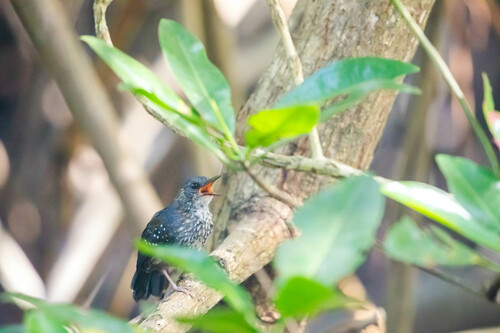
Black-chinned Antbird (Hypocnemoides melanopogon) Black-chinned Antbird
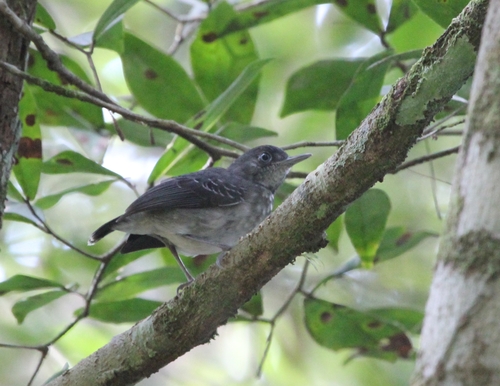
Silvered Antbird (Sclateria naevia) Silvered Antbird

Media

Loading…

In short

The Black-chinned Antbird and Silvered Antbird can be distinguished by their tail markings and habitat preferences. The Black-chinned Antbird has a narrower white tip on its tail, while the Silvered Antbird shows more pronounced white spots on its wing coverts. Vocalizations are distinct between the two species.

Identification tips

  1. Look for the narrow white tail tip on the Black-chinned Antbird. 2. Note the white spots on wing coverts of the Silvered Antbird. 3. Listen for distinct vocalizations. 4. Consider habitat: Black-chinned in gallery forests, Silvered near water edges.

Size

Both species are similar in size, typical of small antbirds.

Plumage

The Black-chinned Antbird is dark gray above with a narrow white tail tip and white wing covert tips; males have black throats. The Silvered Antbird has up to three rows of small white spots on the wing coverts and varies in underpart coloration, with more scalloped gray in the north and west and whiter underparts in the east and south.

Behaviour

Black-chinned Antbirds typically forage in close-knit pairs. Little specific behavior is noted for the Silvered Antbird.

Habitat

The Black-chinned Antbird is found in seasonally flooded and gallery forests, while the Silvered Antbird prefers river and water-edge habitats, including seasonally flooded forests and poorly drained areas within terra firme.

Voice

Vocalizations are a key differentiator, though specific details are not provided here. Observers should rely on audio recordings for accurate identification.

Submit a better description

Use the same sections as the comparison. Your text is published immediately.

The Black-chinned Antbird and Silvered Antbird can be distinguished by their tail markings and habitat preferences. The Black-chinned Antbird has a narrower white tip on its tail, while the Silvered Antbird shows more pronounced white spots on its wing coverts. Vocalizations are distinct between the two species.

  1. Look for the narrow white tail tip on the Black-chinned Antbird. 2. Note the white spots on wing coverts of the Silvered Antbird. 3. Listen for distinct vocalizations. 4. Consider habitat: Black-chinned in gallery forests, Silvered near water edges.

Both species are similar in size, typical of small antbirds.

The Black-chinned Antbird is dark gray above with a narrow white tail tip and white wing covert tips; males have black throats. The Silvered Antbird has up to three rows of small white spots on the wing coverts and varies in underpart coloration, with more scalloped gray in the north and west and whiter underparts in the east and south.

Black-chinned Antbirds typically forage in close-knit pairs. Little specific behavior is noted for the Silvered Antbird.

The Black-chinned Antbird is found in seasonally flooded and gallery forests, while the Silvered Antbird prefers river and water-edge habitats, including seasonally flooded forests and poorly drained areas within terra firme.

Vocalizations are a key differentiator, though specific details are not provided here. Observers should rely on audio recordings for accurate identification.

Discard your changes?

You have unsaved edits. If you leave now, those changes will be lost.

Black-chinned Antbird · Silvered Antbird · My Tricky Birds