Birdr

Black-faced Antthrush vs White-breasted Wood-Wren

Formicarius analis versus Henicorhina leucosticta

Play a quiz with Black-faced Antthrush and White-breasted Wood-Wren
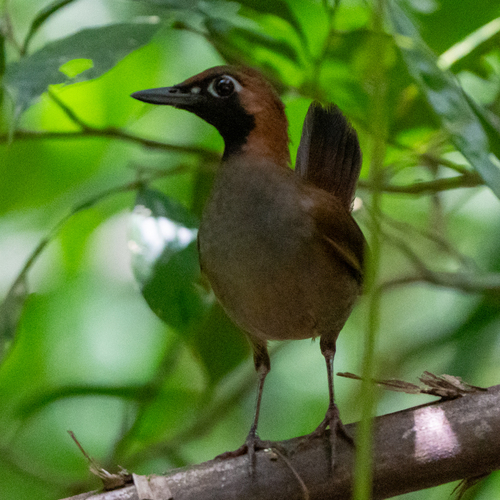
Black-faced Antthrush (Formicarius analis) Black-faced Antthrush
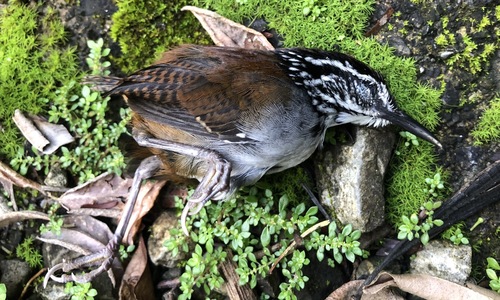
White-breasted Wood-Wren (Henicorhina leucosticta) White-breasted Wood-Wren

Media

Loading…

In short

The Black-faced Antthrush and White-breasted Wood-Wren are distinct in both structure and behavior. The Antthrush is a ground-dwelling bird with a more robust, thrush-like body, while the Wood-Wren is a small, active bird with a distinctive white supercilium and streaked face. Their vocalizations are also notably different.

Identification tips

  1. Look for the black face and throat of the Black-faced Antthrush. 2. Note the white supercilium and streaked face of the White-breasted Wood-Wren. 3. Observe behavior: Antthrushes walk on the ground, while Wood-Wrens are more active in the understory. 4. Listen for vocalizations: rhythmic for Antthrush, melodious whistles for Wood-Wren.

Size

The Black-faced Antthrush is larger and more robust compared to the smaller, more compact White-breasted Wood-Wren.

Plumage

The Black-faced Antthrush has a mostly brown body with a black face and throat, whereas the White-breasted Wood-Wren has warm brown upperparts with a whitish supercilium, heavily streaked ear coverts, and white underparts that become rufous or buff posteriorly.

Behaviour

The Black-faced Antthrush is often seen walking on the forest floor, whereas the White-breasted Wood-Wren is more active and typically found flitting through the understory.

Habitat

Both species inhabit forested areas, but the Black-faced Antthrush is more likely to be found on the ground in dense, humid forests, while the White-breasted Wood-Wren prefers the understory of similar habitats.

Voice

The Black-faced Antthrush has a distinctive, rhythmic song, while the White-breasted Wood-Wren's song is a series of melodious whistles. These vocal differences are reliable for identification.

Submit a better description

Use the same sections as the comparison. Your text is published immediately.

The Black-faced Antthrush and White-breasted Wood-Wren are distinct in both structure and behavior. The Antthrush is a ground-dwelling bird with a more robust, thrush-like body, while the Wood-Wren is a small, active bird with a distinctive white supercilium and streaked face. Their vocalizations are also notably different.

  1. Look for the black face and throat of the Black-faced Antthrush. 2. Note the white supercilium and streaked face of the White-breasted Wood-Wren. 3. Observe behavior: Antthrushes walk on the ground, while Wood-Wrens are more active in the understory. 4. Listen for vocalizations: rhythmic for Antthrush, melodious whistles for Wood-Wren.

The Black-faced Antthrush is larger and more robust compared to the smaller, more compact White-breasted Wood-Wren.

The Black-faced Antthrush has a mostly brown body with a black face and throat, whereas the White-breasted Wood-Wren has warm brown upperparts with a whitish supercilium, heavily streaked ear coverts, and white underparts that become rufous or buff posteriorly.

The Black-faced Antthrush is often seen walking on the forest floor, whereas the White-breasted Wood-Wren is more active and typically found flitting through the understory.

Both species inhabit forested areas, but the Black-faced Antthrush is more likely to be found on the ground in dense, humid forests, while the White-breasted Wood-Wren prefers the understory of similar habitats.

The Black-faced Antthrush has a distinctive, rhythmic song, while the White-breasted Wood-Wren's song is a series of melodious whistles. These vocal differences are reliable for identification.

Discard your changes?

You have unsaved edits. If you leave now, those changes will be lost.

Black-faced Antthrush · White-breasted Wood-Wren · My Tricky Birds