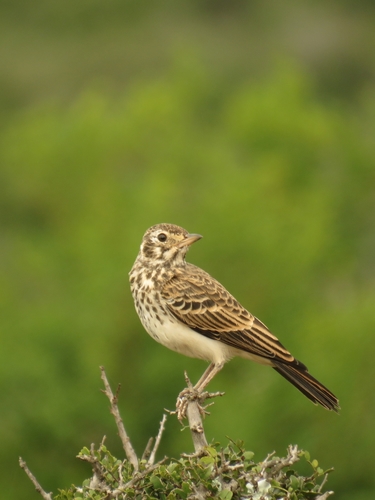
Blue Bustard vs Dusky Lark
Eupodotis caerulescens versus Pinarocorys nigricans
Play a quiz with Blue Bustard and Dusky Lark
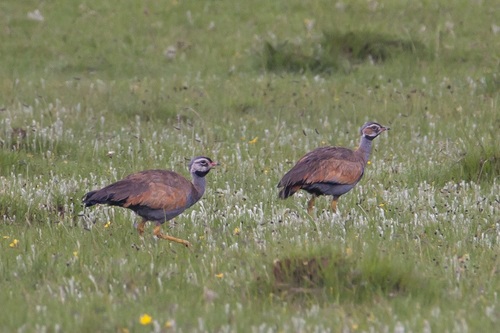
Blue Bustard
Dusky Lark
In short
The Blue Bustard and Dusky Lark can be distinguished by their size and plumage. The Blue Bustard is larger with a striking black-and-white face, while the Dusky Lark is smaller and more uniformly colored. Observing their behavior and habitat can also aid in identification.
Identification tips
- Size: Use size as a primary indicator; the Blue Bustard is much larger. 2. Facial Markings: Look for the Blue Bustard's distinctive black-and-white face. 3. Group Behavior: Note if the bird is in a group (Blue Bustard) or alone (Dusky Lark). 4. Habitat: Consider the habitat; open grasslands suggest Blue Bustard, while arid savanna points to Dusky Lark. 5. Calls: Listen for the Blue Bustard's loud, discordant calls.
Size
The Blue Bustard is significantly larger than the Dusky Lark.
Plumage
The Blue Bustard has a high-contrast black-and-white face, whereas the Dusky Lark is more uniformly dusky or brownish without such distinct facial markings.
Behaviour
Blue Bustards are often seen in pairs or small family groups, sometimes exhibiting cooperative breeding behaviors. Dusky Larks are more solitary and are not known for such social structures.
Habitat
Blue Bustards are typically found in open grasslands, while Dusky Larks prefer more arid, open habitats such as savannas.
Voice
The Blue Bustard's calls are unrhythmical and discordant, audible up to 3 km away. Specific vocalization details for the Dusky Lark are not provided.