
Bluethroat vs Red-breasted Flycatcher
Luscinia svecica versus Ficedula parva
Play a quiz with Bluethroat and Red-breasted Flycatcher
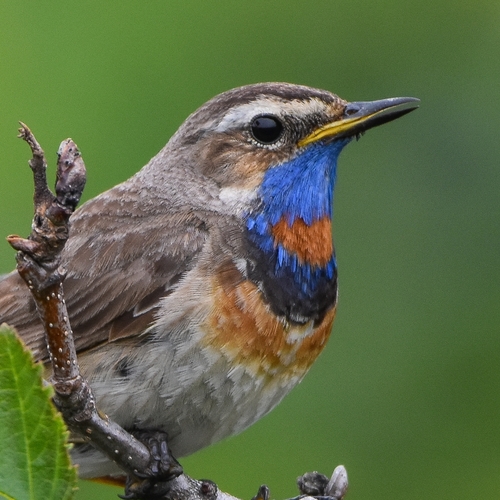 Bluethroat
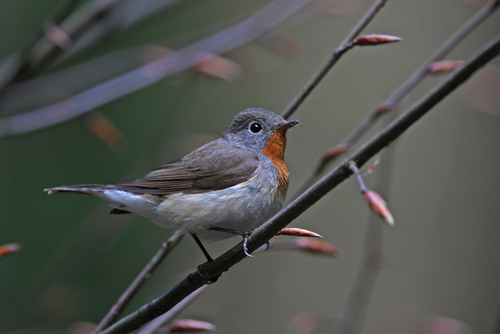 Red-breasted Flycatcher
In short
The most reliable field mark between Bluethroat and Red-breasted Flycatcher is the presence of a bold blue throat patch (often with a central red or white spot) on adult male Bluethroats in spring and early summer, versus the orange throat patch on adult male Red-breasted Flycatchers. Females and immatures of both species can be confusingly plain, but the Red-breasted Flycatcher always shows a distinctive white eyering and a contrasting black-and-white tail pattern, while Bluethroat lacks these features. Juvenile and first-winter birds of both species are dull, but the flycatcher's tail pattern and eyering remain useful. Structure and behavior also differ: Bluethroat is slightly larger and more robust, often seen on or near the ground in dense, wet vegetation, while Red-breasted Flycatcher is daintier, with a more upright posture and frequent tail-flicking in woodland settings.
Identification tips
- Throat color (adult males, spring/summer): Bluethroat shows a bright blue throat with a central red or white spot (depending on subspecies), bordered below by a black and rufous band; Red-breasted Flycatcher has a clear orange throat patch, never blue. This is the most reliable mark in breeding males.
- Tail pattern (all ages, all seasons): Red-breasted Flycatcher always has a black tail with white bases to the outer tail feathers, visible as a black-and-white pattern when the tail is spread or flicked. Bluethroat's tail is plain brown with a rufous base and dark terminal band, lacking the sharp black-and-white contrast.
- White eyering (all ages, all seasons): Red-breasted Flycatcher always shows a noticeable white eyering, even in juveniles and females. Bluethroat lacks a strong eyering.
- Bill structure: Red-breasted Flycatcher has a fine, pointed, black bill with a pale pinkish base, typical of aerial insectivores. Bluethroat's bill is slightly heavier and lacks the extensive pinkish base.
- Overall structure: Bluethroat is slightly larger and more robust, with a longer tail and heavier body. Red-breasted Flycatcher is daintier and more upright in posture.
- Behavior: Bluethroat is often on or near the ground, moving through dense, wet vegetation; Red-breasted Flycatcher perches higher, flicks its tail upwards, and makes short sallying flights for insects.
- Habitat: Bluethroat prefers wet, bushy, or reedy areas; Red-breasted Flycatcher is found in open woodland, parks, and sometimes gardens, rarely in dense, wet habitats.
- Juvenile/first-winter confusion: Both species can be plain brown above and pale below, but only the flycatcher shows the white eyering and black-and-white tail pattern at all ages.
- Female confusion: Female Bluethroat is plain with a cream throat and sometimes a dark crescent; female Red-breasted Flycatcher is also plain but always has the white eyering and tail pattern.
- Flight views: In flight, look for the flycatcher's black-and-white tail; Bluethroat lacks this and shows a more uniform tail with a rufous base.
- Song: If singing, Red-breasted Flycatcher gives a sweet, whistled song with a rattling call; Bluethroat's song is not described here, so use with caution.
- Seasonal changes: Bluethroat's blue throat can be obscured by pale feather tips after the summer moult, making it less obvious in autumn and winter; Red-breasted Flycatcher's orange throat is only present in adult males during breeding.
- Subspecies variation: Bluethroat subspecies differ in the color and presence of the throat spot (red, white, or absent), but all have blue throats in males; Red-breasted Flycatcher never shows blue.
- Foraging style: Bluethroat hops and skulks low, often in cover; Red-breasted Flycatcher is more active, flicking its tail and sallying for insects.
- Context: If seen in dense, wet, reedy habitat, Bluethroat is more likely; in open woodland or parks, especially with tail-flicking and white eyering, suspect Red-breasted Flycatcher.
Size
Both species are small passerines, but Bluethroat is slightly larger and bulkier than Red-breasted Flycatcher. The flycatcher is described as only slightly larger than a Eurasian Wren, with a noticeably daintier build and finer bill. Bluethroat appears more robust overall, with a slightly longer tail and heavier structure. These differences are subtle in the field but may help when birds are seen side by side. [wikipedia]
Plumage
-
Juvenile/First-winter: Juvenile Bluethroats are freckled and spotted dark brown above and below for a few weeks after fledging, then moult into a first-winter plumage resembling adult females: plain, with a cream throat and breast and a dark crescent, lacking strong color. Juvenile and immature Red-breasted Flycatchers are similarly plain brown above and pale below, but always show a clear white eyering and a black-and-white tail pattern (white at the base of the outer tail feathers, rest black), which is visible both perched and in flight. These tail and eyering marks are present in all ages and sexes of Red-breasted Flycatcher, but never in Bluethroat.
-
Adult males (breeding): Bluethroat males in spring/summer have a bright blue throat, often with a central red or white spot, bordered below by a black and then a rufous or chestnut band. The blue is brightest just before and during the breeding season, and can be partly obscured by pale feather tips after the summer moult. Red-breasted Flycatcher males have a muted brown back, grey head, white underparts, and a clear orange throat patch, never blue.
-
Females/Non-breeding: Female Bluethroats and first-winter birds are plain with a cream throat and breast, sometimes with a faint dark crescent, and lack the blue or orange throat. Female and immature Red-breasted Flycatchers are similar in overall color but always have the white eyering and black-and-white tail pattern.
-
Flight/upperwing: No distinctive upperwing panels or patterns are described for either species; tail pattern is the main flight mark for Red-breasted Flycatcher.
Behaviour
Bluethroat is typically seen low to the ground, often skulking in dense, wet vegetation such as bushy swamps or wet birch woods, and may be seen hopping on the ground or flicking its tail. Red-breasted Flycatcher is more arboreal, often perching at medium height in open woodland, flicking its tail upwards while holding its wingtips down, and making short sallying flights to catch insects. The flycatcher also inspects leaves and trunks in a warbler-like manner and is more likely to be seen in the canopy or on bare branches. Bluethroat is less aerial and more terrestrial in its foraging style.
Habitat
Bluethroat breeds in wet, bushy environments such as birch woods, bushy swamps, and reedbeds, often near water and in dense cover. Red-breasted Flycatcher prefers open woodland, especially with mature trees, and is less tied to wet habitats. During migration, Red-breasted Flycatcher may occur in parks and gardens, but is rarely found in the dense, wet habitats favored by Bluethroat. Habitat can be a strong clue, especially in the breeding season.
Voice
Red-breasted Flycatcher has a song of far-carrying, repetitive, sweet whistles, often preceded by quiet 'zit' or 'tsi-it' notes and followed by a descending sequence; its call is a short, rattling 'zrrrt.' Bluethroat's song and calls are not described in the provided notes, so vocalization is only diagnostic for Red-breasted Flycatcher when singing. In winter, the flycatcher is mostly silent but may give a 'chip-chip-chr-rrr' call. Use voice with caution unless the flycatcher is singing.