
Bonaparte's Gull vs Franklin's Gull
Chroicocephalus philadelphia versus Leucophaeus pipixcan
Play a quiz with Bonaparte's Gull and Franklin's Gull
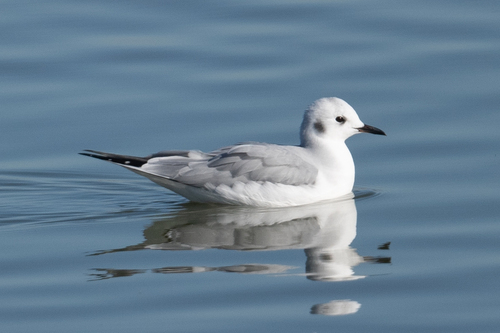 Bonaparte's Gull
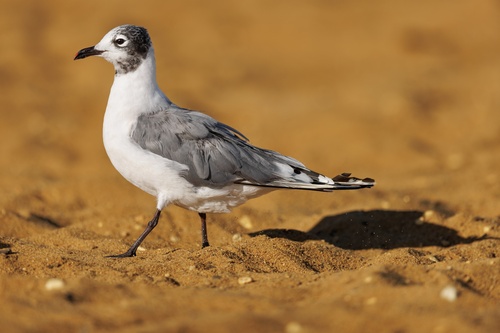 Franklin's Gull
In short
The most reliable field mark between Bonaparte's Gull and Franklin's Gull is the underwing pattern in flight: Bonaparte's shows a strikingly white underwing with little to no dark on the primaries, while Franklin's has a darker underwing and a strong white trailing edge on the upperwing (adults). For immatures, Bonaparte's first-year birds have a brown bar across the forewing and a black-tipped tail, while Franklin's young lack the white wing band and have less developed hoods. Structurally, Bonaparte's is noticeably smaller and more delicate, with a thinner, darker bill and pinkish legs, compared to Franklin's heavier build, thicker red bill, and red legs. Adult Franklin's Gulls have a much darker grey back and wings than Bonaparte's, and their hood is more extensive and blacker in breeding plumage. Both species lose the hood in winter, but Bonaparte's retains a paler neck and more delicate features.
Identification tips
- Underwing in flight (all ages): Bonaparte's Gull has a strikingly white underwing with little or no dark on the primaries, while Franklin's Gull shows a darker underwing; adults have a broad white trailing edge on the upperwing.
- First-year/juvenile wing pattern: Bonaparte's first-year birds show a brown bar across the forewing, blackish tips to the secondaries, and a black tip to the tail; Franklin's young lack the white wing band of adults but do not show the same brown forewing bar or black tail tip.
- Adult upperwing (breeding): Bonaparte's has black-and-white striped wingtips above, with the outer four primaries white with black tips; Franklin's adult has a much darker grey back and wings, with a broad white trailing edge on the upperwing.
- Bill color and shape: Bonaparte's has a short, thin, black bill; Franklin's has a thicker, red bill (especially in breeding plumage).
- Leg color: Bonaparte's legs are pinkish-red in winter, orangish-red in summer; Franklin's legs are red (especially in breeding plumage).
- Head pattern (breeding): Bonaparte's has a slaty black hood that is slightly less extensive and often paler than Franklin's, which has a deeper black hood.
- Head pattern (non-breeding): Both lose the hood, but Bonaparte's retains a pale grey rear neck and a more delicate, 'clean' face; Franklin's face often appears darker and less crisp.
- Size and structure: Bonaparte's is smaller, lighter, with a rounder head and finer bill; Franklin's is bulkier, with a heavier build and thicker bill.
- Back and wing color: Bonaparte's has pale grey upperparts; Franklin's is much darker grey above, especially on the wings and back.
- Tail: Bonaparte's first-year birds have a black tip to the tail; Franklin's does not show this feature.
- Behavior: Bonaparte's often appears more delicate and tern-like in flight, with quicker, more fluttery wingbeats; Franklin's is steadier and more powerful.
- Habitat context: Bonaparte's is more likely in forested lakes, rivers, and a wider range of habitats; Franklin's prefers open marshes and prairie wetlands in breeding season.
- Bare part color in winter: Bonaparte's bill and legs remain dark/pinkish; Franklin's may retain some red in the bill and legs, but overall appears darker and more robust.
- Pitfalls: Immature Bonaparte's can be confused with Little Gull, but Little Gull is even smaller and has a black (not brown) forewing bar. Franklin's is darker and chunkier than Bonaparte's at all ages.
- Sex differences: Both species show little to no plumage difference between sexes; structure and size are more reliable than subtle color differences.
Size
Bonaparte's Gull is distinctly smaller and lighter than Franklin's Gull. Bonaparte's measures 28–38 cm in length (wingspan 76–84 cm), while Franklin's is 32–36 cm long (wingspan 85–95 cm) and heavier (average adult mass 280 g vs. Bonaparte's 180–225 g). In the field, Bonaparte's looks more petite, with a smaller, rounder head and finer bill, while Franklin's appears chunkier and more robust.
Plumage
Juvenile and first-year birds are best separated by wing and tail pattern in flight. Bonaparte's first-year birds show a brown bar across the forewing, blackish tips to the secondaries, and a black tip to the tail; their underwing is very pale, almost white. Franklin's young birds lack the white wing band of adults and have less developed hoods, but do not show the same brown forewing bar or black tail tip as Bonaparte's. Adults in breeding plumage: Bonaparte's has a pale grey back, white underparts, and a slaty black hood (lost in winter), with a strikingly white underwing and black-and-white striped wingtips above. Franklin's adult has a much darker grey back and wings, black hood (lost in winter), red bill and legs, and a broad white trailing edge on the upperwing. In non-breeding plumage, both lose the hood, but Bonaparte's retains a paler neck and more delicate look, while Franklin's still appears darker overall.
Behaviour
Both species are agile and buoyant in flight, but Bonaparte's Gull often appears more tern-like, with quick, buoyant wingbeats and a more delicate, fluttery flight style. Franklin's Gull, being heavier and stockier, shows a steadier, more powerful flight. On the ground, Bonaparte's tends to be more active and dainty, while Franklin's appears bulkier and more assertive.
Habitat
Both species can overlap in migration and winter, but Bonaparte's Gull is primarily a northern North American breeder and is more likely found along forested lakes and rivers, as well as coastal areas in migration and winter. Franklin's Gull breeds in the interior of North America, especially prairie marshes, and winters further south. In mixed flocks, Franklin's often prefers more open or marshy habitats, while Bonaparte's can be found in a wider range of inland and coastal waters.