Birdr

Common Sandpiper vs Spotted Sandpiper

Actitis hypoleucos versus Actitis macularius

Play a quiz with Common Sandpiper and Spotted Sandpiper
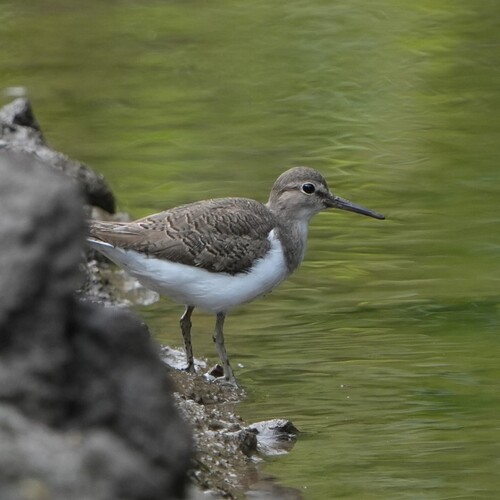
Common Sandpiper (Actitis hypoleucos) Common Sandpiper
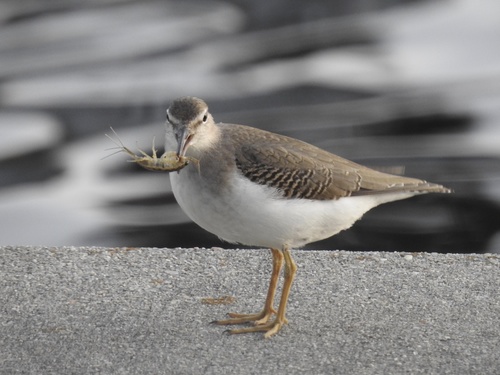
Spotted Sandpiper (Actitis macularius) Spotted Sandpiper

Media

Loading…

In short

The Spotted Sandpiper (Actitis macularia) is easily distinguished from the Common Sandpiper (Actitis hypoleucos) by its distinctive spotting on the underparts, more frequent teetering behavior, and different flight characteristics. The Common Sandpiper is slightly larger, has a longer tail, and lacks the spotting on its underparts, which makes for a clear identification when seen side by side.

Identification tips

  1. Birds of the World Similar-Species Diagnostics:
  2. "Common Sandpiper never shows spotting on underparts, even in Alternate plumage." (Source: Birds of the World Similar Species section for Common Sandpiper)
  3. "Common Sandpiper is best distinguished from Basic- and Juvenile-plumaged Spotted Sandpiper by long tail, which extends much farther beyond folded wing-tips than on Spotted." (Source: Birds of the World Similar Species section for Common Sandpiper)
  4. "Spotted Sandpiper averages slightly grayer, Common slightly browner." (Source: Birds of the World Similar Species section for Common Sandpiper)

  5. AI Field Diagnostics:

  6. Look for Spotting: If the underparts are spotted, you are likely looking at a Spotted Sandpiper. The absence of spotting is a key indicator of the Common Sandpiper.
  7. Tail Length: Observe the tail length in relation to the wings. The Common Sandpiper's tail extends significantly beyond its folded wings, which will help in distinguishing it from the Spotted Sandpiper.
  8. Teetering Behavior: Pay attention to their behavior; the frequent teetering of the Spotted Sandpiper is a notable characteristic not often seen in the Common Sandpiper.
  9. Vocalizations: Listen for calls—if you hear a sharp "peet-weet" from a bird in flight, it's likely a Spotted Sandpiper. In contrast, the Common Sandpiper's calls have a more trilled, continuous quality.
  10. Coloration: The overall color may also help; Spotted Sandpipers are generally grayer than the browner Common Sandpipers.

By focusing on these key differences in plumage, behavior, and vocalization, birdwatchers can confidently distinguish between the Spotted and Common Sandpipers in the field.

Size

Plumage

Behaviour

Habitat

Voice

Submit a better description

Use the same sections as the comparison. Your text is published immediately.

The Spotted Sandpiper (Actitis macularia) is easily distinguished from the Common Sandpiper (Actitis hypoleucos) by its distinctive spotting on the underparts, more frequent teetering behavior, and different flight characteristics. The Common Sandpiper is slightly larger, has a longer tail, and lacks the spotting on its underparts, which makes for a clear identification when seen side by side.

  1. Birds of the World Similar-Species Diagnostics:
  2. "Common Sandpiper never shows spotting on underparts, even in Alternate plumage." (Source: Birds of the World Similar Species section for Common Sandpiper)
  3. "Common Sandpiper is best distinguished from Basic- and Juvenile-plumaged Spotted Sandpiper by long tail, which extends much farther beyond folded wing-tips than on Spotted." (Source: Birds of the World Similar Species section for Common Sandpiper)
  4. "Spotted Sandpiper averages slightly grayer, Common slightly browner." (Source: Birds of the World Similar Species section for Common Sandpiper)

  5. AI Field Diagnostics:

  6. Look for Spotting: If the underparts are spotted, you are likely looking at a Spotted Sandpiper. The absence of spotting is a key indicator of the Common Sandpiper.
  7. Tail Length: Observe the tail length in relation to the wings. The Common Sandpiper's tail extends significantly beyond its folded wings, which will help in distinguishing it from the Spotted Sandpiper.
  8. Teetering Behavior: Pay attention to their behavior; the frequent teetering of the Spotted Sandpiper is a notable characteristic not often seen in the Common Sandpiper.
  9. Vocalizations: Listen for calls—if you hear a sharp "peet-weet" from a bird in flight, it's likely a Spotted Sandpiper. In contrast, the Common Sandpiper's calls have a more trilled, continuous quality.
  10. Coloration: The overall color may also help; Spotted Sandpipers are generally grayer than the browner Common Sandpipers.

By focusing on these key differences in plumage, behavior, and vocalization, birdwatchers can confidently distinguish between the Spotted and Common Sandpipers in the field.

  • Spotted Sandpiper: Length is 18–20 cm with a wingspan of 37–40 cm. Males typically weigh between 34–41 g, while females are slightly heavier at 43–50 g.
  • Common Sandpiper: Length is slightly larger at 19–21 cm with a wingspan of 38–41 cm. Weight ranges from 33–93 g, indicating a broader weight range that can overlap with the Spotted Sandpiper.
  • Spotted Sandpiper: Characterized by a brownish to olive-gray upperbody with bold black spots on white underparts. The spotting is unique to its plumage among North American shorebirds, especially noticeable in alternate plumage. In basic plumage, the upperparts are grayer and less distinctly marked.
  • Common Sandpiper: Exhibits greenish-brown upperparts and white underparts that do not feature the spotting found in Spotted Sandpipers. Instead, it has dark lateral breast patches. The tertials are conspicuously dotted, which is absent in Spotted Sandpipers.
  • Spotted Sandpiper: Known for its distinctive teetering behavior, frequently bobbing its tail up and down, which is more pronounced compared to the Common Sandpiper.
  • Common Sandpiper: Less inclined to teeter as prominently as the Spotted Sandpiper. It often forages singly or in small groups and can be seen running quickly and pausing frequently.
  • Spotted Sandpiper: Commonly found near freshwater habitats such as rivers and lakes across North America, breeding primarily in regions with ample shorelines.
  • Common Sandpiper: Prefers a range of wetland habitats, often seen along the edges of rivers and lakes, but is primarily regular in the Bering Sea and western Aleutian Islands in North America.
  • Spotted Sandpiper: Flight call is a series of sharp, shrill notes resembling "peet-weet" or "weet-weet-weet."
  • Common Sandpiper: Produces a more rapid and pulsating call, often described as a "swee-wee-wee" series, sometimes consisting of three notes.

Discard your changes?

You have unsaved edits. If you leave now, those changes will be lost.

Common Sandpiper · Spotted Sandpiper · My Tricky Birds