Birdr

Common Swift vs Barn Swallow

Apus apus versus Hirundo rustica

Play a quiz with Common Swift and Barn Swallow

Common Swift (Apus apus) Common Swift
Barn Swallow (Hirundo rustica) Barn Swallow

Media

Loading…

In short

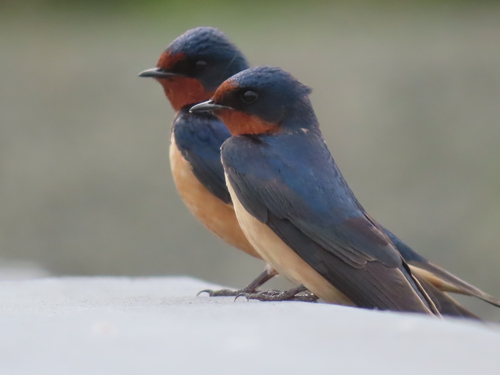
The Common Swift and Barn Swallow are both aerial insectivores with forked tails, but the swift is uniformly dark with a small white throat patch, while the swallow has a glossy blue back, rufous throat, and creamy underparts. Swifts are almost always in flight, whereas swallows perch frequently.

Identification tips

  1. Tail Shape: Swifts have a deeply forked tail, but less pronounced than the long streamers of a Barn Swallow. 2. Plumage: Look for the swift's uniform dark body versus the swallow's glossy blue upperparts and rufous throat. 3. Behavior: Swifts are almost always in flight; swallows often perch. 4. Vocalization: Listen for the swift's screaming calls compared to the swallow's twittering song. 5. Habitat: Swifts are more likely in urban areas, whereas swallows prefer open fields and water bodies.

Size

Common Swift is larger (16–18 cm) and heavier (31–52 g) than the Barn Swallow (17–19 cm, 16–24 g), with a broader wingspan.

Plumage

Common Swift is uniformly black-brown with a small off-white throat patch. Barn Swallow has a glossy steel-blue back, rufous-chestnut throat, and creamy or buffy white underparts.

Behaviour

Common Swifts are almost constantly airborne, rarely perching, while Barn Swallows often perch on wires or branches.

Habitat

Common Swifts are found over a wide range of habitats, including urban areas, while Barn Swallows are often seen in open areas, farmlands, and near water.

Voice

Common Swifts have a high-pitched screaming call, while Barn Swallows have a more varied, twittering song.

Submit a better description

Use the same sections as the comparison. Your text is published immediately.

The Common Swift and Barn Swallow are both aerial insectivores with forked tails, but the swift is uniformly dark with a small white throat patch, while the swallow has a glossy blue back, rufous throat, and creamy underparts. Swifts are almost always in flight, whereas swallows perch frequently.

  1. Tail Shape: Swifts have a deeply forked tail, but less pronounced than the long streamers of a Barn Swallow. 2. Plumage: Look for the swift's uniform dark body versus the swallow's glossy blue upperparts and rufous throat. 3. Behavior: Swifts are almost always in flight; swallows often perch. 4. Vocalization: Listen for the swift's screaming calls compared to the swallow's twittering song. 5. Habitat: Swifts are more likely in urban areas, whereas swallows prefer open fields and water bodies.

Common Swift is larger (16–18 cm) and heavier (31–52 g) than the Barn Swallow (17–19 cm, 16–24 g), with a broader wingspan.

Common Swift is uniformly black-brown with a small off-white throat patch. Barn Swallow has a glossy steel-blue back, rufous-chestnut throat, and creamy or buffy white underparts.

Common Swifts are almost constantly airborne, rarely perching, while Barn Swallows often perch on wires or branches.

Common Swifts are found over a wide range of habitats, including urban areas, while Barn Swallows are often seen in open areas, farmlands, and near water.

Common Swifts have a high-pitched screaming call, while Barn Swallows have a more varied, twittering song.

Discard your changes?

You have unsaved edits. If you leave now, those changes will be lost.

Common Swift · Barn Swallow · My Tricky Birds