Birdr

Common Yellowthroat vs Cape May Warbler

Geothlypis trichas versus Setophaga tigrina

Play a quiz with Common Yellowthroat and Cape May Warbler

Common Yellowthroat (Geothlypis trichas) Common Yellowthroat
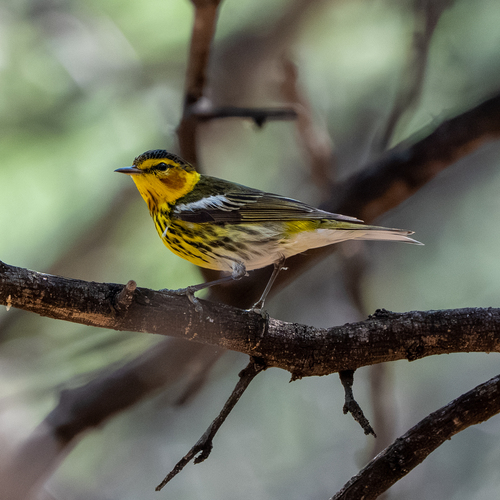
Cape May Warbler (Setophaga tigrina) Cape May Warbler

Media

Loading…

In short

The Common Yellowthroat and Cape May Warbler can be distinguished by their distinct facial patterns: the Common Yellowthroat has a prominent black mask, while the Cape May Warbler features chestnut ear-patches. Both species are small warblers, but their plumage and habitat preferences offer further clues.

Identification tips

  1. Look for the black mask on the Common Yellowthroat; it's a key feature. 2. Note the chestnut ear-patches and streaked breast of the Cape May Warbler. 3. Observe habitat: Common Yellowthroats are in dense shrubs, Cape May Warblers in conifers. 4. Listen for the Common Yellowthroat's 'witchity' song versus the Cape May Warbler's thin 'tsee' notes.

Size

Both species are small warblers, with the Cape May Warbler being slightly more slender.

Plumage

The Common Yellowthroat has a distinctive black mask across the face, which is absent in the Cape May Warbler. The Cape May Warbler has a yellow breast streaked with black and chestnut ear-patches, while the Common Yellowthroat is more uniformly yellow below.

Behaviour

Common Yellowthroats are often seen skulking in dense vegetation, while Cape May Warblers are more likely to be observed foraging in trees, especially during spruce budworm outbreaks.

Habitat

Common Yellowthroats prefer marshes and dense, shrubby areas, whereas Cape May Warblers are typically found in coniferous forests, especially during budworm outbreaks.

Voice

The Common Yellowthroat's song is a distinctive 'witchity-witchity-witchity,' while the Cape May Warbler's song is a high-pitched, thin 'tsee-tsee-tsee.'

Submit a better description

Use the same sections as the comparison. Your text is published immediately.

The Common Yellowthroat and Cape May Warbler can be distinguished by their distinct facial patterns: the Common Yellowthroat has a prominent black mask, while the Cape May Warbler features chestnut ear-patches. Both species are small warblers, but their plumage and habitat preferences offer further clues.

  1. Look for the black mask on the Common Yellowthroat; it's a key feature. 2. Note the chestnut ear-patches and streaked breast of the Cape May Warbler. 3. Observe habitat: Common Yellowthroats are in dense shrubs, Cape May Warblers in conifers. 4. Listen for the Common Yellowthroat's 'witchity' song versus the Cape May Warbler's thin 'tsee' notes.

Both species are small warblers, with the Cape May Warbler being slightly more slender.

The Common Yellowthroat has a distinctive black mask across the face, which is absent in the Cape May Warbler. The Cape May Warbler has a yellow breast streaked with black and chestnut ear-patches, while the Common Yellowthroat is more uniformly yellow below.

Common Yellowthroats are often seen skulking in dense vegetation, while Cape May Warblers are more likely to be observed foraging in trees, especially during spruce budworm outbreaks.

Common Yellowthroats prefer marshes and dense, shrubby areas, whereas Cape May Warblers are typically found in coniferous forests, especially during budworm outbreaks.

The Common Yellowthroat's song is a distinctive 'witchity-witchity-witchity,' while the Cape May Warbler's song is a high-pitched, thin 'tsee-tsee-tsee.'

Discard your changes?

You have unsaved edits. If you leave now, those changes will be lost.

Common Yellowthroat · Cape May Warbler · My Tricky Birds