Birdr

Crested Becard vs Mottle-cheeked Tyrannulet

Pachyramphus validus versus Phylloscartes ventralis

Play a quiz with Crested Becard and Mottle-cheeked Tyrannulet
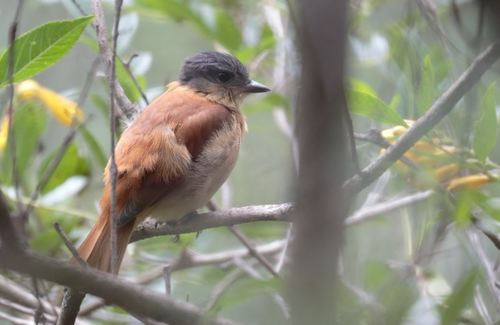
Crested Becard (Pachyramphus validus) Crested Becard
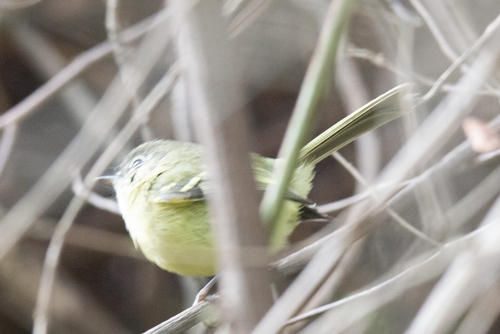
Mottle-cheeked Tyrannulet (Phylloscartes ventralis) Mottle-cheeked Tyrannulet

Media

Loading…

In short

The Crested Becard and Mottle-cheeked Tyrannulet can be differentiated by their plumage and behavior. The Crested Becard is more robust with a distinct crest, while the Mottle-cheeked Tyrannulet is smaller, lacks a crest, and has prominent wingbars and white tertial markings.

Identification tips

Look for the crest on the Crested Becard, which is absent in the Mottle-cheeked Tyrannulet. Note the prominent wingbars and white tertial markings on the Mottle-cheeked Tyrannulet. Observe behavior: the Crested Becard perches and scans, while the Mottle-cheeked Tyrannulet is active and joins mixed-species flocks.

Size

The Crested Becard is generally larger and more robust than the smaller, more delicate Mottle-cheeked Tyrannulet.

Plumage

The Crested Becard has a crest and lacks the prominent wingbars and white tertial markings seen on the Mottle-cheeked Tyrannulet, which is olive-green above and paler below.

Behaviour

The Crested Becard perches and scans for prey before moving, while the Mottle-cheeked Tyrannulet is more active, often joining mixed-species flocks and foraging continuously.

Habitat

The Mottle-cheeked Tyrannulet is found at altitudes of 1000–2200 m in forest habitats, while the Crested Becard's habitat preferences are less specific in the provided notes.

Submit a better description

Use the same sections as the comparison. Your text is published immediately.

The Crested Becard and Mottle-cheeked Tyrannulet can be differentiated by their plumage and behavior. The Crested Becard is more robust with a distinct crest, while the Mottle-cheeked Tyrannulet is smaller, lacks a crest, and has prominent wingbars and white tertial markings.

Look for the crest on the Crested Becard, which is absent in the Mottle-cheeked Tyrannulet. Note the prominent wingbars and white tertial markings on the Mottle-cheeked Tyrannulet. Observe behavior: the Crested Becard perches and scans, while the Mottle-cheeked Tyrannulet is active and joins mixed-species flocks.

The Crested Becard is generally larger and more robust than the smaller, more delicate Mottle-cheeked Tyrannulet.

The Crested Becard has a crest and lacks the prominent wingbars and white tertial markings seen on the Mottle-cheeked Tyrannulet, which is olive-green above and paler below.

The Crested Becard perches and scans for prey before moving, while the Mottle-cheeked Tyrannulet is more active, often joining mixed-species flocks and foraging continuously.

The Mottle-cheeked Tyrannulet is found at altitudes of 1000–2200 m in forest habitats, while the Crested Becard's habitat preferences are less specific in the provided notes.

Discard your changes?

You have unsaved edits. If you leave now, those changes will be lost.

Crested Becard · Mottle-cheeked Tyrannulet · My Tricky Birds