Birdr

Dark-throated Seedeater vs Chestnut Seedeater

Sporophila ruficollis versus Sporophila cinnamomea

Play a quiz with Dark-throated Seedeater and Chestnut Seedeater
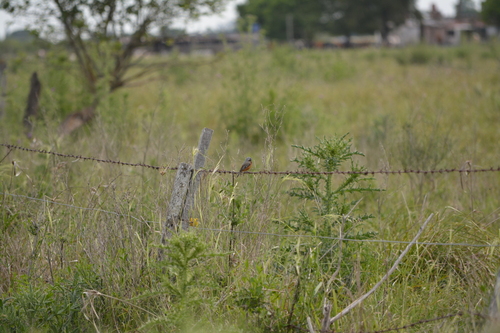
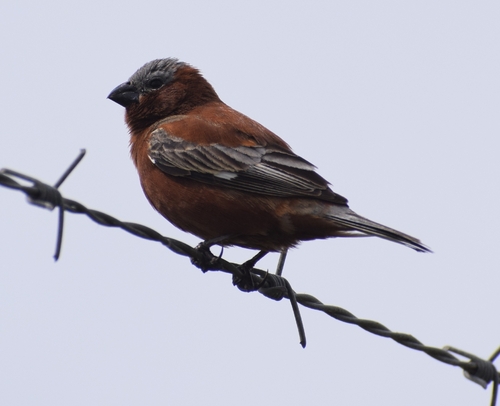
Dark-throated Seedeater (Sporophila ruficollis) Dark-throated Seedeater
Chestnut Seedeater (Sporophila cinnamomea) Chestnut Seedeater

Media

Loading…

In short

The Dark-throated Seedeater and Chestnut Seedeater are closely related and can be challenging to distinguish. The most reliable field mark is the rich rusty-brown throat of the male Dark-throated Seedeater, which contrasts with its gray cap and chestnut belly, while the Chestnut Seedeater lacks this distinct throat coloration. Both species are small seedeaters, often found in grassland habitats.

Identification tips

Size

Both species are small and similar in size, typical of seedeaters.

Plumage

The male Dark-throated Seedeater has a gray cap and chestnut belly with a distinctive rich rusty-brown throat, which can extend to the hind neck in rare morphs. The Chestnut Seedeater lacks this throat coloration, making the throat color a key distinguishing feature. Females of both species are dull and buffy brown, making them difficult to identify.

Behaviour

Dark-throated Seedeaters are highly migratory and often found in small groups or mixed-species flocks. They specialize in foraging on unopened grass seeds. The Chestnut Seedeater's behavior is less documented but is non-migratory.

Habitat

The Dark-throated Seedeater breeds in NE Argentina to SC Brazil and migrates to open country areas south of the Amazon Basin. The Chestnut Seedeater prefers tall, undulating grasslands, which are increasingly threatened by habitat loss.

Submit a better description

Use the same sections as the comparison. Your text is published immediately.

The Dark-throated Seedeater and Chestnut Seedeater are closely related and can be challenging to distinguish. The most reliable field mark is the rich rusty-brown throat of the male Dark-throated Seedeater, which contrasts with its gray cap and chestnut belly, while the Chestnut Seedeater lacks this distinct throat coloration. Both species are small seedeaters, often found in grassland habitats.

  • Look for the rich rusty-brown throat on male Dark-throated Seedeaters.
  • Note the gray cap and chestnut belly of the Dark-throated Seedeater.
  • Observe the habitat: Dark-throated Seedeaters are migratory, while Chestnut Seedeaters prefer tall grasslands.
  • Females are difficult to distinguish; focus on males for identification.

Both species are small and similar in size, typical of seedeaters.

The male Dark-throated Seedeater has a gray cap and chestnut belly with a distinctive rich rusty-brown throat, which can extend to the hind neck in rare morphs. The Chestnut Seedeater lacks this throat coloration, making the throat color a key distinguishing feature. Females of both species are dull and buffy brown, making them difficult to identify.

Dark-throated Seedeaters are highly migratory and often found in small groups or mixed-species flocks. They specialize in foraging on unopened grass seeds. The Chestnut Seedeater's behavior is less documented but is non-migratory.

The Dark-throated Seedeater breeds in NE Argentina to SC Brazil and migrates to open country areas south of the Amazon Basin. The Chestnut Seedeater prefers tall, undulating grasslands, which are increasingly threatened by habitat loss.

Discard your changes?

You have unsaved edits. If you leave now, those changes will be lost.

Dark-throated Seedeater · Chestnut Seedeater · My Tricky Birds