
Birdr

Eurasian Three-toed Woodpecker vs Japanese Pygmy Woodpecker

Picoides tridactylus versus Yungipicus kizuki

Play a quiz with Eurasian Three-toed Woodpecker and Japanese Pygmy Woodpecker
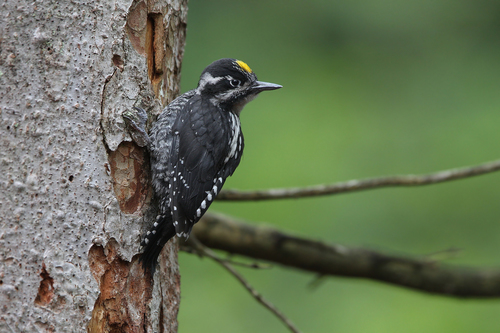
Eurasian Three-toed Woodpecker (Picoides tridactylus) Eurasian Three-toed Woodpecker
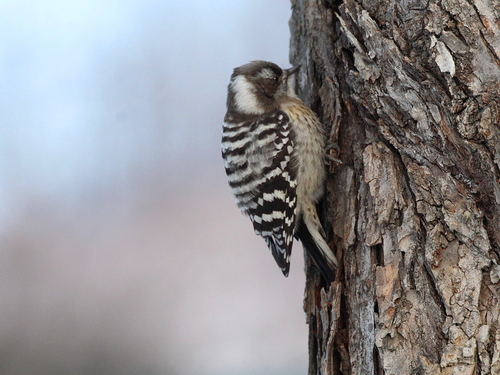
Japanese Pygmy Woodpecker (Yungipicus kizuki) Japanese Pygmy Woodpecker

Media

Loading…

In short

The Eurasian Three-toed Woodpecker and the Japanese Pygmy Woodpecker can be differentiated primarily by size and toe count. The Eurasian Three-toed is larger and has three toes, while the Japanese Pygmy is smaller with four toes. Both species have barred backs, but their vocalizations and habitats differ.

Identification tips

Size

The Eurasian Three-toed Woodpecker is larger than the Japanese Pygmy Woodpecker.

Plumage

Both species have barred backs, but the Eurasian Three-toed Woodpecker typically has a more contrasting black and white pattern, while the Japanese Pygmy Woodpecker's plumage is more subdued and brownish.

Behaviour

The Eurasian Three-toed Woodpecker often forages on dead or dying trees, while the Japanese Pygmy Woodpecker is more likely to be seen in active motion, flitting around branches.

Habitat

The Eurasian Three-toed Woodpecker is found in boreal and montane forests, often in coniferous areas, whereas the Japanese Pygmy Woodpecker inhabits a wider range of wooded environments, including mixed and deciduous forests.

Voice

The Eurasian Three-toed Woodpecker's calls are less varied and more mechanical, while the Japanese Pygmy Woodpecker has a more varied and high-pitched call.

Submit a better description

Use the same sections as the comparison. Your text is published immediately.

The Eurasian Three-toed Woodpecker and the Japanese Pygmy Woodpecker can be differentiated primarily by size and toe count. The Eurasian Three-toed is larger and has three toes, while the Japanese Pygmy is smaller with four toes. Both species have barred backs, but their vocalizations and habitats differ.

  • Toe count: Eurasian Three-toed has three toes, Japanese Pygmy has four.
  • Size: Eurasian Three-toed is noticeably larger.
  • Plumage: Look for the more contrasting black and white pattern on the Eurasian Three-toed.
  • Habitat: Note the type of forest; coniferous suggests Eurasian Three-toed, mixed or deciduous suggests Japanese Pygmy.
  • Vocalization: Listen for the mechanical calls of the Eurasian Three-toed versus the varied calls of the Japanese Pygmy.

The Eurasian Three-toed Woodpecker is larger than the Japanese Pygmy Woodpecker.

Both species have barred backs, but the Eurasian Three-toed Woodpecker typically has a more contrasting black and white pattern, while the Japanese Pygmy Woodpecker's plumage is more subdued and brownish.

The Eurasian Three-toed Woodpecker often forages on dead or dying trees, while the Japanese Pygmy Woodpecker is more likely to be seen in active motion, flitting around branches.

The Eurasian Three-toed Woodpecker is found in boreal and montane forests, often in coniferous areas, whereas the Japanese Pygmy Woodpecker inhabits a wider range of wooded environments, including mixed and deciduous forests.

The Eurasian Three-toed Woodpecker's calls are less varied and more mechanical, while the Japanese Pygmy Woodpecker has a more varied and high-pitched call.

Discard your changes?

You have unsaved edits. If you leave now, those changes will be lost.

Eurasian Three-toed Woodpecker · Japanese Pygmy Woodpecker · My Tricky Birds