Birdr

Gila Woodpecker vs Cactus Wren

Melanerpes uropygialis versus Campylorhynchus brunneicapillus

Play a quiz with Gila Woodpecker and Cactus Wren

Gila Woodpecker (Melanerpes uropygialis) Gila Woodpecker
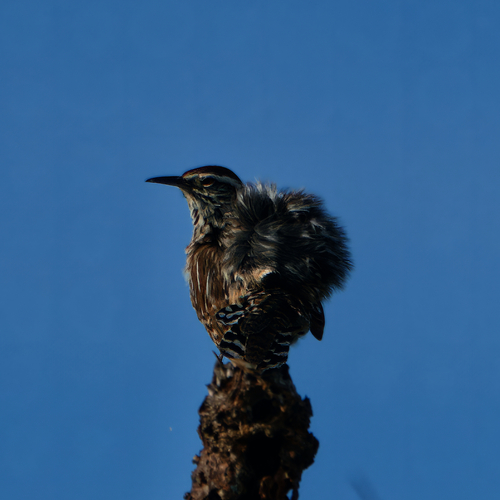
Cactus Wren (Campylorhynchus brunneicapillus) Cactus Wren

Media

Loading…

In short

The Gila Woodpecker and Cactus Wren can be distinguished primarily by their structure and habitat preferences. The Gila Woodpecker has a straight, chisel-like bill typical of woodpeckers, while the Cactus Wren has a longer, curved bill suited for probing. Both species are common in desert environments, but the Gila Woodpecker is often seen on saguaro cacti, whereas the Cactus Wren prefers dense shrubs and cacti.

Identification tips

1. Bill Shape: Look for the straight, chisel-like bill of the Gila Woodpecker versus the longer, curved bill of the Cactus Wren. 2. Habitat: Note the presence of saguaro cacti for Gila Woodpeckers; Cactus Wrens are more often in dense shrubs. 3. Plumage: Check for the barred back of the Gila Woodpecker and the spotted breast with a white supercilium of the Cactus Wren.

Size

The Gila Woodpecker is generally larger and more robust than the Cactus Wren.

Plumage

The Gila Woodpecker has a barred black-and-white back and a plain face with a red cap in males, while the Cactus Wren features a spotted breast and a distinctive white supercilium.

Behaviour

Gila Woodpeckers often cling to vertical surfaces like tree trunks or cacti, whereas Cactus Wrens are more likely to be seen hopping through dense vegetation.

Habitat

Gila Woodpeckers are commonly found on saguaro cacti and other large trees, while Cactus Wrens prefer dense shrubs and smaller cacti.

Submit a better description

Use the same sections as the comparison. Your text is published immediately.

The Gila Woodpecker and Cactus Wren can be distinguished primarily by their structure and habitat preferences. The Gila Woodpecker has a straight, chisel-like bill typical of woodpeckers, while the Cactus Wren has a longer, curved bill suited for probing. Both species are common in desert environments, but the Gila Woodpecker is often seen on saguaro cacti, whereas the Cactus Wren prefers dense shrubs and cacti.

1. Bill Shape: Look for the straight, chisel-like bill of the Gila Woodpecker versus the longer, curved bill of the Cactus Wren. 2. Habitat: Note the presence of saguaro cacti for Gila Woodpeckers; Cactus Wrens are more often in dense shrubs. 3. Plumage: Check for the barred back of the Gila Woodpecker and the spotted breast with a white supercilium of the Cactus Wren.

The Gila Woodpecker is generally larger and more robust than the Cactus Wren.

The Gila Woodpecker has a barred black-and-white back and a plain face with a red cap in males, while the Cactus Wren features a spotted breast and a distinctive white supercilium.

Gila Woodpeckers often cling to vertical surfaces like tree trunks or cacti, whereas Cactus Wrens are more likely to be seen hopping through dense vegetation.

Gila Woodpeckers are commonly found on saguaro cacti and other large trees, while Cactus Wrens prefer dense shrubs and smaller cacti.

Discard your changes?

You have unsaved edits. If you leave now, those changes will be lost.

Gila Woodpecker · Cactus Wren · My Tricky Birds