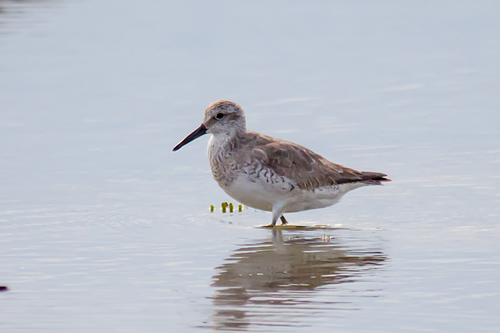
Greater Yellowlegs vs Great Knot
Tringa melanoleuca versus Calidris tenuirostris
Play a quiz with Greater Yellowlegs and Great Knot
Greater Yellowlegs
Great Knot
In short
The Greater Yellowlegs and Great Knot are both shorebirds but differ significantly in appearance and behavior. The Greater Yellowlegs is known for its bright yellow legs and upright stance, while the Great Knot is more robust with a shorter, thicker bill.
Identification tips
- Leg Color: Look for the bright yellow legs of the Greater Yellowlegs. 2. Bill Shape: The Greater Yellowlegs has a longer, slightly upturned bill compared to the shorter, thicker bill of the Great Knot. 3. Plumage: Note the streaked neck and white underparts of the Greater Yellowlegs versus the mottled, sometimes reddish, plumage of the Great Knot. 4. Behavior: Observe the social behavior; Greater Yellowlegs are often solitary, while Great Knots are seen in flocks. 5. Habitat: Consider the habitat; Greater Yellowlegs are found in a variety of wetland habitats, whereas Great Knots are coastal specialists.
Size
The Greater Yellowlegs is larger and more slender than the Great Knot, which is more compact and robust.
Plumage
Greater Yellowlegs have a more uniform grayish-brown plumage with distinctive white underparts and streaked neck, whereas Great Knots have a more mottled appearance with a reddish hue during breeding season.
Behaviour
Greater Yellowlegs are more solitary and often seen alone or in small groups, while Great Knots are more social and often found in large flocks.
Habitat
Greater Yellowlegs prefer freshwater and saline wetlands across the Americas, while Great Knots are typically found in coastal mudflats and sandy beaches, primarily in the Eastern Hemisphere.
Voice
Greater Yellowlegs are known for their loud, piercing calls, often described as 'yelping', whereas Great Knots are generally quieter and less vocal.