
Green-backed Camaroptera vs Bar-throated Apalis
Camaroptera brachyura versus Apalis thoracica
Play a quiz with Green-backed Camaroptera and Bar-throated Apalis
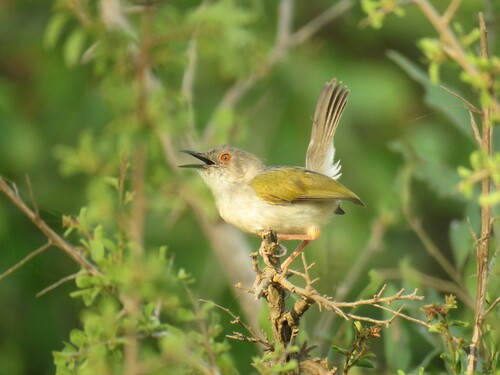 Green-backed Camaroptera
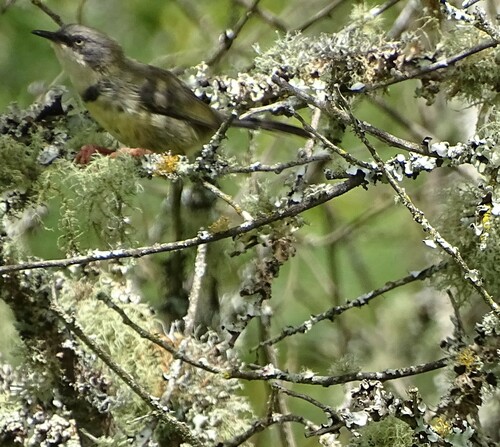 Bar-throated Apalis
In short
The most reliable field mark to separate Green-backed Camaroptera from Bar-throated Apalis is the presence of a narrow black breast band in all forms of Bar-throated Apalis, which is completely absent in Green-backed Camaroptera. Juvenile Apalis may show an incomplete band, but even then, Camaroptera never shows any dark breast band at any age. Structure also helps: Camaroptera is a compact, short-tailed, olive-green bird usually deep in cover, while Apalis is slender, with a noticeably long tail, and often shows white outer tail feathers. Both can show green upperparts, but Apalis may also be grey above depending on subspecies. Underparts color and tail pattern are key in ambiguous views.
Identification tips
- Breast band (all ages): Bar-throated Apalis always shows a narrow black breast band (though incomplete in juveniles and narrower in females), while Green-backed Camaroptera never shows any breast band. This is the single most reliable mark in all plumages.
- Tail length and pattern: Apalis has a distinctly long tail with white outer feathers, often flicked or fanned, visible both in flight and when perched. Camaroptera’s tail is short, rounded, and lacks white; it is rarely flicked.
- Upperparts color: Both can appear green above, but Apalis may also be grey above depending on subspecies. Camaroptera is always green-backed.
- Underparts color: Camaroptera has whitish-grey underparts; Apalis has white or pale yellow underparts, sometimes buffy in juveniles.
- Bill shape: Apalis has a longer, slender, slightly downcurved black bill; Camaroptera’s bill is shorter and stubbier.
- Eye color: Apalis has a pale eye, which can stand out in good light; Camaroptera’s eye color is not distinctive.
- Jizz and posture: Camaroptera appears compact, short-tailed, and often hunched low in cover. Apalis is more slender, elongated, and perches more upright, often in the open.
- Behavior: Camaroptera is secretive and rarely leaves dense cover; Apalis is more likely to be seen in the open, moving actively and flicking its tail.
- Flight views: In flight, look for the white outer tail feathers of Apalis; Camaroptera’s tail is plain and short.
- Juvenile confusion: Juvenile Apalis may lack a full breast band but often shows some dark across the chest; juvenile Camaroptera is paler yellow on the breast but never shows any dark band.
- Sex differences: Both sexes of Apalis have the breast band, but it is narrower in females; Camaroptera sexes are similar.
- Habitat context: Dense, tangled thickets favor Camaroptera; open bush and forest edge favor Apalis.
- Size impression: Both are similar in mass, but Apalis looks longer and more attenuated due to its tail.
- Pitfall: Green upperparts alone are not diagnostic—focus on underparts, tail, and breast band.
- When marks fail: In poor light or partial views, prioritize tail length/pattern and any hint of a breast band.
Size
Both species are very similar in mass (Camaroptera ~10.0g, Apalis ~10.5g [wikidata]), but Bar-throated Apalis is slightly longer (11–13 cm vs. Camaroptera’s 11.5 cm [wikipedia]). The difference in length is largely due to the Apalis’s longer tail, which is a useful field clue. In the hand or at very close range, this is subtle, but in the field, Apalis often looks more elongated and attenuated, while Camaroptera appears more compact and short-tailed.
Plumage
- Juveniles: Juvenile Bar-throated Apalis has buffer underparts and may show an incomplete black breast band, while juvenile Green-backed Camaroptera is paler yellow on the breast but never shows any dark band. Both have pale underparts, but only Apalis can show any dark across the chest at this age.
- Adults: Adult Camaroptera has green upperparts, olive wings, and whitish-grey underparts without any breast band. Bar-throated Apalis (adult) can have grey or green upperparts (depending on subspecies), but always has a narrow black breast band, white or pale yellow underparts, and white outer tail feathers. Both sexes of Apalis show the breast band, though it is narrower in females. Camaroptera never shows a breast band or white outer tail feathers.
- Tail: Apalis always has white outer tail feathers, visible in flight and often when perched; Camaroptera’s tail is uniformly colored and noticeably shorter.
- Bill and Eye: Apalis has a longer, slender, slightly curved black bill and a pale eye; Camaroptera’s bill is shorter and less distinctive, and eye color is not noted as a field mark.
Behaviour
Green-backed Camaroptera is a skulking species, typically staying low in dense cover and rarely exposing itself for long. It often moves through tangles and undergrowth, and is more likely to be heard than seen. Bar-throated Apalis is more active and agile, often seen flitting about in more open bushes and forest edges, frequently fanning or flicking its long tail and showing its white outer tail feathers. Apalis is more likely to be seen in the open, especially when foraging or moving between perches.
Habitat
Both species occur in the Afrotropics and can overlap in range, but Camaroptera is more strictly tied to dense, low cover and thickets, often close to the ground. Bar-throated Apalis prefers forest edges, open woodland, and bushy areas, and is more likely to be seen higher up or at the edge of cover. If you see a small greenish bird deep in a tangle, Camaroptera is more likely; if it’s in a more open bush or edge habitat, consider Apalis.
Green-backed Camaroptera · Bar-throated Apalis · My Tricky Birds