

Green Thorntail vs Butterfly Coquette
Discosura conversii versus Lophornis verreauxii
Play a quiz with Green Thorntail and Butterfly Coquette
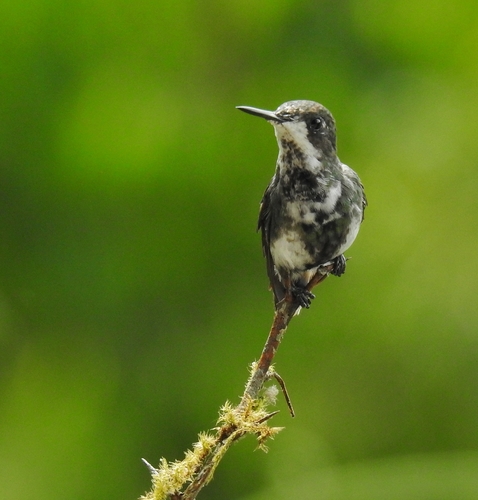 Green Thorntail
 Butterfly Coquette
In short
The most reliable field mark between Green Thorntail and Butterfly Coquette is the tail: adult male Green Thorntail shows an extremely long, deeply forked, narrow tail, while Butterfly Coquette males have a shorter, maroon tail without such deep forking. Females of both species lack extravagant tail streamers, but Green Thorntail females have a notched tail with distinctive white in the outer feathers, while Butterfly Coquette females have a maroon or bronzy-green tail. Males of Butterfly Coquette are also unique in showing a long, red-tipped green crest and green 'whiskers' with white tips, which Green Thorntail entirely lacks. Both species have a white rump band, but their head and facial patterns, and the color of their uppertail coverts, are key for separation. Immature and female birds can be separated by face and tail pattern with careful observation.
Identification tips
- Tail shape and length (adult males): Green Thorntail males have an extremely long, deeply forked, narrow bluish-black tail, often held out or cocked at an angle. Butterfly Coquette males have a shorter, maroon tail that is not deeply forked.
- Crest and whiskers (adult males): Only Butterfly Coquette males show a long, red-tipped green crest and long green 'whiskers' with white tips. Green Thorntail never shows a crest or whiskers.
- Uppertail coverts: Green Thorntail males have a coppery bronze rump with bluish-black, while Butterfly Coquette males have deep reddish uppertail coverts (bronzy olive in subspecies klagesi). This is visible when perched or in good light.
- White rump band: Both species have a white band across the rump, so this mark alone is not diagnostic, but it can be used in combination with other features.
- Facial pattern (females): Green Thorntail females have a broad white cheek patch and a dull black chin with white spots. Butterfly Coquette females have a whitish malar patch but lack the broad cheek patch and spotted chin.
- Tail pattern (females): Green Thorntail females have a notched tail with bluish-black central feathers and white-based, white-tipped outer feathers. Butterfly Coquette females have a maroon or bronzy-green tail without the distinctive white pattern.
- Underpart color: Green Thorntail males have a bright metallic green throat and greenish-blue breast center, while Butterfly Coquette males have green underparts with white thighs and golden highlights on the breast (females).
- Juvenile chin: Green Thorntail juveniles have a grayish-white chin, which can help separate them from Butterfly Coquette if seen well.
- Size impression: Green Thorntail males appear longer and more slender due to their tail, but actual body size is similar between species.
- Perching and display: Green Thorntail males often perch on high, bare twigs and may be seen performing dive displays. Butterfly Coquette display behavior is not described here.
- Habitat context: If seen in humid montane or lowland forest canopy in Costa Rica, Panama, Colombia, or Ecuador, Green Thorntail is more likely. Butterfly Coquette is more widespread in northern South America.
- No wing pattern differences: Neither species has a distinctive upperwing pattern in flight at any age, so focus on tail and head/face.
- Sex differences: Only male Butterfly Coquette shows crest and whiskers; females of both species are more subtly marked and require attention to face and tail pattern.
- Pitfalls: Do not rely on the white rump band alone; check for tail shape, crest, and facial pattern. Immature and female birds are best separated by tail and face, not overall color.
- Subspecies variation: Butterfly Coquette subspecies klagesi is darker with bronzy olive uppertail coverts and bronzy-green tail, but still lacks the deeply forked tail of Green Thorntail.
Size
Green Thorntail males are slightly longer (9.5–10.2 cm) than Butterfly Coquette (7.5–9.1 cm), but females are smaller (6.6–7.5 cm). Green Thorntail is lighter (mean 3.0 g, sex not always recorded), while Butterfly Coquette's weight is not specified. Both are among the smallest hummingbirds, so size alone is not a strong field mark, but the extremely long tail of male Green Thorntail makes it appear longer and more slender in the field.
Plumage
- Juvenile/Immature/Non-breeding: No distinctive upperwing or flight pattern is described for either species at any age; separation relies on tail and face pattern, not wing.
- Adult Male: Green Thorntail males have a metallic green crown, lighter metallic green back, coppery bronze rump with bluish-black, a broad white rump band, and a deeply forked, narrow bluish-black tail. The throat and breast are bright metallic green to greenish-blue. Butterfly Coquette males have a deep green head with a long, red-tipped green crest and long green 'whiskers' with white tips, a green back with golden highlights, deep reddish uppertail coverts, a white rump band, green underparts, white thighs, and a maroon tail. They lack the deeply forked tail of Green Thorntail.
- Adult Female: Green Thorntail females have a dark green back, darker rump, notched but not elongated tail with bluish-black central feathers and white-based, white-tipped outer feathers, a broad white cheek patch, and a dull black chin with white spots. Butterfly Coquette females lack crest and whiskers, have a whitish malar patch, less intense red uppertail coverts, golden highlights on the breast, and a maroon or bronzy-green tail.
- Juvenile: Green Thorntail juveniles resemble adults but have a grayish-white chin. No juvenile-specific marks are described for Butterfly Coquette.
Behaviour
Green Thorntail males often perch on high, bare twigs and perform dive displays during the breeding season. They forage mostly at the tops of flowering trees, hovering with the tail cocked at a right angle to the body. Butterfly Coquette behavior is not described in detail, but as a coquette, it likely also forages at flowers and may show active, agile flight. The exaggerated tail of Green Thorntail males is often held out and accentuates their slender appearance, especially when hovering or displaying.
Habitat
Green Thorntail is found in humid montane and lowland evergreen forests, typically in the canopy or at the edges, from 300–1,400 m depending on country (Costa Rica, Panama, Colombia, Ecuador). Butterfly Coquette occurs in a broader range across Bolivia, Brazil, Colombia, Ecuador, Peru, and Venezuela, but specific habitat details are not provided here. Both are canopy specialists, but Green Thorntail is more tied to humid montane and lowland forest edges and clearings.