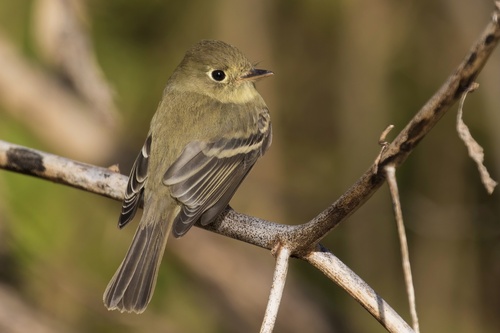
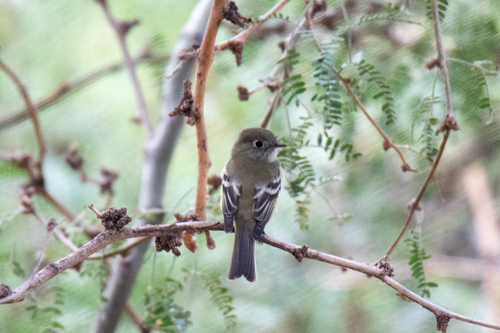
Hammond's Flycatcher vs Western Flycatcher
Empidonax hammondii versus Empidonax difficilis
Play a quiz with Hammond's Flycatcher and Western Flycatcher
Hammond's Flycatcher
Western Flycatcher
In short
Hammond's Flycatcher and Western Flycatcher are both small, olive-gray Empidonax flycatchers, making them challenging to differentiate. Key differences include bill size and primary projection, with Hammond's having a shorter bill and longer primary projection. Vocalizations can also aid in identification, though they are similar.
Identification tips
- Bill size: Hammond's has a shorter, narrower bill. 2. Primary projection: Hammond's shows longer primary projection beyond the tertials. 3. Vocalizations: Listen for the higher-pitched call of Hammond's. 4. Habitat: Consider the forest type; Hammond's favors mature coniferous forests.
Size
Both species are similar in size, but Hammond's Flycatcher generally appears slightly smaller due to its shorter bill.
Plumage
Both species exhibit olive-gray plumage with pale underparts and a distinct eye-ring. Differences in plumage are subtle and not reliable for identification.
Behaviour
Hammond's Flycatcher is primarily an aerial forager, often seen catching insects on the wing. Western Flycatcher shares similar foraging behaviors but may be more aggressive in interactions.
Habitat
Hammond's Flycatcher prefers mature coniferous forests, while Western Flycatcher can be found in a wider range of wooded habitats, including mixed forests.
Voice
Vocalizations are similar, but Hammond's Flycatcher has a slightly higher-pitched call. Western Flycatcher's call is more variable and complex.