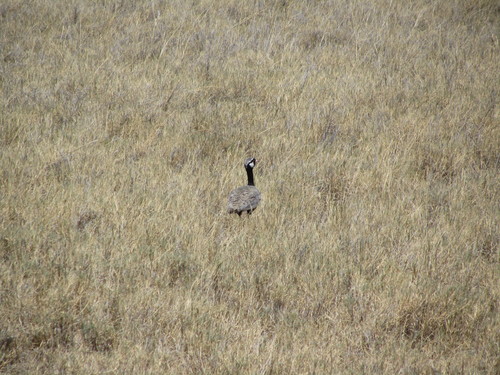
Karoo Bustard vs White-quilled Bustard
Heterotetrax vigorsii versus Afrotis afraoides
Play a quiz with Karoo Bustard and White-quilled Bustard
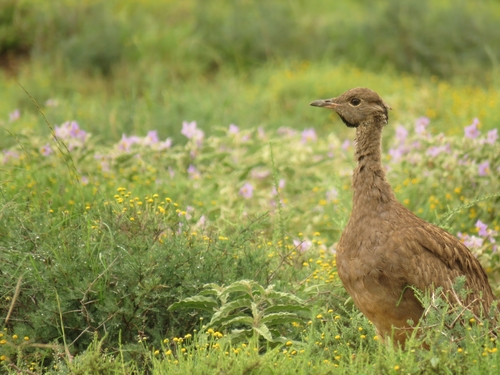
Karoo Bustard
White-quilled Bustard
In short
The Karoo Bustard and White-quilled Bustard can be told apart by their distinct plumage patterns and habitats. The Karoo Bustard has a black patch from chin to foreneck, while the White-quilled Bustard male features a black head and underparts with a white cheek patch and collar. Both species inhabit dry regions, but their ranges and specific environments differ.
Identification tips
1. Look for the black patch from chin to foreneck in Karoo Bustard. 2. Check for white cheek patch and collar in male White-quilled Bustard. 3. Consider habitat: Karoo Bustard prefers more arid, shrub-dotted landscapes, while White-quilled Bustard is found in a variety of dry grassland and savanna habitats. 4. Note the presence of groups or pairs, as Karoo Bustards may be seen in small parties.
Size
Both species are similar in size, typical of medium-sized bustards.
Plumage
Karoo Bustard has a large black patch from chin to foreneck, with off-white belly and pinkish upperparts. White-quilled Bustard males have a black head and underparts, a white cheek patch, collar, and wing band, with golden-brown, gray, and darker brown upperparts. Females of the White-quilled Bustard lack the white cheek patch and collar.
Behaviour
Karoo Bustards are often seen in pairs or small groups and may be cooperative breeders. White-quilled Bustards are highly sedentary and exhibit sexual dimorphism.
Habitat
Karoo Bustard inhabits dry, open karoo country with scattered shrubs and stony substrate. White-quilled Bustard is found in Nama Karoo, Kalahari sandveld, dry grasslands, open savanna, and grass dunes, mainly in Namibia, Botswana, and parts of South Africa and Lesotho.
Voice
Vocalizations are similar between the two species, making them unreliable for differentiation.