Birdr

Laughing Gull vs Magnificent Frigatebird

Leucophaeus atricilla versus Fregata magnificens

Play a quiz with Laughing Gull and Magnificent Frigatebird
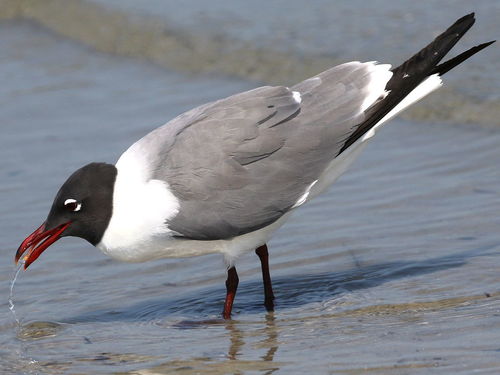
Laughing Gull (Leucophaeus atricilla) Laughing Gull
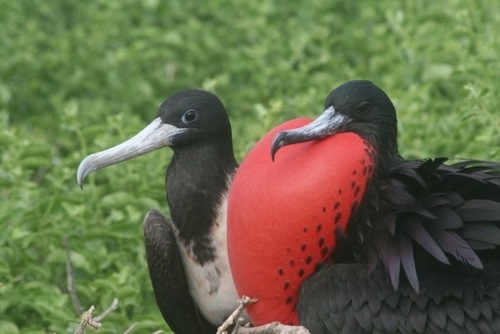
Magnificent Frigatebird (Fregata magnificens) Magnificent Frigatebird

Media

Loading…

In short

The Laughing Gull and Magnificent Frigatebird are distinct in size and behavior. The Laughing Gull is a small, black-hooded gull commonly seen along coasts, while the Magnificent Frigatebird is a large seabird known for its aerial prowess and distinctive red gular sac in males.

Identification tips

1. Size: Frigatebirds are much larger with long wings and forked tails. 2. Behavior: Look for Laughing Gulls on land or near human activity; frigatebirds are almost always seen in flight. 3. Plumage: In breeding season, Laughing Gulls have a black head, while male frigatebirds have a red gular sac. 4. Habitat: Laughing Gulls are coastal, frigatebirds are pelagic. 5. Vocalizations: Listen for the Laughing Gull's calls; frigatebirds are mostly silent.

Size

The Laughing Gull is much smaller than the Magnificent Frigatebird. Frigatebirds have a wingspan that can reach over 2 meters, dwarfing the gull's more modest wingspan.

Plumage

Laughing Gulls have a black head during breeding season, with dark gray mantles and white underparts. Magnificent Frigatebirds are mostly black, with males displaying a bright red gular sac during courtship. Females have a white breast and belly.

Behaviour

Laughing Gulls are often seen walking on beaches and scavenging near human activity. In contrast, Magnificent Frigatebirds are almost exclusively aerial, rarely landing on water due to their short legs and small feet.

Habitat

Laughing Gulls are found along sandy or rocky shores and salt-marsh islands. Magnificent Frigatebirds are typically seen soaring over oceans and coastal areas, often nesting in large colonies on remote islands.

Voice

Laughing Gulls are known for their distinctive 'laughing' calls. Magnificent Frigatebirds are generally silent, with males producing drumming sounds during courtship displays.

Submit a better description

Use the same sections as the comparison. Your text is published immediately.

The Laughing Gull and Magnificent Frigatebird are distinct in size and behavior. The Laughing Gull is a small, black-hooded gull commonly seen along coasts, while the Magnificent Frigatebird is a large seabird known for its aerial prowess and distinctive red gular sac in males.

1. Size: Frigatebirds are much larger with long wings and forked tails. 2. Behavior: Look for Laughing Gulls on land or near human activity; frigatebirds are almost always seen in flight. 3. Plumage: In breeding season, Laughing Gulls have a black head, while male frigatebirds have a red gular sac. 4. Habitat: Laughing Gulls are coastal, frigatebirds are pelagic. 5. Vocalizations: Listen for the Laughing Gull's calls; frigatebirds are mostly silent.

The Laughing Gull is much smaller than the Magnificent Frigatebird. Frigatebirds have a wingspan that can reach over 2 meters, dwarfing the gull's more modest wingspan.

Laughing Gulls have a black head during breeding season, with dark gray mantles and white underparts. Magnificent Frigatebirds are mostly black, with males displaying a bright red gular sac during courtship. Females have a white breast and belly.

Laughing Gulls are often seen walking on beaches and scavenging near human activity. In contrast, Magnificent Frigatebirds are almost exclusively aerial, rarely landing on water due to their short legs and small feet.

Laughing Gulls are found along sandy or rocky shores and salt-marsh islands. Magnificent Frigatebirds are typically seen soaring over oceans and coastal areas, often nesting in large colonies on remote islands.

Laughing Gulls are known for their distinctive 'laughing' calls. Magnificent Frigatebirds are generally silent, with males producing drumming sounds during courtship displays.

Discard your changes?

You have unsaved edits. If you leave now, those changes will be lost.

Laughing Gull · Magnificent Frigatebird · My Tricky Birds