Birdr

Lesser Kestrel vs Common Kestrel

Falco naumanni versus Falco tinnunculus

Play a quiz with Lesser Kestrel and Common Kestrel

Lesser Kestrel (Falco naumanni) Lesser Kestrel
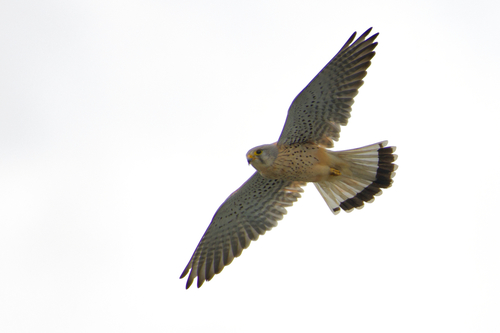
Common Kestrel (Falco tinnunculus) Common Kestrel

Media

Loading…

In short

The Lesser Kestrel and Common Kestrel are similar small falcons, but adult males can be distinguished by plumage details: the Lesser Kestrel has a cleaner, less marked head and lacks the black spots on the back found in the Common Kestrel. In flight, wing formula differences can help, though they are subtle and require good views.

Identification tips

Size

Both species are similar in size, making structural differences more important for identification.

Plumage

Adult male Lesser Kestrels have a cleaner, less marked head compared to the Common Kestrel, which has a more conspicuously marked head with a dark moustachial stripe. Lesser Kestrels lack the black spots on the back that are present in Common Kestrels. Females and juveniles of both species are more challenging to differentiate, as they are more uniformly colored and heavily spotted.

Behaviour

Both species exhibit similar hunting behaviors, often seen hovering over fields.

Habitat

Both species can be found in open habitats such as fields and grasslands, though the Common Kestrel has a broader range and can be found in more varied environments.

Voice

Vocalizations are similar and not a reliable field mark for distinguishing these species.

Submit a better description

Use the same sections as the comparison. Your text is published immediately.

The Lesser Kestrel and Common Kestrel are similar small falcons, but adult males can be distinguished by plumage details: the Lesser Kestrel has a cleaner, less marked head and lacks the black spots on the back found in the Common Kestrel. In flight, wing formula differences can help, though they are subtle and require good views.

  • Adult males: Look for the cleaner head of the Lesser Kestrel and absence of black spots on the back.
  • In flight: Check the wing formula; the Lesser Kestrel's p10 is longer than p7, while in the Common Kestrel, p10 is equal to p7.
  • Females and juveniles: More challenging to differentiate; focus on structural differences and subtle plumage cues.
  • Perched birds: Note that the wingtips of the Lesser Kestrel reach the dark subterminal tail-band.

Both species are similar in size, making structural differences more important for identification.

Adult male Lesser Kestrels have a cleaner, less marked head compared to the Common Kestrel, which has a more conspicuously marked head with a dark moustachial stripe. Lesser Kestrels lack the black spots on the back that are present in Common Kestrels. Females and juveniles of both species are more challenging to differentiate, as they are more uniformly colored and heavily spotted.

Both species exhibit similar hunting behaviors, often seen hovering over fields.

Both species can be found in open habitats such as fields and grasslands, though the Common Kestrel has a broader range and can be found in more varied environments.

Vocalizations are similar and not a reliable field mark for distinguishing these species.

Discard your changes?

You have unsaved edits. If you leave now, those changes will be lost.

Lesser Kestrel · Common Kestrel · My Tricky Birds