Little Bustard vs Yellow-billed Cuckoo
Tetrax tetrax versus Coccyzus americanus
Play a quiz with Little Bustard and Yellow-billed Cuckoo

Little Bustard
Yellow-billed Cuckoo
In short
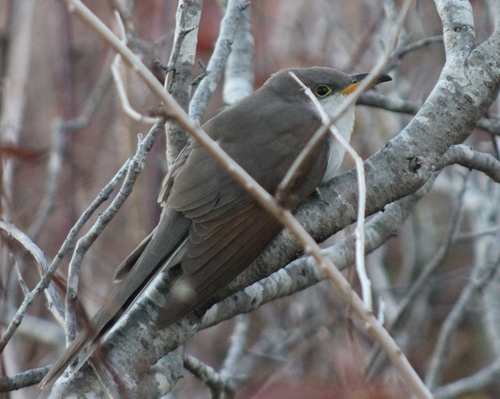
The Little Bustard and Yellow-billed Cuckoo are distinct in appearance and behavior. The Little Bustard is a ground-dwelling bird with a stout body and short neck, while the Yellow-billed Cuckoo is a slender arboreal bird with a long tail and distinctive yellow bill. These differences make them easily distinguishable in the field.
Identification tips
1. Location and habitat: Check if you are in open fields (Little Bustard) or wooded areas (Yellow-billed Cuckoo). 2. Body shape: Look for a stocky, ground-dwelling bird (Little Bustard) versus a slender bird with a long tail (Yellow-billed Cuckoo). 3. Bill color: The Yellow-billed Cuckoo has a yellow bill, a key distinguishing feature. 4. Behavior: Observe if the bird is on the ground or in trees. 5. Vocalizations: Listen for the Yellow-billed Cuckoo's distinctive calls.
Size
The Little Bustard is larger and more robust, with a stocky build, compared to the slender and smaller Yellow-billed Cuckoo.
Plumage
The Little Bustard has a mottled brown and white plumage, with males displaying a striking black and white neck pattern during breeding season. The Yellow-billed Cuckoo has a plain brown upper body with a white underbody and a long tail with white tips.
Behaviour
The Little Bustard is often seen walking or running on the ground in open fields, while the Yellow-billed Cuckoo is usually found perched or moving through trees, often in search of insects.
Habitat
Little Bustards prefer open grasslands and agricultural fields, whereas Yellow-billed Cuckoos inhabit deciduous woodlands and forest edges.
Voice
The Little Bustard is generally silent, especially outside the breeding season, while the Yellow-billed Cuckoo is known for its distinctive, repetitive 'kowlp' calls.