
Long-billed Dowitcher vs Common Snipe
Limnodromus scolopaceus versus Gallinago gallinago
Play a quiz with Long-billed Dowitcher and Common Snipe
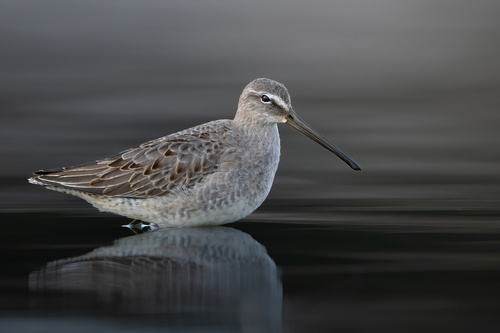 Long-billed Dowitcher
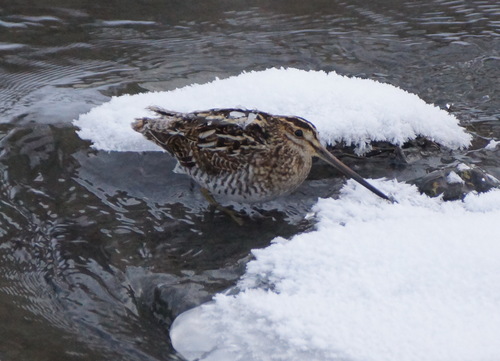 Common Snipe
In short
The most reliable field mark between Long-billed Dowitcher and Common Snipe is the large, bright white rump and uppertail visible in flight on Long-billed Dowitcher of any age, which contrasts with the Common Snipe’s more cryptic, barred tail and lack of a white rump. Juvenile and adult dowitchers also show a more uniform upperwing and lack the bold pale stripes and strong scapular contrast of snipe. Structurally, dowitchers are longer-billed and more compact, often probing with a rapid 'sewing machine' motion, while snipe appear more slender and cryptic, flushing with a zig-zag flight. In non-breeding plumage, both can appear grayish and are easily confused, but the rump and tail pattern in flight, and bill length and shape, remain reliable. Listen for differences in calls if seen in flight or flushed.
Identification tips
- White rump in flight (all ages): Long-billed Dowitcher shows a large, bright white rump and uppertail extending up the back, visible only when the bird takes off or flies; Common Snipe lacks this, showing a cryptically barred tail and rump.
- Tail barring: Dowitcher tail is barred black and white, with black bars twice as wide as the white; snipe tail is more evenly and finely barred, blending with the rest of the upperparts.
- Upperwing and scapular pattern (juveniles/immatures): Juvenile dowitchers have plain, dark upperwings with chestnut-fringed upperparts and dull tertials; snipe juveniles and adults have bold pale stripes on the upperwing and scapulars, especially obvious in flight.
- Bill length and shape: Dowitcher bill is very long (about twice head length), straight, and black with a yellowish base; snipe bill is also long but slightly shorter and appears more delicate in proportion to the head.
- Face pattern: Snipe shows a strong dark eye-stripe with pale supercilium above and below; dowitcher has a whitish supercilium and dark loral stripe, but the facial contrast is less striking.
- Underparts in breeding plumage: Dowitcher is rich rufous below with black barring and white flanks; snipe is pale below with no rufous and less barring.
- Non-breeding/winter plumage: Both become grayish, but dowitcher remains more uniform with a gray breast and white belly, while snipe retains some mottling and a stronger face pattern.
- Feeding behavior: Dowitchers feed openly in shallow water with rapid, repeated bill probes ('sewing machine'); snipe probe more slowly and are often hidden, only flushing when approached.
- Flight style: Snipe flushes with a rapid, zig-zag flight and quickly drops back into cover; dowitcher takes off more directly and may circle before landing again.
- Courtship display: Snipe males perform a high, circling flight with shallow dives, producing a mechanical 'drumming' sound; dowitchers do not drum, but may chase females in flight.
- Habitat preference: Dowitchers favor open, shallow freshwater; snipe prefer dense, wet marshes and are less likely to be seen in the open.
- Group size: Dowitchers often feed in flocks; snipe are usually solitary or in small groups.
- Voice: Dowitcher gives a sharp, high-pitched call in flight; snipe gives a sharp 'scape' call when flushed and a unique drumming display.
- Sex differences: Not reliably separable in the field for either species; both sexes look similar.
- Pitfalls: In dull winter plumage, both can appear gray and patternless; rely on rump/tail in flight, bill length, and feeding behavior for separation.
Size
Despite appearances, Common Snipe is slightly heavier on average (119.5g vs 104.0g for Long-billed Dowitcher [wikidata]), but both are medium-sized, stocky waders. In the field, snipe may look longer-bodied and more slender due to their posture and longer tail projection, while dowitchers appear more compact and front-heavy, accentuated by their very long, straight bill. Both have similar overall length and wingspan, but these differences are subtle and best used as supporting marks.
Plumage
-
Juvenile/immature birds in flight: Long-billed Dowitcher of all ages shows a large, bright white rump and uppertail extending onto the back, only visible in flight, with a tail barred black and white (black bars twice as wide as white). Juvenile dowitchers have upperparts fringed chestnut, and tertials that are dark gray with narrow buff edges and very dull internal markings. Common Snipe, by contrast, lacks a white rump; its tail is cryptically barred and not as striking in flight, and the upperwing shows bold pale stripes and strong scapular contrast, especially obvious in flight or when flushed. Snipe upperparts are mottled brown with straw-yellow stripes, and the face pattern is more sharply defined with a dark eye-stripe and pale supercilium.
-
Adult breeding plumage: Long-billed Dowitcher is rufous below with black barring on the breast and white barring on the flanks, plus a dark crown. Common Snipe is more cryptic, mottled brown above with straw-yellow stripes and pale below, lacking the rich rufous and barring of dowitcher.
-
Non-breeding/winter plumage: Both become drabber and greyer, but dowitcher retains the white rump in flight and a more uniform gray breast, while snipe remains more patterned above and below with a strong facial stripe pattern.
-
Sexes: Both species are similar between sexes; female dowitchers are slightly heavier and longer-billed, but this is not field-diagnostic.
Behaviour
Long-billed Dowitchers feed in shallow freshwater by rapidly probing with their bills in a 'sewing machine' motion, often in groups. They are more likely to be seen wading openly. Common Snipe are shy, solitary or in small groups, and prefer to stay hidden in dense vegetation, flushing only when closely approached. Their flight is erratic and zig-zagging, making them harder to track. Snipe also perform a unique 'winnowing' display flight, producing a drumming sound with their tail feathers during courtship, which dowitchers do not.
Habitat
Long-billed Dowitchers are most often found in open, shallow freshwater habitats such as marshes, flooded fields, and pond edges, especially during migration and winter. Common Snipe are more strictly associated with dense, wet marshes, bogs, and wet meadows, often in areas with thick cover. While both can overlap in wetland habitats, snipe are more likely to be flushed from dense vegetation, whereas dowitchers are more often seen feeding in the open.
Voice
The best separation by sound is in flight: Long-billed Dowitcher gives a sharp, high-pitched call (not described in detail here), which is a key field mark, especially in winter when plumage is similar. Common Snipe, when flushed, gives a sharp 'scape, scape' call and, during display, produces a unique 'drumming' or 'winnowing' sound with its tail feathers. Dowitchers do not produce this mechanical drumming.