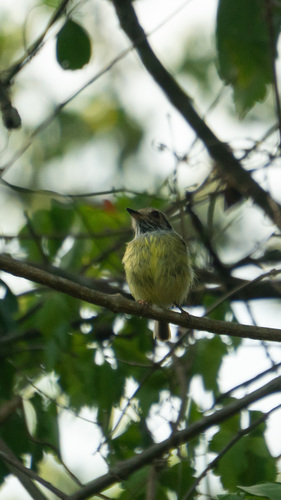
Mottle-cheeked Tyrannulet vs Eared Pygmy-Tyrant
Phylloscartes ventralis versus Myiornis auricularis
Play a quiz with Mottle-cheeked Tyrannulet and Eared Pygmy-Tyrant
Mottle-cheeked Tyrannulet
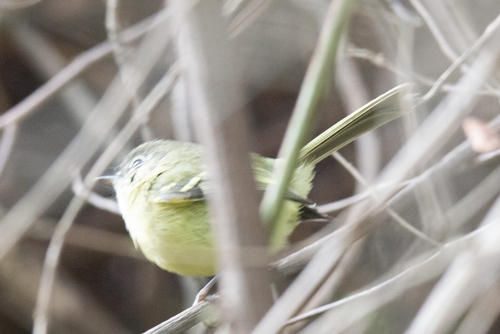
Eared Pygmy-Tyrant
In short
The Mottle-cheeked Tyrannulet and the Eared Pygmy-Tyrant can be differentiated by their size and habitat preferences. The Mottle-cheeked Tyrannulet is larger and found at higher elevations, while the Eared Pygmy-Tyrant is smaller and inhabits lower forest levels.
Identification tips
- Size: Mottle-cheeked Tyrannulet is noticeably larger. 2. Elevation: Mottle-cheeked Tyrannulet is found at higher elevations (1000–2200 m) compared to the Eared Pygmy-Tyrant (sea level to 1200 m). 3. Plumage: Look for white markings on the tertials and wingbars on the Mottle-cheeked Tyrannulet. 4. Behavior: Mottle-cheeked Tyrannulet often joins mixed-species flocks.
Size
The Mottle-cheeked Tyrannulet is larger than the Eared Pygmy-Tyrant.
Plumage
Both species have olive-green plumage, but the Mottle-cheeked Tyrannulet features prominent white markings on the tertials and obvious wingbars, while the Eared Pygmy-Tyrant's plumage is less distinctly marked.
Behaviour
The Mottle-cheeked Tyrannulet perches horizontally and joins mixed-species flocks, foraging actively for invertebrates. The Eared Pygmy-Tyrant also forages actively, usually in lower growth or the midstory.
Habitat
The Mottle-cheeked Tyrannulet is found at elevations between 1000–2200 m in various forest habitats, whereas the Eared Pygmy-Tyrant inhabits humid forests and edges from sea level to 1200 m.
Mottle-cheeked Tyrannulet · Eared Pygmy-Tyrant · My Tricky Birds