Birdr

Plain Tyrannulet vs Euler's Flycatcher

Inezia inornata versus Lathrotriccus euleri

Play a quiz with Plain Tyrannulet and Euler's Flycatcher
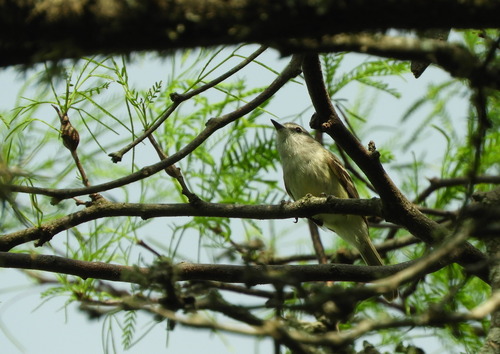
Plain Tyrannulet (Inezia inornata) Plain Tyrannulet
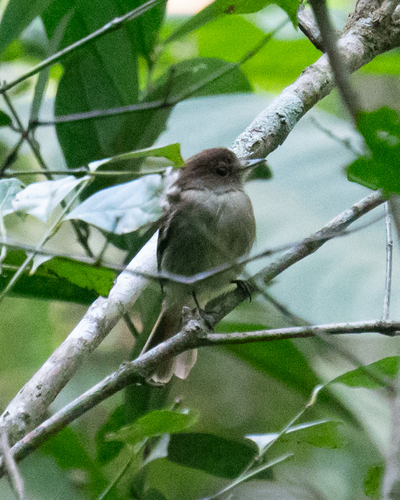
Euler's Flycatcher (Lathrotriccus euleri) Euler's Flycatcher

Media

Loading…

In short

The Plain Tyrannulet and Euler's Flycatcher are both small, inconspicuous flycatchers, but they can be distinguished by their structure and subtle plumage differences. The Plain Tyrannulet has a more slender bill and lacks the obvious wing bars seen in Euler's Flycatcher. Observing their behavior and habitat can also aid in identification.

Identification tips

  1. Bill shape: Look for the slender bill of the Plain Tyrannulet. 2. Wing bars: Note the presence of faint wing bars on Euler's Flycatcher. 3. Habitat: Consider the habitat; Plain Tyrannulets prefer open edges, while Euler's Flycatchers are more forest-inclined. 4. Behavior: Observe behavior; Plain Tyrannulets are more active and often in pairs.

Size

Both species are small flycatchers, but the Plain Tyrannulet is slightly more compact with a finer bill.

Plumage

The Plain Tyrannulet is generally drab with no wing bars, while Euler's Flycatcher has faint wing bars and a slightly more contrasting plumage. Euler's Flycatcher may also show a hint of a pale supercilium.

Behaviour

Plain Tyrannulets are often seen in pairs and can be quite active, flitting through foliage. Euler's Flycatcher tends to be more solitary and may perch more conspicuously.

Habitat

Plain Tyrannulets are found in scrubby areas and forest edges, often near water. Euler's Flycatcher prefers more densely forested habitats but can also be found at edges.

Voice

Vocalizations are not well-documented for both species, but Euler's Flycatcher typically has a more complex song compared to the Plain Tyrannulet's simpler calls.

Submit a better description

Use the same sections as the comparison. Your text is published immediately.

The Plain Tyrannulet and Euler's Flycatcher are both small, inconspicuous flycatchers, but they can be distinguished by their structure and subtle plumage differences. The Plain Tyrannulet has a more slender bill and lacks the obvious wing bars seen in Euler's Flycatcher. Observing their behavior and habitat can also aid in identification.

  1. Bill shape: Look for the slender bill of the Plain Tyrannulet. 2. Wing bars: Note the presence of faint wing bars on Euler's Flycatcher. 3. Habitat: Consider the habitat; Plain Tyrannulets prefer open edges, while Euler's Flycatchers are more forest-inclined. 4. Behavior: Observe behavior; Plain Tyrannulets are more active and often in pairs.

Both species are small flycatchers, but the Plain Tyrannulet is slightly more compact with a finer bill.

The Plain Tyrannulet is generally drab with no wing bars, while Euler's Flycatcher has faint wing bars and a slightly more contrasting plumage. Euler's Flycatcher may also show a hint of a pale supercilium.

Plain Tyrannulets are often seen in pairs and can be quite active, flitting through foliage. Euler's Flycatcher tends to be more solitary and may perch more conspicuously.

Plain Tyrannulets are found in scrubby areas and forest edges, often near water. Euler's Flycatcher prefers more densely forested habitats but can also be found at edges.

Vocalizations are not well-documented for both species, but Euler's Flycatcher typically has a more complex song compared to the Plain Tyrannulet's simpler calls.

Discard your changes?

You have unsaved edits. If you leave now, those changes will be lost.

Plain Tyrannulet · Euler's Flycatcher · My Tricky Birds