Birdr

Saddle-billed Stork vs Southern Tchagra

Ephippiorhynchus senegalensis versus Tchagra tchagra

Play a quiz with Saddle-billed Stork and Southern Tchagra
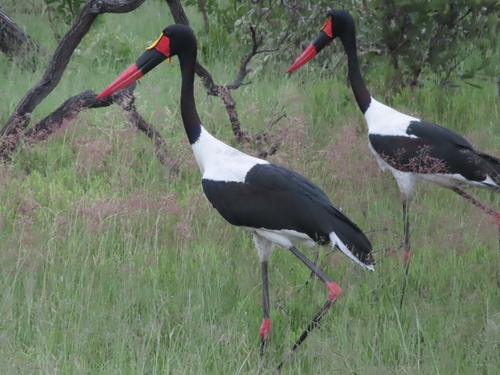
Saddle-billed Stork (Ephippiorhynchus senegalensis) Saddle-billed Stork
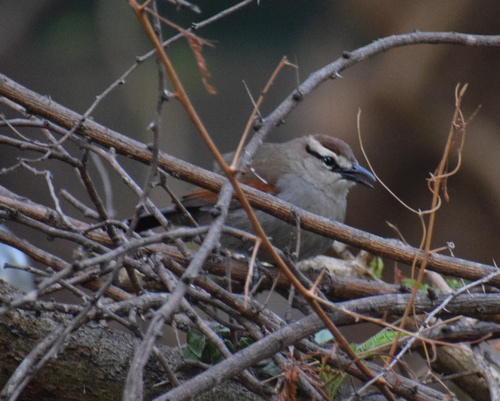
Southern Tchagra (Tchagra tchagra) Southern Tchagra

Media

Loading…

In short

The Saddle-billed Stork is a large, striking wader with a distinctive bill, while the Southern Tchagra is a smaller, passerine bird with a more subdued appearance. These species are not closely related and are unlikely to be confused in the field due to their size and habitat differences.

Identification tips

Look for the large size and striking bill of the Saddle-billed Stork when near water. In contrast, the smaller size and white supercilium of the Southern Tchagra are key in dry, scrubby areas. Their habitats rarely overlap, aiding in identification.

Size

The Saddle-billed Stork is much larger, standing at about 150 cm tall, compared to the Southern Tchagra, which is around 18 cm in length.

Plumage

The Saddle-billed Stork has a bold black and white plumage with a striking red and black bill featuring a yellow saddle, while the Southern Tchagra has a more muted brown and gray plumage with a distinctive white supercilium.

Behaviour

Saddle-billed Storks are typically seen wading in water, often alone or in pairs, while Southern Tchagras are more often found skulking in dense vegetation or foraging on the ground.

Habitat

Saddle-billed Storks are found in wetlands and open water bodies, whereas Southern Tchagras prefer dry, scrubby habitats and thickets.

Voice

The Saddle-billed Stork is generally silent, while the Southern Tchagra has a distinctive, melodious song and various calls.

Submit a better description

Use the same sections as the comparison. Your text is published immediately.

The Saddle-billed Stork is a large, striking wader with a distinctive bill, while the Southern Tchagra is a smaller, passerine bird with a more subdued appearance. These species are not closely related and are unlikely to be confused in the field due to their size and habitat differences.

Look for the large size and striking bill of the Saddle-billed Stork when near water. In contrast, the smaller size and white supercilium of the Southern Tchagra are key in dry, scrubby areas. Their habitats rarely overlap, aiding in identification.

The Saddle-billed Stork is much larger, standing at about 150 cm tall, compared to the Southern Tchagra, which is around 18 cm in length.

The Saddle-billed Stork has a bold black and white plumage with a striking red and black bill featuring a yellow saddle, while the Southern Tchagra has a more muted brown and gray plumage with a distinctive white supercilium.

Saddle-billed Storks are typically seen wading in water, often alone or in pairs, while Southern Tchagras are more often found skulking in dense vegetation or foraging on the ground.

Saddle-billed Storks are found in wetlands and open water bodies, whereas Southern Tchagras prefer dry, scrubby habitats and thickets.

The Saddle-billed Stork is generally silent, while the Southern Tchagra has a distinctive, melodious song and various calls.

Discard your changes?

You have unsaved edits. If you leave now, those changes will be lost.

Saddle-billed Stork · Southern Tchagra · My Tricky Birds