Birdr

Scrub Euphonia vs Thick-billed Euphonia

Euphonia affinis versus Euphonia laniirostris

Play a quiz with Scrub Euphonia and Thick-billed Euphonia
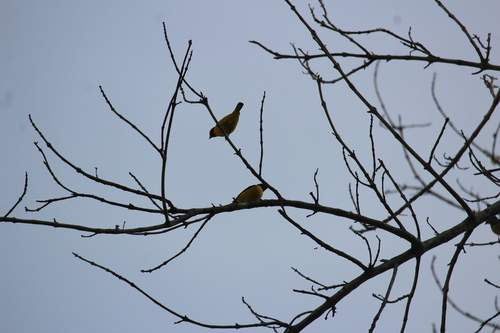
Scrub Euphonia (Euphonia affinis) Scrub Euphonia
Thick-billed Euphonia (Euphonia laniirostris) Thick-billed Euphonia

Media

Loading…

In short

The Scrub Euphonia (Euphonia affinis) and the Thick-billed Euphonia (Euphonia laniirostris) are both small, colorful birds found in Central America, yet they exhibit distinct differences in plumage, habitat preferences, and vocalizations. The Scrub Euphonia has a more vibrant yellow underpart and is commonly found in a wider range of habitats, while the Thick-billed Euphonia is recognized for its glossy blue plumage and specific preference for secondary woodlands and gardens.

Identification tips

  1. Birds of the World Similar-Species Diagnostics:
  2. The Scrub Euphonia is noted for its "vibrant yellow underparts," which stand out in various habitats, while the Thick-billed Euphonia males are described as having "glossy steel blue" plumage with a "yellow forecrown patch that reaches to just behind the eye." These features can help birdwatchers distinguish between the two species, especially when seen together.

  3. AI Field Diagnostics:

  4. When identifying the Scrub Euphonia, look for its bright yellow underparts and dark blue-black head, especially in open areas or fruiting trees. The more vibrant coloration can be a key indicator.
  5. For the Thick-billed Euphonia, focus on the glossy blue coloration and the distinctive yellow forecrown patch, particularly in more wooded areas or gardens. The thicker bill is also a notable characteristic that can help in identification.
  6. Pay attention to their vocalizations; the Scrub Euphonia's doubled notes are a unique identifier in mixed flocks, whereas the Thick-billed Euphonia’s calls are generally softer and may be less distinct.
  7. Habitat can also provide clues: if you’re in a scrubby or agricultural area, and you see a bright yellow bird, it’s likely the Scrub Euphonia. In more wooded or garden-like settings, you might encounter the Thick-billed Euphonia.

These differences are essential for birdwatchers to note, aiding in the accurate identification of these two similar yet distinct species.

Size

Both species are of similar small size typical of the Euphonia genus, measuring approximately 10-12 cm in length. However, the Thick-billed Euphonia tends to have a slightly bulkier appearance due to its thicker bill, which can be a distinguishing feature when observed closely.

Plumage

Behaviour

Both species are social and often found in pairs or small groups, frequently joining mixed flocks. The Scrub Euphonia tends to be more active in various habitats, while the Thick-billed Euphonia prefers to stay near forest edges and gardens. Both species exhibit typical euphonious behavior, such as foraging for fruits and insects.

Habitat

Voice

Submit a better description

Use the same sections as the comparison. Your text is published immediately.

The Scrub Euphonia (Euphonia affinis) and the Thick-billed Euphonia (Euphonia laniirostris) are both small, colorful birds found in Central America, yet they exhibit distinct differences in plumage, habitat preferences, and vocalizations. The Scrub Euphonia has a more vibrant yellow underpart and is commonly found in a wider range of habitats, while the Thick-billed Euphonia is recognized for its glossy blue plumage and specific preference for secondary woodlands and gardens.

  1. Birds of the World Similar-Species Diagnostics:
  2. The Scrub Euphonia is noted for its "vibrant yellow underparts," which stand out in various habitats, while the Thick-billed Euphonia males are described as having "glossy steel blue" plumage with a "yellow forecrown patch that reaches to just behind the eye." These features can help birdwatchers distinguish between the two species, especially when seen together.

  3. AI Field Diagnostics:

  4. When identifying the Scrub Euphonia, look for its bright yellow underparts and dark blue-black head, especially in open areas or fruiting trees. The more vibrant coloration can be a key indicator.
  5. For the Thick-billed Euphonia, focus on the glossy blue coloration and the distinctive yellow forecrown patch, particularly in more wooded areas or gardens. The thicker bill is also a notable characteristic that can help in identification.
  6. Pay attention to their vocalizations; the Scrub Euphonia's doubled notes are a unique identifier in mixed flocks, whereas the Thick-billed Euphonia’s calls are generally softer and may be less distinct.
  7. Habitat can also provide clues: if you’re in a scrubby or agricultural area, and you see a bright yellow bird, it’s likely the Scrub Euphonia. In more wooded or garden-like settings, you might encounter the Thick-billed Euphonia.

These differences are essential for birdwatchers to note, aiding in the accurate identification of these two similar yet distinct species.

Both species are of similar small size typical of the Euphonia genus, measuring approximately 10-12 cm in length. However, the Thick-billed Euphonia tends to have a slightly bulkier appearance due to its thicker bill, which can be a distinguishing feature when observed closely.

  • Scrub Euphonia: Males are bright yellow below with a contrasting dark blue-black head and back. The underparts are vibrant yellow, making them easily recognizable. Females are more subdued, with olive green and yellow underparts.
  • Thick-billed Euphonia: Males display a striking glossy steel blue plumage with a bright yellow forecrown patch that extends just behind the eye. Their underparts are also bright yellow, but they lack the vivid yellow underparts of the Scrub Euphonia. Females are similarly olive above and yellow below but are generally duller than the females of the Scrub Euphonia.

Both species are social and often found in pairs or small groups, frequently joining mixed flocks. The Scrub Euphonia tends to be more active in various habitats, while the Thick-billed Euphonia prefers to stay near forest edges and gardens. Both species exhibit typical euphonious behavior, such as foraging for fruits and insects.

  • Scrub Euphonia: Found in a variety of habitats including arid to humid forests, scrubby woodlands, agricultural areas with scattered trees, and fruiting trees in villages. It has a broader range, extending from southern Tamaulipas to Oaxaca in Mexico and into Costa Rica.
  • Thick-billed Euphonia: Prefers secondary woodlands, forest borders, and scrub clearings, often below 1200 m in elevation. Its habitat is generally more specialized compared to that of the Scrub Euphonia.
  • Scrub Euphonia: Known for its distinctive doubled or tripled notes, which are different from the calls of other similar species. It has a clear, melodic song that resonates in its varied habitats.
  • Thick-billed Euphonia: Vocalizations are less documented but are typically softer and more nuanced than those of the Scrub Euphonia. Their calls may blend more with the sounds of mixed-species flocks they often join.

Discard your changes?

You have unsaved edits. If you leave now, those changes will be lost.

Scrub Euphonia · Thick-billed Euphonia · My Tricky Birds