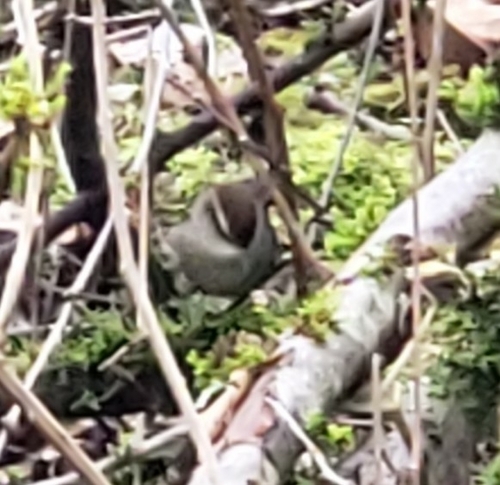
Sedge Wren vs Bewick's Wren
Cistothorus stellaris versus Thryomanes bewickii
Play a quiz with Sedge Wren and Bewick's Wren
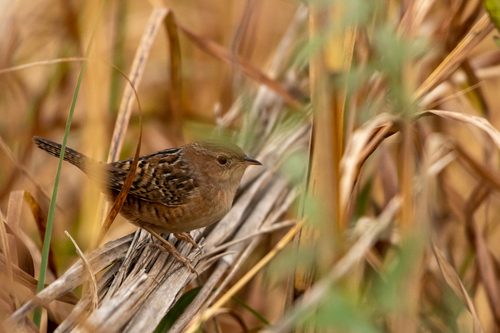
Sedge Wren
Bewick's Wren
In short
The Sedge Wren and Bewick's Wren are both small, brown wrens, but they differ in structure and habitat preferences. The Sedge Wren is more nomadic and prefers wet, grassy areas, while Bewick's Wren is more resident and favors open woodlands and thickets. Key differences include the Sedge Wren's shorter tail and more restricted supercilium compared to the Bewick's Wren's longer tail and prominent white supercilium.
Identification tips
- Tail length: Sedge Wren has a shorter tail; Bewick's Wren has a longer tail.
- Supercilium: Sedge Wren's supercilium is less distinct; Bewick's Wren has a prominent white supercilium.
- Habitat: Look for Sedge Wrens in wet, grassy areas and Bewick's Wrens in open woodlands and thickets.
- Vocalization: Listen for the Sedge Wren's complex, improvised song versus the Bewick's Wren's varied, learned song.
Size
Both species are similar in size, but the Bewick's Wren has a slightly longer tail.
Plumage
Sedge Wrens have a more subdued plumage with less distinct markings, while Bewick's Wrens exhibit a prominent white supercilium and more contrasting plumage.
Behaviour
Sedge Wrens are known for their nomadic behavior, often moving to different breeding areas within a season. Bewick's Wrens are more territorial and resident, often seen foraging in low vegetation.
Habitat
Sedge Wrens prefer wet, grassy habitats prone to flooding or drying, while Bewick's Wrens inhabit open woodlands, thickets, and areas with cavity-like structures.
Voice
Sedge Wrens have a complex song with improvisation, while Bewick's Wrens have a varied song repertoire learned from neighbors, with geographic variation.