Birdr

Spotted Crake vs Lesser Moorhen

Porzana porzana versus Paragallinula angulata

Play a quiz with Spotted Crake and Lesser Moorhen
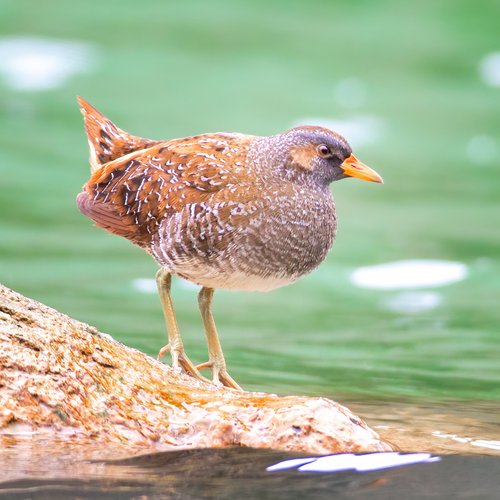
Spotted Crake (Porzana porzana) Spotted Crake
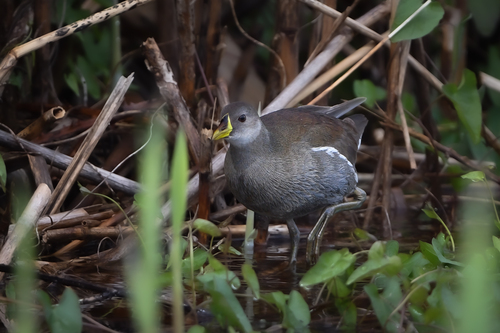
Lesser Moorhen (Paragallinula angulata) Lesser Moorhen

Media

Loading…

In short

The most reliable field mark between Spotted Crake and Lesser Moorhen is the Spotted Crake's distinctive white spotting on the flanks and dark barring, which is absent in Lesser Moorhen. Spotted Crake shows a short, straight yellow bill with a red base, while Lesser Moorhen's bill is different (details not provided, but not described as short and straight). In adults, Spotted Crake has a blue-grey breast and brown upperparts with white spots, whereas Lesser Moorhen lacks these features. Juvenile Spotted Crakes replace the blue-grey with brown but still show the spotted and barred pattern. Structure and leg color also help: Spotted Crake has green legs with long toes and a short buff-tinged tail. Lesser Moorhen, by contrast, is more Gallinula-like and lacks these specific marks.

Identification tips

  1. Flank spotting and barring: Spotted Crake always shows white spots and dark barring on the flanks, a key mark in both adults and immatures. Lesser Moorhen lacks these spots and barring—look for clean, unmarked flanks.
  2. Breast color: Adult Spotted Crake has a blue-grey breast, while immatures have brown. Lesser Moorhen does not show this blue-grey or the same brown wash; expect a more uniform, Gallinula-like underpart.
  3. Bill shape and color: Spotted Crake has a short, straight yellow bill with a red base. If you see a longer, more Gallinula-like bill, suspect Lesser Moorhen.
  4. Tail: Spotted Crake's tail is short and buff underneath—watch for this when the bird flicks its tail. Lesser Moorhen's tail is not described as buff or particularly short.
  5. Legs and toes: Spotted Crake has green legs with long toes, visible when walking or wading. Lesser Moorhen's leg color is not specified but is unlikely to be green with such long toes.
  6. Upperparts: Spotted Crake is brown above with some patterning, while Lesser Moorhen is expected to be plainer and more uniformly dark (as in Gallinula).
  7. Juvenile confusion: Even in juvenile/immature Spotted Crake, the flank spotting and barring persist, though the breast is brown. This is still diagnostic against Lesser Moorhen.
  8. Downy chicks: Both species' chicks are black and not separable at this stage.
  9. Flight views: No distinctive upperwing or flight marks are described for either species, so rely on body and flank pattern even in flight.
  10. Overall jizz: Spotted Crake is compact with a short tail and straight bill; Lesser Moorhen may appear more Gallinula-like in structure.
  11. Habitat overlap: Both use marshes and wetlands; do not use habitat alone to separate them.
  12. Voice: Not described in the sources—do not rely on vocalizations for separation.
  13. Pitfalls: Do not confuse Spotted Crake with Sora (which lacks breast spotting and has an unstreaked crown stripe), but Sora is not Lesser Moorhen.
  14. Season and sex: No seasonal or sexual differences are described that affect identification; use the above marks year-round.
  15. When in doubt: If you see a small rail with white-spotted flanks and a short, straight yellow bill, it is a Spotted Crake. Absence of these marks, especially in a plainer, Gallinula-like bird, points to Lesser Moorhen.

Size

Spotted Crake is a small rail, with a body mass of about 80g and a length of 19–22.5 cm, making it slightly smaller than a Water Rail. There is no direct measurement for Lesser Moorhen in the provided sources, but the name and genus placement suggest it is also a small rail, likely similar in size or slightly smaller than Common Moorhen. In the field, size alone is not a reliable separator unless both species are side by side, as both are small, compact rails.

Plumage

Adult Spotted Crakes are brown above with prominent white spots on the flanks and dark barring, and a blue-grey breast. The short tail is buff underneath. Immatures are similar but have brown replacing the blue-grey breast, while still showing the spotted and barred pattern. Downy chicks are black. Lesser Moorhen, by contrast, lacks the white spotting and barring of Spotted Crake. Its plumage is not described in detail in the sources, but as a Gallinula relative, it is expected to be plainer and lacks the Spotted Crake's distinctive flank spotting and barring. No age-specific wing or flight pattern marks are described for either species in the sources, so focus on flank and breast pattern for all ages.

Behaviour

Spotted Crake typically probes in mud or shallow water with its bill, also picking up food by sight. Both species are rails and likely show similar secretive, skulking behavior in dense marsh vegetation. No unique behavioral differences are described in the sources that would reliably separate them in the field.

Habitat

Spotted Crake breeds in marshes and sedge beds across temperate Europe and western Asia. Lesser Moorhen's habitat is not described in the provided sources, but as a Gallinula relative, it is likely to be found in similar wetland habitats. In areas where both might occur as vagrants, habitat alone is not diagnostic.

Submit a better description

Use the same sections as the comparison. Your text is published immediately.

The most reliable field mark between Spotted Crake and Lesser Moorhen is the Spotted Crake's distinctive white spotting on the flanks and dark barring, which is absent in Lesser Moorhen. Spotted Crake shows a short, straight yellow bill with a red base, while Lesser Moorhen's bill is different (details not provided, but not described as short and straight). In adults, Spotted Crake has a blue-grey breast and brown upperparts with white spots, whereas Lesser Moorhen lacks these features. Juvenile Spotted Crakes replace the blue-grey with brown but still show the spotted and barred pattern. Structure and leg color also help: Spotted Crake has green legs with long toes and a short buff-tinged tail. Lesser Moorhen, by contrast, is more Gallinula-like and lacks these specific marks.

  1. Flank spotting and barring: Spotted Crake always shows white spots and dark barring on the flanks, a key mark in both adults and immatures. Lesser Moorhen lacks these spots and barring—look for clean, unmarked flanks.
  2. Breast color: Adult Spotted Crake has a blue-grey breast, while immatures have brown. Lesser Moorhen does not show this blue-grey or the same brown wash; expect a more uniform, Gallinula-like underpart.
  3. Bill shape and color: Spotted Crake has a short, straight yellow bill with a red base. If you see a longer, more Gallinula-like bill, suspect Lesser Moorhen.
  4. Tail: Spotted Crake's tail is short and buff underneath—watch for this when the bird flicks its tail. Lesser Moorhen's tail is not described as buff or particularly short.
  5. Legs and toes: Spotted Crake has green legs with long toes, visible when walking or wading. Lesser Moorhen's leg color is not specified but is unlikely to be green with such long toes.
  6. Upperparts: Spotted Crake is brown above with some patterning, while Lesser Moorhen is expected to be plainer and more uniformly dark (as in Gallinula).
  7. Juvenile confusion: Even in juvenile/immature Spotted Crake, the flank spotting and barring persist, though the breast is brown. This is still diagnostic against Lesser Moorhen.
  8. Downy chicks: Both species' chicks are black and not separable at this stage.
  9. Flight views: No distinctive upperwing or flight marks are described for either species, so rely on body and flank pattern even in flight.
  10. Overall jizz: Spotted Crake is compact with a short tail and straight bill; Lesser Moorhen may appear more Gallinula-like in structure.
  11. Habitat overlap: Both use marshes and wetlands; do not use habitat alone to separate them.
  12. Voice: Not described in the sources—do not rely on vocalizations for separation.
  13. Pitfalls: Do not confuse Spotted Crake with Sora (which lacks breast spotting and has an unstreaked crown stripe), but Sora is not Lesser Moorhen.
  14. Season and sex: No seasonal or sexual differences are described that affect identification; use the above marks year-round.
  15. When in doubt: If you see a small rail with white-spotted flanks and a short, straight yellow bill, it is a Spotted Crake. Absence of these marks, especially in a plainer, Gallinula-like bird, points to Lesser Moorhen.

Spotted Crake is a small rail, with a body mass of about 80g and a length of 19–22.5 cm, making it slightly smaller than a Water Rail. There is no direct measurement for Lesser Moorhen in the provided sources, but the name and genus placement suggest it is also a small rail, likely similar in size or slightly smaller than Common Moorhen. In the field, size alone is not a reliable separator unless both species are side by side, as both are small, compact rails.

Adult Spotted Crakes are brown above with prominent white spots on the flanks and dark barring, and a blue-grey breast. The short tail is buff underneath. Immatures are similar but have brown replacing the blue-grey breast, while still showing the spotted and barred pattern. Downy chicks are black. Lesser Moorhen, by contrast, lacks the white spotting and barring of Spotted Crake. Its plumage is not described in detail in the sources, but as a Gallinula relative, it is expected to be plainer and lacks the Spotted Crake's distinctive flank spotting and barring. No age-specific wing or flight pattern marks are described for either species in the sources, so focus on flank and breast pattern for all ages.

Spotted Crake typically probes in mud or shallow water with its bill, also picking up food by sight. Both species are rails and likely show similar secretive, skulking behavior in dense marsh vegetation. No unique behavioral differences are described in the sources that would reliably separate them in the field.

Spotted Crake breeds in marshes and sedge beds across temperate Europe and western Asia. Lesser Moorhen's habitat is not described in the provided sources, but as a Gallinula relative, it is likely to be found in similar wetland habitats. In areas where both might occur as vagrants, habitat alone is not diagnostic.

Discard your changes?

You have unsaved edits. If you leave now, those changes will be lost.

Spotted Crake · Lesser Moorhen · My Tricky Birds