Birdr

Three-banded Courser vs Double-banded Courser

Rhinoptilus cinctus versus Smutsornis africanus

Play a quiz with Three-banded Courser and Double-banded Courser
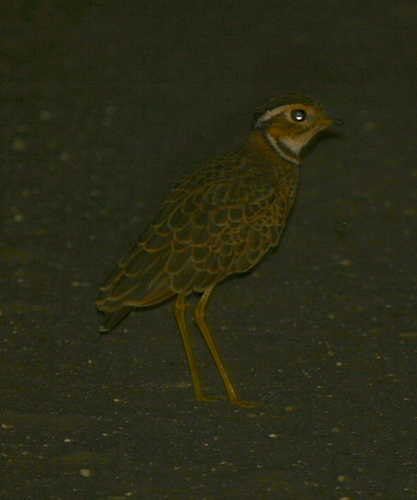
Three-banded Courser (Rhinoptilus cinctus) Three-banded Courser
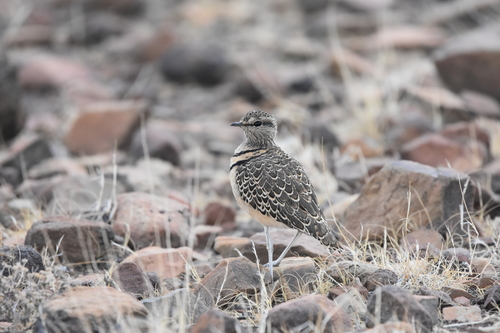
Double-banded Courser (Smutsornis africanus) Double-banded Courser

Media

Loading…

In short

The Three-banded Courser and Double-banded Courser can be distinguished by their breast bands: the Three-banded has three, while the Double-banded has two. They also prefer different habitats, with the Three-banded Courser favoring woodlands and the Double-banded Courser preferring open plains.

Identification tips

Breast bands: Three-banded Courser has three, Double-banded has two. Habitat: Look for Three-banded in woodlands and Double-banded in open plains. Facial markings: Three-banded has intricate patterns, Double-banded is plain. Flight: Double-banded shows chestnut/rufous inner primaries, Three-banded shows uniform brown.

Size

Both species are medium-sized coursers, with the Double-banded Courser generally being slightly larger.

Plumage

The Three-banded Courser has a darker dorsal plumage and intricate facial markings, while the Double-banded Courser is paler overall with a plain face. In flight, the Double-banded Courser shows rich chestnut or rufous inner primaries and secondaries, contrasting with the Three-banded Courser's more uniform brown.

Behaviour

The Three-banded Courser is primarily nocturnal and secretive, making it difficult to observe, while the Double-banded Courser is more likely to be seen during the day.

Habitat

The Three-banded Courser is found in semi-arid to mesic woodlands, whereas the Double-banded Courser inhabits short-grass areas on open plains or the edges of pans in semi-arid and arid shrublands or semi-deserts.

Submit a better description

Use the same sections as the comparison. Your text is published immediately.

The Three-banded Courser and Double-banded Courser can be distinguished by their breast bands: the Three-banded has three, while the Double-banded has two. They also prefer different habitats, with the Three-banded Courser favoring woodlands and the Double-banded Courser preferring open plains.

Breast bands: Three-banded Courser has three, Double-banded has two. Habitat: Look for Three-banded in woodlands and Double-banded in open plains. Facial markings: Three-banded has intricate patterns, Double-banded is plain. Flight: Double-banded shows chestnut/rufous inner primaries, Three-banded shows uniform brown.

Both species are medium-sized coursers, with the Double-banded Courser generally being slightly larger.

The Three-banded Courser has a darker dorsal plumage and intricate facial markings, while the Double-banded Courser is paler overall with a plain face. In flight, the Double-banded Courser shows rich chestnut or rufous inner primaries and secondaries, contrasting with the Three-banded Courser's more uniform brown.

The Three-banded Courser is primarily nocturnal and secretive, making it difficult to observe, while the Double-banded Courser is more likely to be seen during the day.

The Three-banded Courser is found in semi-arid to mesic woodlands, whereas the Double-banded Courser inhabits short-grass areas on open plains or the edges of pans in semi-arid and arid shrublands or semi-deserts.

Discard your changes?

You have unsaved edits. If you leave now, those changes will be lost.

Three-banded Courser · Double-banded Courser · My Tricky Birds