Western Bowerbird vs Spotted Bowerbird
Chlamydera guttata versus Chlamydera maculata
Play a quiz with Western Bowerbird and Spotted Bowerbird
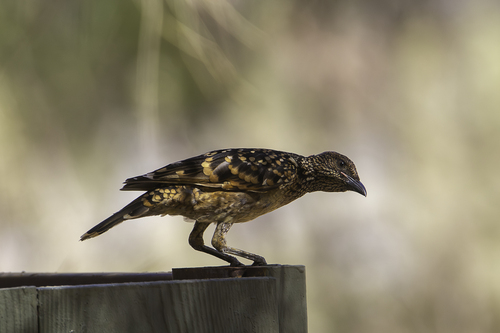 Western Bowerbird
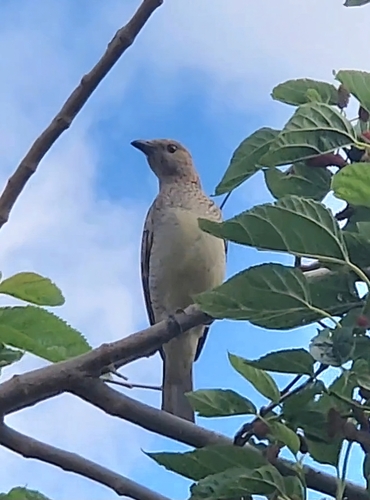 Spotted Bowerbird
In short
The most reliable field mark for separating Western Bowerbird from Spotted Bowerbird is overall coloration and spotting: Western Bowerbird is browner and more evenly spotted with reddish or buff spots, while Spotted Bowerbird is darker above with more extensive amber spotting and a paler, cream-colored underside. Both species have a pink or lilac-pink nuchal crest, but Spotted Bowerbird's is typically larger and more conspicuous, especially in displaying males. Structure is subtly different, with Spotted Bowerbird being slightly larger and more robust. Range is a strong clue: Western Bowerbird is restricted to central and western Australia, while Spotted Bowerbird is found in eastern Australia. Vocalizations and bower decoration behaviors can also help, but are more context-dependent.
Identification tips
- Spotting pattern and color: Western Bowerbird is brown with reddish or buff spots on the upperparts and buff underparts; Spotted Bowerbird is darker (blackish-brown) above with amber spots and a paler, cream-colored underside with scalloping and yellowish undertail. This is the most consistent field mark for all ages.
- Nuchal crest: Both have a pink or lilac-pink erectile crest on the nape, but Spotted Bowerbird's is larger, more lilac-toned, and more prominent, especially in males during display. Western Bowerbird's crest is smaller and pinker.
- Head and face: Spotted Bowerbird has a pale rufous head streaked with grey-brown, contrasting with the darker upperparts; Western Bowerbird's head is more uniformly brown with spotting.
- Underparts: Spotted Bowerbird has cream underparts with greyish scalloping and a yellowish tinge to the lower belly and undertail; Western Bowerbird's underparts are buff and less patterned.
- Size and structure: Spotted Bowerbird is slightly larger and more robust, but this is subtle and not always reliable in the field unless birds are together.
- Sexual monomorphism: Both species are similar in plumage between sexes, but female Western Bowerbird may be more heavily spotted on the throat.
- Bower decoration: Both species build avenue bowers and decorate with colorful objects, but Western Bowerbird tends to use more green and white items (including man-made objects), while Spotted Bowerbird's bower may be more variable in decoration.
- Display behavior: Spotted Bowerbird males display with wide circling, raised head, cocked tail, drooped wings, and aggressive use of decorations; Western Bowerbird males perform ritualized dances with tail fanning and wing flicking.
- Vocal mimicry: Spotted Bowerbird is a strong mimic, often imitating other birds and environmental sounds, especially when disturbed. Western Bowerbird is not known for mimicry.
- Habitat and range: Western Bowerbird is found in central and northwestern Australia (arid/semi-arid woodlands), while Spotted Bowerbird is in eastern Australia (open sclerophyll/riverine woodlands, orchards, gardens). Location is often decisive.
- Context of observation: If seen at a bower, look for the type of decorations and display behavior; Spotted Bowerbird's displays are more elaborate and include more mimicry.
- Tail: Western Bowerbird females have slightly longer tails than males, but this is subtle and not a primary field mark.
- Pitfalls: Both species can appear similar at a distance or in poor light; focus on the spotting pattern, head color, and underpart contrast. Immature and adult birds are not described as differing markedly in these features.
- When marks fail: If plumage is not clearly visible, use vocalizations and habitat as secondary cues. If in doubt, range is often the best separator.
- No age-specific flight marks: There are no distinctive juvenile or immature upperwing patterns described for either species, so rely on overall color and spotting for all ages.
Size
Spotted Bowerbird is slightly larger and heavier than Western Bowerbird. Spotted Bowerbird averages about 29 cm in length and 142 g in mass [wikidata], while Western Bowerbird is 24–28 cm and 120–150 g [wikipedia]. Both are mid-sized bowerbirds, but Spotted Bowerbird has a somewhat bulkier, more compact build. In the field, this difference is subtle and may be hard to judge unless the birds are side by side.
Plumage
There are no specific notes on age-dependent upperwing patterns or juvenile flight marks for either species, so separation relies on overall coloration and spotting across all ages. Western Bowerbird is brown overall with reddish or buff spots on the throat, chest, neck, back, head, and wings; the underparts are buff. The pink erectile crest on the nape is present but usually smaller and less showy than in Spotted Bowerbird. The female Western Bowerbird is similar to the male but with heavier spotting on the throat. Spotted Bowerbird is darker above (blackish-brown) with extensive amber spotting on the upperparts, a pale rufous head streaked with grey-brown, and a paler, cream-colored underside with greyish scalloping and barring; the lower belly and undertail have a yellowish wash. The nuchal crest is lilac-pink, larger, and more prominent, especially in displaying males. Both species are sexually monomorphic, but Spotted Bowerbird's plumage is more contrasting and the crest more striking.
Behaviour
Both species are classic bowerbirds, building avenue-type bowers and decorating them with colorful objects. Western Bowerbird males decorate with green and white objects (berries, shells, bones, glass, metal) and perform ritualized dances with tail fanning, wing flicking, and crest erection. Spotted Bowerbird males display with wide circling, raised head, cocked tail, drooped wings, and aggressive use of decorations as props. Their courtship displays can be prolonged and involve complex movements. Spotted Bowerbird is especially noted for its vocal mimicry during display, including imitating other birds and environmental sounds. Both species use their nuchal crests in display, but Spotted Bowerbird's is more prominent and often more vigorously erected.
Habitat
Western Bowerbird is found in central and northwestern Australia, favoring arid and semi-arid woodlands, often with mistletoe clumps for nesting. Its range is disjunct and does not overlap with Spotted Bowerbird. Spotted Bowerbird is found in drier habitats of eastern Australia, especially open sclerophyll woodlands with dense understories, and is often associated with eucalypt and brigalow woodlands, riverine areas, orchards, and even rural gardens. Habitat context is a strong clue: a bowerbird in central or western Australia is almost certainly Western Bowerbird; in eastern Australia, it is Spotted Bowerbird.
Voice
Spotted Bowerbird is an accomplished mimic, frequently imitating the calls of other birds (including raptors and corvids) as well as non-avian sounds (fence wire, wood chopping, stock whip, etc.), especially when disturbed at the bower or nest. Its typical calls are loud, harsh churrings and complex mimicry. Western Bowerbird also calls at its bower, but there are no specific notes on mimicry or distinctive calls, suggesting its vocalizations are less varied and less likely to include mimicry. If you hear a bowerbird mimicking a wide range of sounds, it is more likely to be Spotted Bowerbird.