
Western Capercaillie vs Common Quail
Tetrao urogallus versus Coturnix coturnix
Play a quiz with Western Capercaillie and Common Quail
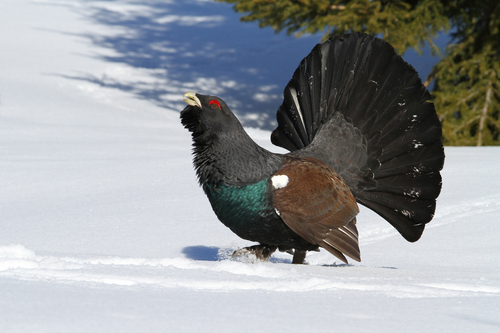 Western Capercaillie
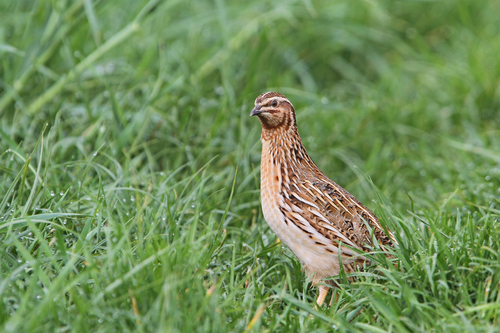 Common Quail
In short
The most reliable way to separate Western Capercaillie from Common Quail in any view is by sheer size: Capercaillie is a massive, turkey-sized grouse, while Common Quail is a tiny, sparrow-sized gamebird. Even at a distance or in flight, the Capercaillie's bulk, long tail, and broad wings are unmistakable compared to the compact, long-winged, and short-tailed silhouette of a quail. If size is hard to judge, look for the Capercaillie's dark, heavy body and, in males, metallic green breast and white wing spots, versus the quail's streaked brown plumage and white eyestripe. Both species are ground-dwellers, but Capercaillie prefers dense forests, while quail are found in open fields and grasslands.
Identification tips
- Size is the single most decisive field mark: Capercaillie is enormous, even the smallest female is many times larger than a Common Quail. Use this first in any view.
- Silhouette and structure: Capercaillie has a long, broad tail and thick neck, with a heavy, rounded body and broad wings. Quail is compact, with a short tail and long, pointed wings (adapted for migration).
- Plumage: adult males: Capercaillie males are dark with a metallic green breast and a white wing spot; no quail shows these features. Quail males have a white chin and eyestripe, and are streaked brown overall.
- Plumage: adult females: Capercaillie hens are barred brown above and buff below, with a red eye patch and white wing spot; quail females are streaked brown but lack the red eye patch and are much smaller and more compact.
- Juveniles: Young Capercaillie resemble the hen but are still much larger than any quail; no distinctive juvenile wing pattern overlap is described for either species.
- Bare parts: Both sexes of Capercaillie have a conspicuous red bare patch above the eye ('roses'), absent in quail.
- Wing pattern in flight: Capercaillie shows broad, rounded wings with a white spot at the base (wing bow); quail has long, pointed wings with no white spot.
- Bill: Capercaillie has a thick, strong bill suited for eating tough vegetation; quail has a much finer bill.
- Behavior when flushed: Capercaillie may walk or run before flying, and when it does, the flight is heavy and noisy; quail flushes rapidly and low, with quick, direct flight.
- Habitat: Capercaillie is found in dense forests, rarely in open country; quail is found in open fields and grasslands, never in deep forest.
- Vocalization: Capercaillie males display with a clicking and popping song at dawn; quail gives a distinctive three-note call, often heard in open country.
- Courtship display: Only Capercaillie males perform elaborate ground and tree displays with fanned tails and drooped wings; quail does not display in this manner.
- Legs and feet: Capercaillie has feathered legs and toes with 'snowshoe' adaptations, visible in close views or tracks; quail legs are unfeathered and adapted for running.
- Footprints: Capercaillie tracks are large and distinctive, with a snowshoe effect in winter; quail tracks are tiny and delicate.
- Context and abundance: Capercaillie is rare and local in much of its range, usually in mature forest; quail is widespread in open country and more likely to be encountered by ear than by sight.
Size
Western Capercaillie is dramatically larger: males average 2885 g (and can reach over 4 kg), with lengths of 74–100 cm and wingspans up to 125 cm. Females are still much larger than a quail, at 1.5–2.5 kg and 54–64 cm long. Common Quail is tiny by comparison, weighing just 70–140 g, measuring 16–18 cm in length, and with a wingspan of 32–35 cm. Even a female Capercaillie dwarfs a quail. In the field, this size gap is so extreme that confusion is only possible with very poor views or in silhouette, but even then, Capercaillie's bulk and long tail stand out.
Plumage
No age or wing pattern overlap: Capercaillie chicks resemble the cryptic brown hen, but are still much larger than any quail and quickly develop adult-like size and structure. Adult male Capercaillie are dark grey-brown with a metallic green breast, black to white belly, and a conspicuous white spot on the wing bow; females are brown with black and silver barring above and buffy below. Both sexes have a bright red bare patch above the eye. Common Quail is streaked brown overall, with a white eyestripe and (in males) a white chin; both sexes are compact and lack any metallic or green tones. Quail wings are proportionally long and pointed, unlike the broad, rounded wings of Capercaillie. No distinctive upperwing patterns are described for either species' juveniles that could cause confusion in flight.
Behaviour
Capercaillie is primarily a forest bird, often seen on the ground or displaying on low branches during the long spring courtship season. Males perform elaborate displays with fanned tails and drooped wings. Common Quail is secretive, usually remaining hidden in grass or crops, and is more often heard than seen. Quail are migratory and may flush with rapid, low flight when disturbed, while Capercaillie is more likely to walk or run unless seriously threatened, and when it does fly, it does so with heavy, noisy wingbeats.
Habitat
Capercaillie inhabits dense, mature forests across Europe and the Palearctic, especially areas with conifers and open understory. It is rarely found in open country. Common Quail prefers open habitats: grasslands, fields, and agricultural land, avoiding dense woodland. If you see a large grouse in deep forest, it's almost certainly a Capercaillie; if you flush a small, streaky gamebird from a field, it's a quail.
Voice
Capercaillie males produce a unique display song: a series of double-clicks accelerating into popping and scraping sounds, most often heard at dawn during the lekking season. Common Quail is famous for its repetitive three-note 'wet-my-lips' call, repeated in quick succession, and is more often detected by voice than by sight. The two vocalizations are entirely different and diagnostic if heard.