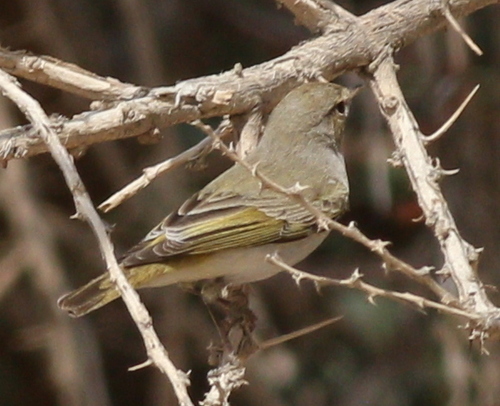
Wood Warbler vs Eastern Bonelli's Warbler
Phylloscopus sibilatrix versus Phylloscopus orientalis
Play a quiz with Wood Warbler and Eastern Bonelli's Warbler
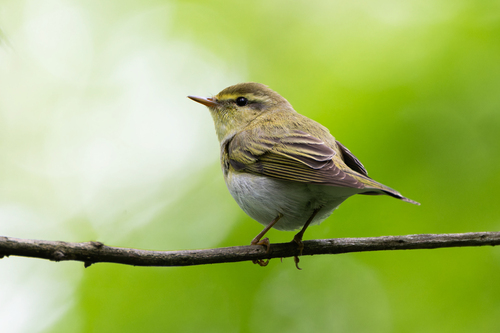
Wood Warbler
Eastern Bonelli's Warbler
In short
The most reliable field mark to distinguish the Wood Warbler from the Eastern Bonelli's Warbler is the bright lemon-yellow throat and breast of the Wood Warbler, contrasting with the more subdued and uniform underparts of the Eastern Bonelli's Warbler. Both species are leaf warblers with similar structure, but their vocalizations and subtle plumage differences can aid in identification.
Identification tips
- Look for the bright lemon-yellow throat and breast of the Wood Warbler.
- Note the uniform pale greyish-white underparts of the Eastern Bonelli's Warbler.
- Listen for the accelerating trill of the Wood Warbler versus the monotonous 'chip' call of the Eastern Bonelli's Warbler.
- Consider habitat: Wood Warblers in mature deciduous woodlands, Eastern Bonelli's Warblers in more open woodlands and scrub.
Size
Both species are similar in size, typical of small leaf warblers, and size alone is not a reliable distinguishing feature.
Plumage
The Wood Warbler has a bright lemon-yellow throat and breast with a white belly, while the Eastern Bonelli's Warbler has a more uniform pale greyish-white underparts. The Wood Warbler also displays a more pronounced yellowish-green on the upperparts compared to the greyer tones of the Eastern Bonelli's Warbler.
Behaviour
Both species exhibit typical leaf warbler behavior, actively foraging among foliage. The Wood Warbler may appear more active and flitty, but behavior is not a strong distinguishing feature.
Habitat
Wood Warblers prefer deciduous woodlands, often with a preference for mature trees, while Eastern Bonelli's Warblers are more commonly found in open woodlands and scrubby areas. Overlapping habitats can occur, so habitat alone is not definitive.
Voice
The Wood Warbler's song is a distinctive, accelerating trill, while the Eastern Bonelli's Warbler has a more monotonous, repeated 'chip' or 'chup' call. Vocalizations are a reliable way to differentiate these species when heard.