Birdr

Wood Warbler vs Western Bonelli's Warbler

Phylloscopus sibilatrix versus Phylloscopus bonelli

Play a quiz with Wood Warbler and Western Bonelli's Warbler
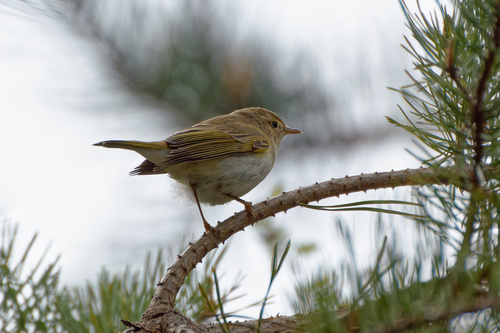
Wood Warbler (Phylloscopus sibilatrix) Wood Warbler
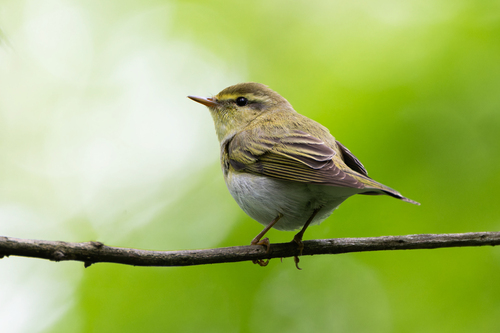
Western Bonelli's Warbler (Phylloscopus bonelli) Western Bonelli's Warbler

Media

Loading…

In short

The Wood Warbler and Western Bonelli's Warbler are both medium-sized leaf-warblers, but the Wood Warbler is distinguished by its bright yellow throat and chest, contrasting with white underparts, while the Western Bonelli's Warbler has a more uniform pale grey-brown appearance with a greenish-yellow rump. Their songs differ notably, with the Wood Warbler having a distinctive accelerating trill.

Identification tips

Size

Both species are similar in size, around 11.5 cm in length.

Plumage

Wood Warbler has a bright yellow throat and chest with white underparts and a more pronounced yellow supercilium. In contrast, Western Bonelli's Warbler is generally pale grey-brown with a greenish-yellow rump and less distinct supercilium.

Behaviour

Both species are active in the canopy, but the Wood Warbler often shows more conspicuous foraging behavior, sometimes hovering to catch insects.

Habitat

Both species inhabit deciduous and mixed woodlands, but the Wood Warbler prefers more mature forests with a dense canopy.

Voice

The Wood Warbler's song is a distinctive accelerating trill, while the Western Bonelli's Warbler has a slower, flatter trill with a metallic quality. Calls also differ, with the Wood Warbler having a clearer, more ringing call.

Submit a better description

Use the same sections as the comparison. Your text is published immediately.

The Wood Warbler and Western Bonelli's Warbler are both medium-sized leaf-warblers, but the Wood Warbler is distinguished by its bright yellow throat and chest, contrasting with white underparts, while the Western Bonelli's Warbler has a more uniform pale grey-brown appearance with a greenish-yellow rump. Their songs differ notably, with the Wood Warbler having a distinctive accelerating trill.

  • Look for bright yellow throat and chest in Wood Warbler, contrasting with white underparts.
  • Check for greenish-yellow rump in Western Bonelli's Warbler.
  • Listen for song differences: Wood Warbler has an accelerating trill, while Western Bonelli's Warbler's trill is slower and flatter.
  • Observe habitat preference: Wood Warbler is more often in mature forests.

Both species are similar in size, around 11.5 cm in length.

Wood Warbler has a bright yellow throat and chest with white underparts and a more pronounced yellow supercilium. In contrast, Western Bonelli's Warbler is generally pale grey-brown with a greenish-yellow rump and less distinct supercilium.

Both species are active in the canopy, but the Wood Warbler often shows more conspicuous foraging behavior, sometimes hovering to catch insects.

Both species inhabit deciduous and mixed woodlands, but the Wood Warbler prefers more mature forests with a dense canopy.

The Wood Warbler's song is a distinctive accelerating trill, while the Western Bonelli's Warbler has a slower, flatter trill with a metallic quality. Calls also differ, with the Wood Warbler having a clearer, more ringing call.

Discard your changes?

You have unsaved edits. If you leave now, those changes will be lost.

Wood Warbler · Western Bonelli's Warbler · My Tricky Birds