
Chevalier stagnatile vs Grand Chevalier
Tringa stagnatilis contre Tringa melanoleuca
Faire un quiz avec Chevalier stagnatile et Grand Chevalier
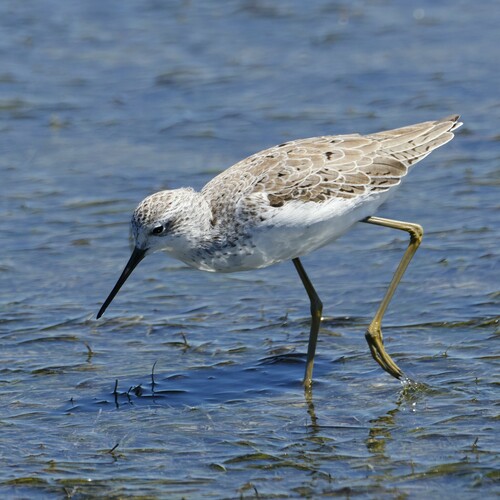 Chevalier stagnatile
 Grand Chevalier
En bref
Le Chevalier stagnatile et le Grand Chevalier peuvent être distingués par leur taille et la forme de leur bec. Le Grand Chevalier est plus grand avec un bec plus épais, légèrement relevé, tandis que le Chevalier stagnatile est plus petit avec un bec mince et droit. Les deux espèces ont des pattes jaunes vives, mais le Grand Chevalier est plus robuste et droit dans sa posture.
Conseils d’identification
- Size: Le Grand Chevalier est plus grand.
- Bill shape: Le Grand Chevalier a un bec plus épais, légèrement relevé ; le Chevalier stagnatile a un bec mince et droit.
- Leg color: Les deux ont des pattes jaunes vives.
- Behavior: Le Grand Chevalier est plus solitaire.
Taille
Le Grand Chevalier est nettement plus grand que le Chevalier stagnatile.
Comportement
Le Grand Chevalier est plus solitaire, souvent vu seul ou en petits groupes, tandis que le Chevalier stagnatile peut être trouvé dans des groupes plus importants.
Habitat
Le Grand Chevalier se reproduit dans des habitats de tourbières marécageuses du centre du Canada et du sud de l'Alaska et hiverne dans des zones humides douces et salines à travers les Amériques. Les préférences d'habitat du Chevalier stagnatile ne sont pas détaillées ici.
Voix
Le Grand Chevalier est connu pour ses appels d'alarme perçants, qui sont distinctifs et souvent décrits comme 'telltale' ou 'yelper.'
Chevalier stagnatile · Grand Chevalier · Mes oiseaux difficiles