
Green-backed Trogon vs Yellow-rumped Cacique
Trogon viridis versus Cacicus cela
Play a quiz with Green-backed Trogon and Yellow-rumped Cacique
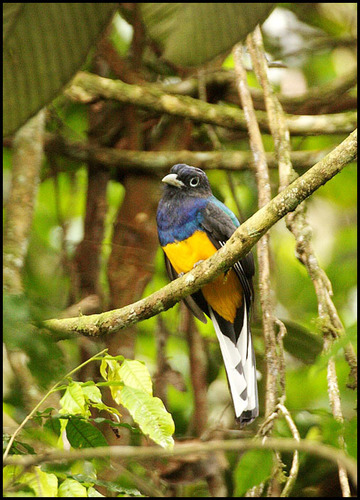 Green-backed Trogon
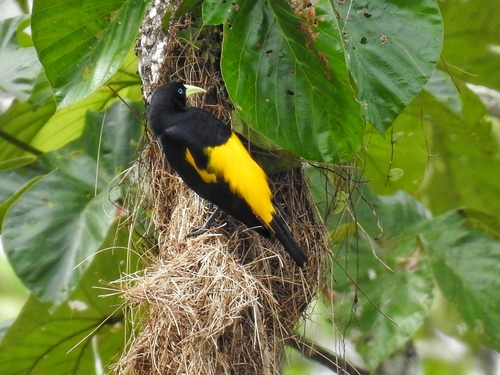 Yellow-rumped Cacique
In short
The Green-backed Trogon and Yellow-rumped Cacique can be distinguished primarily by their plumage and behavior. The trogon features iridescent green and purplish-blue tones with a distinctive white-edged tail, while the cacique is mostly black with prominent yellow patches on the wings, rump, and vent. Behaviorally, the cacique is highly social and often found in colonies, unlike the more solitary trogon.
Identification tips
Look for the Green-backed Trogon's iridescent green and purplish-blue plumage with a white-edged tail. The Yellow-rumped Cacique's black body with yellow patches is distinctive. Observe behavior: caciques are often seen in large colonies, unlike the more solitary trogon.
Size
The Yellow-rumped Cacique is sexually dimorphic in size, with males being larger than females, whereas the Green-backed Trogon does not exhibit such size differences between sexes.
Plumage
The Green-backed Trogon has an iridescent green back, purplish-blue rump, and a white-edged tail, with males showing black cheeks and throat. In contrast, the Yellow-rumped Cacique is primarily black with striking yellow patches on the wings, rump, and vent.
Behaviour
The Yellow-rumped Cacique is highly social, breeding in large colonies, while the Green-backed Trogon is more solitary.
Voice
The Yellow-rumped Cacique is known for its varied vocalizations, including whistling and burbling calls, and can mimic other birds. There is no specific vocalization information for the Green-backed Trogon in the provided notes.
Green-backed Trogon · Yellow-rumped Cacique · My Tricky Birds