
Half-collared Kingfisher vs Striped Kingfisher
Alcedo semitorquata versus Halcyon chelicuti
Play a quiz with Half-collared Kingfisher and Striped Kingfisher
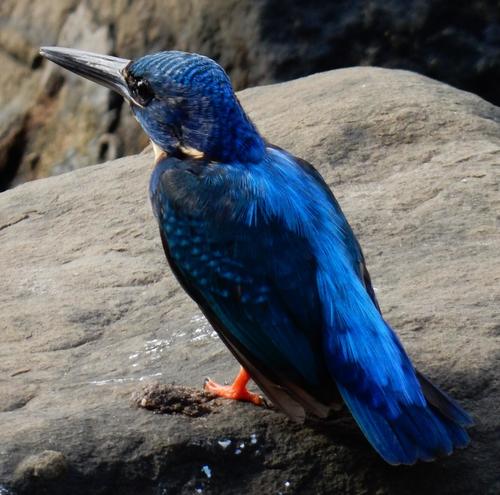 Half-collared Kingfisher
 Striped Kingfisher
In short
The best field mark to separate these two is overall color and wing pattern: Half-collared Kingfisher is a striking blue-and-white bird with a distinctive half-collar and orange underparts, while Striped Kingfisher is mostly brownish-grey above with blue limited to the lower back, wings, and tail, and shows a white wing patch and black bar in flight. Juveniles of Striped Kingfisher are paler and have less blue on the wings, which can cause confusion, but the Half-collared always appears much more blue and lacks brown streaking. Bill color and head pattern are also key: Half-collared has a solid black (male) or mostly black (female) bill and a blue crown, while Striped Kingfisher shows a bicolored bill and a streaked brown crown. Both are similar in size and mass, but their structure and preferred habitats differ.
Identification tips
- Habitat is often decisive: If the bird is seen away from water, especially in open woodland or savanna, it is Striped Kingfisher. Half-collared Kingfisher is almost never found far from water with dense vegetation.
- Overall color: Half-collared Kingfisher always looks vivid blue above with orange underparts and a white throat. Striped Kingfisher is brownish-grey above, with blue limited to the lower back, wings, and tail, and off-white to buff underparts with brown streaks.
- Head pattern: Half-collared has a blue crown with alternating light and dark blue bands and a creamy white stripe on the side of the neck. Striped Kingfisher has a streaked brown crown, a black line through the eye and around the neck, and lacks the blue crown and half-collar.
- Bill color: Male Half-collared has an all-black bill; female has some red at the base of the lower mandible. Striped Kingfisher has a bicolored bill: blackish above and at the tip, reddish-orange below, with juveniles showing duller red.
- Wing pattern in flight: Striped Kingfisher shows a white patch at the base of the primaries, a black bar at the base of the primaries (males), and white wing linings with a black border. Half-collared Kingfisher lacks these features and remains blue above in all views.
- Juvenile confusion: Juvenile Striped Kingfisher is paler, with less blue on the wings and a darker crown, but still shows brown streaking and lacks the vivid blue and orange of Half-collared. Juvenile Half-collared is not described, but should always be blue above and never streaked brown.
- Underparts: Half-collared Kingfisher has clean pale orange underparts; Striped Kingfisher has off-white to buff underparts with brown streaks (especially in southern Africa).
- Neck and collar: Half-collared has a distinctive dark blue 'half collar' on the side of the neck; Striped Kingfisher has a white collar bordered above by a black line.
- Leg color: Both have red or reddish legs, not a reliable separator.
- Perching behavior: Half-collared is usually low over water, often on exposed branches. Striped Kingfisher perches higher, often in treetops, and displays by flicking wings and cocking tail.
- Vocalizations: Only Striped Kingfisher has a distinctive, far-carrying call, often heard at dusk or during display. If you hear the described vocalizations, it is Striped Kingfisher.
- Sex differences: In Striped Kingfisher, males have a buffy-grey crown and a black bar at the base of the primaries; females have a brownish crown and lack the black bar. In Half-collared, only the bill color differs slightly between sexes.
- Context: If seen fishing or diving into water, especially in dense riparian habitat, think Half-collared. If seen sallying from a treetop or displaying, think Striped Kingfisher.
- Streaking: Striped Kingfisher always shows some brown streaking on the crown and underparts (especially southern birds); Half-collared never does.
- Blue extent: Only Half-collared is blue overall; Striped Kingfisher's blue is restricted and only obvious in flight.
Size
Both species are very similar in size, with Half-collared Kingfisher about 18 cm in length and Striped Kingfisher ranging from 16–18 cm. Their body masses are also nearly identical (Half-collared: 35–40 g, Striped: ~38 g) [wikipedia][wikidata]. In the field, neither species is reliably larger, so size alone is not a safe separator.
Plumage
- Juvenile/immature birds: Striped Kingfisher juveniles are paler than adults, with less blue on the wings, a darker crown, and dusky tips to the breast feathers. They also have a duller red on the lower mandible. Half-collared Kingfisher juveniles are not described in detail, but all ages show strong blue upperparts and lack brown streaking.
- Adults perched: Half-collared Kingfisher is vivid blue above with a white throat, orange underparts, and a blue crown with alternating light and dark blue bands. It has a creamy white stripe on each side of the neck and a dark blue 'half collar.' Striped Kingfisher adults are mostly greyish-brown above, with metallic blue limited to the lower back, secondary flight feathers, and tail. The underparts are off-white to buff with brown streaks, especially on the breast and sides. The head is streaked dark brown, with a buffy-grey (male) or brownish (female) background, and a black line through the eye and around the neck.
- In flight: Striped Kingfisher reveals a white patch at the base of the primaries and a black bar at the base of the primaries (in males), with white wing linings bordered in black. These wing patterns are much more visible in flight than when perched. Half-collared Kingfisher does not show these wing patterns and remains blue above in all views.
Behaviour
Half-collared Kingfisher is almost always seen near water, perching quietly on low branches over streams, rivers, or lakes, and diving for fish. Striped Kingfisher is more arboreal, often seen perched high in trees, sometimes away from water, and is more likely to be seen displaying with tail cocked and wings flicking, especially during vocalizations. Striped Kingfisher also tends to be more conspicuous in open woodland or savanna, while Half-collared is more secretive and tied to dense riparian vegetation.
Habitat
Half-collared Kingfisher is restricted to well-vegetated streams, rivers, and lakes in southern and eastern Africa, always close to water and dense shoreline cover. Striped Kingfisher is much more flexible, found in open woodland, savanna, and bushy areas, often well away from water, and is not tied to aquatic habitats. If you see a kingfisher far from water or in dry woodland, it is almost certainly Striped Kingfisher.
Voice
Striped Kingfisher has a distinctive, far-carrying call: a high-pitched 'cheer-cherrrrrr' or 'KEW, kerrrrrrrrr' with a descending trill, often given during display with wings flicked. Half-collared Kingfisher's vocalizations are not described in the notes, so voice is only diagnostic for Striped Kingfisher.
Half-collared Kingfisher · Striped Kingfisher · My Tricky Birds