
Malagasy Brush-Warbler vs Subdesert Brush-Warbler
Nesillas typica versus Nesillas lantzii
Play a quiz with Malagasy Brush-Warbler and Subdesert Brush-Warbler
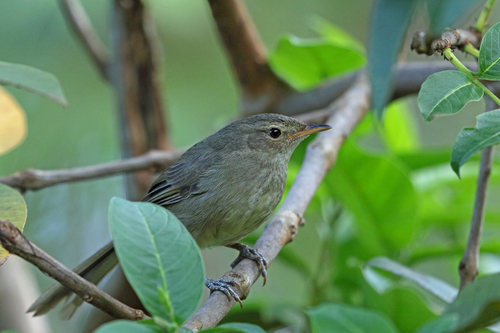 Malagasy Brush-Warbler
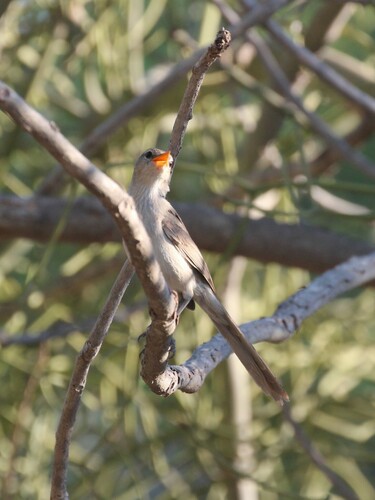 Subdesert Brush-Warbler
In short
Malagasy Brush-Warbler and Subdesert Brush-Warbler are both Nesillas warblers of Madagascar, but the Malagasy is more widespread (also on the Comoros) and typically found in forest undergrowth, while the Subdesert is restricted to Madagascar. The most reliable field mark, based on available information, is the Malagasy's contrasting white eyebrows set against brown plumage. Both species are structurally similar—slim, with long, graduated tails and short, rounded wings—but the Malagasy tends to be slightly heavier and may appear a bit more robust. In the field, habitat and the presence or absence of bold facial markings are your best clues, as detailed information on age-specific plumage or vocal differences is lacking.
Identification tips
- White eyebrows: Malagasy Brush-Warbler shows bold, contrasting white eyebrows above a brown face—this is the single most reliable field mark and applies to all ages and seasons. Subdesert Brush-Warbler lacks any mention of such a strong facial contrast.
- Facial structure: Malagasy has a low forehead and crown, sometimes raised to a slight crest. Look for this subtle shape in perched birds, though it may be hard to judge without direct comparison.
- Tail shape and length: Both species have long, graduated tails; this is not a separating mark but helps confirm you have a Nesillas warbler.
- Wing shape: Both have short, rounded wings, which contribute to their weak, short flights. This is not diagnostic between the two but helps distinguish them from other Malagasy warblers.
- Size: Malagasy is slightly heavier (18.1g) and may appear a bit more robust, but this is not a reliable mark in the field unless both species are seen together.
- Habitat: Malagasy is found in forest undergrowth, especially in moist or dry forests and shrubland, and is widespread in Madagascar and the Comoros. Subdesert is restricted to Madagascar and likely prefers drier, more open habitats—use this context if you know your location and habitat type.
- Behavior: Both species are solitary or in pairs and tend to fly short distances. Behavior is not a reliable separator.
- Bill: Malagasy has a long, brown bill, but there is no comparative information for Subdesert; do not use this mark alone.
- Flight views: No distinctive wing or tail pattern is described for either species in flight, so do not rely on upperwing or tail markings for separation.
- Juvenile/immature plumage: No information is available for age-specific differences, so all field marks above apply equally to adults and immatures.
- Vocalizations: No comparative information is available; do not use song or call for separation based on current sources.
- Sexual dimorphism: Both sexes are similar in structure and plumage, with only minor size differences (males slightly larger in Malagasy).
- Pitfalls: The main pitfall is overlooking the white eyebrow of Malagasy Brush-Warbler or assuming habitat alone is diagnostic—always look for facial contrast first.
- Geographic range: If you are on the Comoros, you are only likely to encounter Malagasy Brush-Warbler. In Madagascar, check habitat and facial markings.
- When in doubt: Prioritize the presence of bold white eyebrows and habitat context; if neither is clear, identification may not be possible with current information.
Size
Malagasy Brush-Warbler averages 18.1g in body mass [wikidata], with male wingspans of 62–70mm and tails 72–93mm (females slightly smaller: wings 58–67mm, tails 67–83mm) [wikipedia]. No direct measurements are available for Subdesert Brush-Warbler, but structurally both are described as slim, with long, graduated tails and short, rounded wings. Expect the Malagasy to be marginally heavier and possibly a touch more robust, but this is subtle and not a reliable field mark without side-by-side comparison.
Plumage
For both species, adults are generally brown above and paler below, but the Malagasy Brush-Warbler stands out with its sharply contrasting white eyebrows—a feature not attributed to Subdesert Brush-Warbler in the available sources. The Malagasy also shows a low forehead and crown, sometimes forming a slight crest. No detailed information is available for juvenile or immature plumages, nor for specific wing pattern differences in flight. Thus, the best separation in all plumages is the presence or absence of bold white eyebrows and overall facial contrast. Both have long, graduated tails and short, rounded wings, with no mention of distinctive age-specific upperwing patterns.
Behaviour
Both species are described as typically solitary or in pairs and tend to fly short distances, likely due to their short, rounded wings. The Malagasy Brush-Warbler is noted for being a bird of forest undergrowth, which may influence its behavior—skulking, low foraging, and quick dashes between cover. There is no behavioral trait described that reliably separates Subdesert from Malagasy in the field, aside from possible habitat preferences.
Habitat
Malagasy Brush-Warbler is widespread in Madagascar and the Comoro Islands, inhabiting forest undergrowth in subtropical or tropical dry forests, moist lowland forests, and moist shrubland [wikipedia]. Subdesert Brush-Warbler is restricted to Madagascar and, by implication of its name and range, likely favors drier, more open or subdesert habitats, though this is not explicitly stated in the available notes. Thus, habitat context can be helpful: Malagasy in moist forest undergrowth, Subdesert in drier, more open areas.
Malagasy Brush-Warbler · Subdesert Brush-Warbler · My Tricky Birds