Birdr

Morelet's Seedeater vs Bananaquit

Sporophila morelleti versus Coereba flaveola

Play a quiz with Morelet's Seedeater and Bananaquit
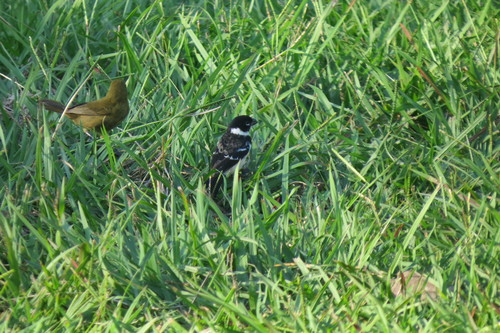
Morelet's Seedeater (Sporophila morelleti) Morelet's Seedeater
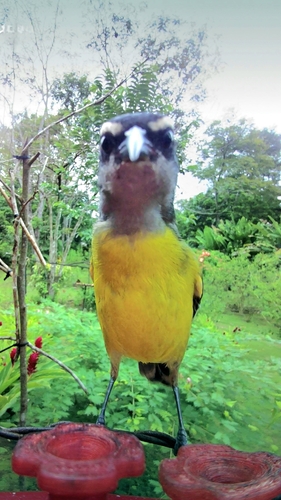
Bananaquit (Coereba flaveola) Bananaquit

Media

Loading…

In short

Morelet's Seedeater and Bananaquit can be distinguished by their plumage and habitat preferences. The male Morelet's Seedeater is notable for its black-and-white plumage, while the Bananaquit has a distinctive yellow underpart. Both species can be found in overlapping ranges in Central America, but they prefer different habitats.

Identification tips

Look for the black-and-white plumage in male Morelet's Seedeater, especially during the breeding season. In contrast, the yellow underparts of the Bananaquit are a clear distinguishing feature. Consider the habitat: Morelet's Seedeater is often found in open areas near water.

Plumage

Male Morelet's Seedeater is black-and-white, making it easily distinguishable from the Bananaquit, which has yellow underparts. Females and juveniles of Morelet's Seedeater are more challenging to differentiate from other seedeaters, but they do not share the Bananaquit's yellow coloration.

Behaviour

Morelet's Seedeater males are frequently observed singing from March to October, while Bananaquits are not noted for such seasonal singing behavior.

Habitat

Morelet's Seedeater inhabits savanna, pastures, and brushy fields, often near water, while the Bananaquit's habitat preferences are not specified in the notes.

Submit a better description

Use the same sections as the comparison. Your text is published immediately.

Morelet's Seedeater and Bananaquit can be distinguished by their plumage and habitat preferences. The male Morelet's Seedeater is notable for its black-and-white plumage, while the Bananaquit has a distinctive yellow underpart. Both species can be found in overlapping ranges in Central America, but they prefer different habitats.

Look for the black-and-white plumage in male Morelet's Seedeater, especially during the breeding season. In contrast, the yellow underparts of the Bananaquit are a clear distinguishing feature. Consider the habitat: Morelet's Seedeater is often found in open areas near water.

Male Morelet's Seedeater is black-and-white, making it easily distinguishable from the Bananaquit, which has yellow underparts. Females and juveniles of Morelet's Seedeater are more challenging to differentiate from other seedeaters, but they do not share the Bananaquit's yellow coloration.

Morelet's Seedeater males are frequently observed singing from March to October, while Bananaquits are not noted for such seasonal singing behavior.

Morelet's Seedeater inhabits savanna, pastures, and brushy fields, often near water, while the Bananaquit's habitat preferences are not specified in the notes.

Discard your changes?

You have unsaved edits. If you leave now, those changes will be lost.

Morelet's Seedeater · Bananaquit · My Tricky Birds