
Speckled Warbler vs Buff-rumped Thornbill
Pyrrholaemus sagittatus versus Acanthiza reguloides
Play a quiz with Speckled Warbler and Buff-rumped Thornbill
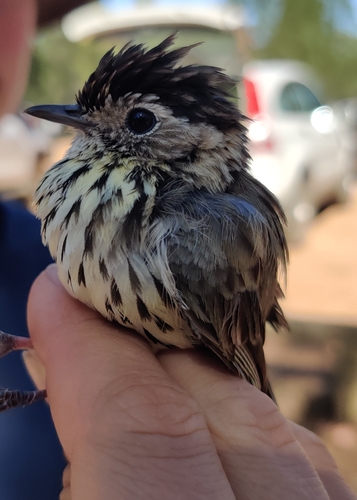 Speckled Warbler
 Buff-rumped Thornbill
In short
The most reliable field mark to separate Speckled Warbler from Buff-rumped Thornbill is the presence of bold black streaking on the underparts and a speckled crown in the warbler, versus the plain pale-yellow underparts and plain crown of the thornbill. Juvenile and adult Buff-rumped Thornbills always show a distinctive buff rump patch, which is never present on Speckled Warbler. In flight, the thornbill’s rump is obvious, while the warbler’s streaked chest and speckled head remain diagnostic at rest or when flushed. Both species are small, ground-foraging birds of eastern Australian woodlands, but the warbler is larger and chunkier, with a heavier bill and a more cryptic, streaked appearance.
Identification tips
- Underpart streaking: Speckled Warbler of all ages shows bold black streaks on yellowish-white underparts; Buff-rumped Thornbill is always plain and pale-yellow below. This is the single most reliable mark.
- Crown pattern: Speckled Warbler has a brown crown with obvious white speckles (male with blackish brow margin, female reddish-brown); Buff-rumped Thornbill’s crown is plain, never speckled or streaked.
- Rump color: Buff-rumped Thornbill always shows a distinctive buff rump patch, visible both perched and in flight. Speckled Warbler’s rump is not contrasting and blends with the streaked upperparts.
- Tail pattern: Both have a dark subterminal band and pale tip, but the thornbill’s tail is proportionally shorter and the buff rump is often visible above it.
- Facial markings: Speckled Warbler has an off-white face with buffy-brown streaks on the ear coverts; Buff-rumped Thornbill’s face is plain and lacks strong markings.
- Bill structure: Warbler has a heavier, more robust bill; thornbill’s bill is thinner and more pointed, typical of Acanthiza.
- Iris color: Adult Buff-rumped Thornbill has white eyes; juveniles have dark eyes. Speckled Warbler has brown eyes at all ages.
- Size and shape: Warbler is larger (11.5–12.5 cm vs. 8–10 cm), bulkier, and more robust; thornbill is smaller, more delicate, and compact.
- Behavior in flocks: Thornbills are often in larger, noisy groups, moving restlessly and acrobatically; warblers are quieter, usually in pairs or small groups, and more secretive.
- Flight jizz: Thornbills show undulating flight and the buff rump is often visible; warblers fly low and direct, sometimes making a distinctive whirring sound with their wings.
- Vocalizations: Thornbills are much more vocal, with rapid, continuous calls; warblers are quieter, with soft, musical songs and mimicry.
- Sex differences: Male Speckled Warbler has a black brow margin, female reddish-brown; Buff-rumped Thornbill shows no obvious sexual dimorphism in the field.
- Juvenile confusion: Juvenile Speckled Warbler is similar to the female but crown spots are more diffuse; juvenile thornbill is like the adult but with dark eyes and always has a buff rump.
- Ground foraging: Both species forage on or near the ground, but warblers are more likely to be seen returning quickly to the ground after being flushed, while thornbills may forage higher and are more acrobatic.
- Context: If seen in a mixed flock, note size and behavior—warbler is the larger, streaked, quieter bird; thornbill is smaller, plain, and more active.
Size
Speckled Warbler is noticeably larger, measuring 11.5–12.5 cm and weighing about 13.5 g [wikipedia], whereas Buff-rumped Thornbill is smaller at 8–10 cm [wikipedia]. The warbler appears bulkier and more robust, while the thornbill is more delicate and compact. In mixed flocks, the warbler stands out as the bigger, heavier bird.
Plumage
- Juvenile/immature: Juvenile Speckled Warbler resembles the female but with a more diffusely spotted crown; underparts are still streaked. Juvenile Buff-rumped Thornbill has dark eyes (adults have white), but always shows the buff rump and lacks any head spotting or underpart streaking.
- Adult: Speckled Warbler has a brown crown with white speckles (male with blackish brow margin, female reddish-brown), off-white face streaked with buffy-brown, and heavily black-streaked yellowish-white underparts. Upperparts are grey-brown with darker streaks. Tail is dark brown with a black subterminal band and white tips. Buff-rumped Thornbill is plain greenish-brown above, very pale-yellow below, with a distinctive buff rump and a tail with a broad blackish band and pale tip. The crown is plain, lacking speckles or streaks. No streaking on underparts. The thornbill’s iris is white in adults, dark in juveniles.
Behaviour
Both species forage on or near the ground and may join mixed-species flocks, but Buff-rumped Thornbill is more likely to be seen in larger, chatty groups (up to 20 or more), often moving acrobatically through lower foliage and sometimes hanging head-down. Speckled Warbler is quieter, more solitary or in pairs, and more secretive, often returning quickly to the ground after being flushed. Thornbills are more restless and vocal while foraging, whereas warblers are subdued and rely on camouflage.
Habitat
Both species inhabit dry forests and open woodlands of eastern Australia. Speckled Warbler is more strictly tied to temperate forests and is often found in areas with dense ground cover or debris. Buff-rumped Thornbill is more adaptable, occurring in a wider range of open eucalypt woodlands and sclerophyll forests, often where the understorey is sparse. Their ranges overlap broadly, so habitat alone is not diagnostic.
Voice
Speckled Warbler has a soft, mellow, musical song with sharp whistles, and is capable of mimicry; its calls are quiet and less persistent. When flushed, it may give a grating twitter. Buff-rumped Thornbill is much more vocal, with a rapid, continuous 'pitta-pitta-pitta-pit' call and constant twittering as it forages. Thornbills are generally noisier and more conspicuous by sound.