
Spotted Piculet vs Varzea Piculet
Picumnus pygmaeus versus Picumnus varzeae
Play a quiz with Spotted Piculet and Varzea Piculet
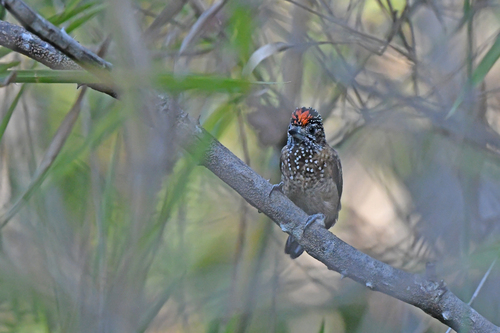 Spotted Piculet
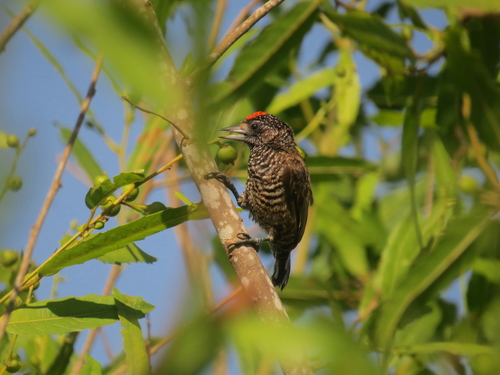 Varzea Piculet
In short
The most reliable field mark between Spotted Piculet and Varzea Piculet is the overall tone of the upperparts and the patterning of the underparts, especially in juveniles and perched birds. Spotted Piculet is slightly larger and shows a darker, more uniform brown above with prominent black and white spotting below, while Varzea Piculet is smaller, has a greener or olive-brown cast to the upperparts, and its underparts often show more barring or rows of black and white tips, especially in juveniles. Both species share a similar cap pattern in adult males, but subtle differences in tail pattern and the quality of underpart markings help separate them. In flight, look for the tone of the upperparts and the extent of white in the tail.
Identification tips
- Juvenile underpart pattern: Juvenile Spotted Piculet shows duller but still spotty underparts, while juvenile Varzea Piculet has more barring or rows of black and white tips. Look for spots (Spotted) versus bars/rows (Varzea) on the belly and flanks.
- Adult upperparts tone: Spotted Piculet is dark brown above, while Varzea Piculet is dark olive- or greenish-brown. In good light, a greener or more olive cast suggests Varzea.
- Adult underparts: Spotted Piculet has large, bold black and white spots on brown to rufous underparts. Varzea Piculet shows more subtle rows of black and white tips, often giving a barred or lined effect rather than discrete spots.
- Cap pattern (males): Both have a black cap with a red patch, but Varzea Piculet's red extends further back on the crown, while Spotted Piculet's is restricted to the forehead. This is subtle and may be hard to judge unless the bird is still and close.
- Tail pattern: Both have white on the tail, but Spotted Piculet shows larger white patches near the end of the outer tail feathers, while Varzea Piculet has a narrower white band. This is best seen on perched birds with spread tails or in flight.
- Face pattern: Both have a mostly dark brown face, but Spotted Piculet's has white tips on some feathers, while Varzea Piculet's has black and white tips. This is a minor difference and not always reliable.
- Chin and throat: Spotted Piculet's chin and throat are black and white in a variable pattern; Varzea Piculet's are black-brown with fine white markings. Look for a more uniform, finely marked throat in Varzea.
- Sex differences: Females of both species lack red on the head, so do not rely on this for species separation.
- Bill and legs: Only Varzea Piculet's bare part colors are described (black bill with blue-gray base, gray legs), but these are not contrasted for Spotted Piculet and may not be reliable in the field.
- Size: Spotted Piculet is slightly larger (10 cm vs. 8–9 cm), but this is subtle and not always useful unless both species are present.
- Habitat: In the Amazonian varzea (seasonally flooded forest), Varzea Piculet is more likely. In other Brazilian habitats, Spotted Piculet is expected.
- Flight views: In flight, look for the overall tone of the upperparts (brown vs. olive/greenish) and the pattern of white in the tail (broader patches in Spotted, narrower bands in Varzea).
- Plumage wear and molt: Both species' juveniles differ from adults, so be cautious with birds showing duller or less distinct markings—check for barring (Varzea) versus spotting (Spotted).
- Pitfalls: Both species can appear similar at a glance, especially females and juveniles. Focus on underpart pattern and upperpart tone as the most consistent field marks.
- Not diagnostic: No differences in vocalizations or behavior are given, so do not use these for separation.
Size
Spotted Piculet is slightly larger, averaging about 10 cm (3.9 in) in length, while Varzea Piculet is smaller at 8–9 cm (3.1–3.5 in). This difference can be subtle in the field but may be noticeable if both are seen together or with direct size references. Both are tiny woodpeckers, but Spotted Piculet may appear a touch bulkier or longer-billed, though the notes do not specify bill differences.
Plumage
- Juveniles: Spotted Piculet juveniles are duller than adults, with less distinct spotting below, but still show large black and white spots on the underparts. Varzea Piculet juveniles are similar to adults but have more barring on the underparts, which can appear as rows of black and white tips rather than discrete spots. This difference in underpart pattern is often the best clue in immature birds.
- Adults (males): Both have a black cap with a red patch on the forehead, but Varzea Piculet's red extends further back on the crown. Spotted Piculet's upperparts are dark brown with black and white tips, while Varzea Piculet's are dark olive-brown to greenish-brown, sometimes with faint black bars. Underparts on Spotted Piculet are light to dark brown (often rufous-tinged) with large black and white spots; Varzea Piculet's are brown or greenish-brown with black and white feather tips in rows, giving a more lined or barred look.
- Tail: Both species have dark tails with white on the inner webs of the innermost pair and white patches or bands on the outer pairs, but Spotted Piculet's white patches are more prominent, while Varzea Piculet's are narrower bands.
- Females: Both lack red on the forehead/crown but otherwise follow the same pattern distinctions as males.
Behaviour
No diagnostic behavioral differences are described in the notes. Both species are small, active woodpeckers likely to forage in similar ways, and no differences in flight style or foraging jizz are noted.
Habitat
Both species are endemic to Brazil, but Varzea Piculet is specifically noted as occurring in the Amazon basin, often associated with varzea (seasonally flooded) forest habitats. Spotted Piculet is also endemic to Brazil but is not specified as restricted to varzea or Amazonian habitats. If the location is a seasonally flooded Amazonian forest, Varzea Piculet is more likely; elsewhere in Brazil, Spotted Piculet is expected.