Birdr

Buff-necked Ibis vs Black-faced Ibis

Theristicus caudatus versus Theristicus melanopis

Play a quiz with Buff-necked Ibis and Black-faced Ibis
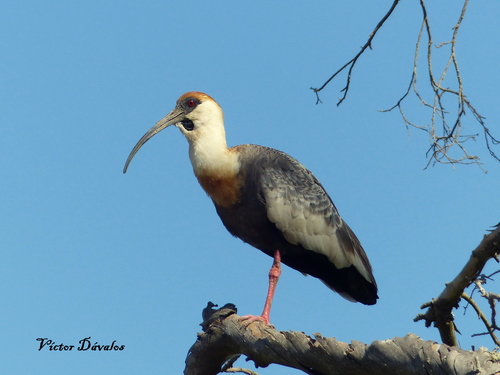
Buff-necked Ibis (Theristicus caudatus) Buff-necked Ibis
Black-faced Ibis (Theristicus melanopis) Black-faced Ibis

Media

Loading…

In short

The Buff-necked Ibis and Black-faced Ibis are similar large waders, but the Buff-necked Ibis is distinguished by its bright buffy head and neck, while the Black-faced Ibis has a more muted face with a distinctive black mask. Both species share a similar structure but differ in plumage coloration and habitat preferences.

Identification tips

Look for the bright buffy head and neck of the Buff-necked Ibis compared to the black mask of the Black-faced Ibis. Observe habitat: Buff-necked Ibis is often in open, dry areas, while Black-faced Ibis is more Andean. Use binoculars to confirm the distinctive facial markings.

Size

Both species are large ibises with similar body size and structure.

Plumage

The Buff-necked Ibis has a bright buffy head and neck, grey back, white primaries and secondaries, and black underparts. In contrast, the Black-faced Ibis features a black mask on its face, which is a key distinguishing feature.

Behaviour

Both species can be seen foraging in open areas, but specific behavioral differences are not well-documented.

Habitat

The Buff-necked Ibis is often found far from water in savannas, ranchlands, and open forests, whereas the Black-faced Ibis is more commonly associated with Andean regions.

Voice

Vocalization details are not well-documented for these species, and differences are not emphasized in the sources.

Submit a better description

Use the same sections as the comparison. Your text is published immediately.

The Buff-necked Ibis and Black-faced Ibis are similar large waders, but the Buff-necked Ibis is distinguished by its bright buffy head and neck, while the Black-faced Ibis has a more muted face with a distinctive black mask. Both species share a similar structure but differ in plumage coloration and habitat preferences.

Look for the bright buffy head and neck of the Buff-necked Ibis compared to the black mask of the Black-faced Ibis. Observe habitat: Buff-necked Ibis is often in open, dry areas, while Black-faced Ibis is more Andean. Use binoculars to confirm the distinctive facial markings.

Both species are large ibises with similar body size and structure.

The Buff-necked Ibis has a bright buffy head and neck, grey back, white primaries and secondaries, and black underparts. In contrast, the Black-faced Ibis features a black mask on its face, which is a key distinguishing feature.

Both species can be seen foraging in open areas, but specific behavioral differences are not well-documented.

The Buff-necked Ibis is often found far from water in savannas, ranchlands, and open forests, whereas the Black-faced Ibis is more commonly associated with Andean regions.

Vocalization details are not well-documented for these species, and differences are not emphasized in the sources.

Discard your changes?

You have unsaved edits. If you leave now, those changes will be lost.

Buff-necked Ibis · Black-faced Ibis · My Tricky Birds