Birdr

Chestnut-flanked White-eye vs Indian White-eye

Zosterops erythropleurus versus Zosterops palpebrosus

Play a quiz with Chestnut-flanked White-eye and Indian White-eye
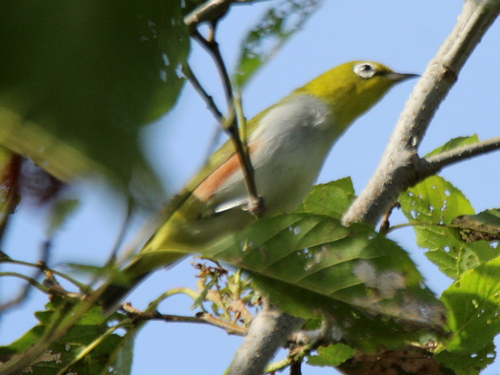
Chestnut-flanked White-eye (Zosterops erythropleurus) Chestnut-flanked White-eye
Indian White-eye (Zosterops palpebrosus) Indian White-eye

Media

Loading…

In short

The Chestnut-flanked White-eye and Indian White-eye are both small, social birds with distinctive white eye-rings, but they can be distinguished by plumage and habitat preferences. The Chestnut-flanked White-eye has a notable chestnut flank, while the Indian White-eye is more uniformly olive-yellow with a bright yellow throat.

Identification tips

1. Look for the chestnut flanks: This is the most reliable field mark for the Chestnut-flanked White-eye. 2. Check the throat color: The Indian White-eye has a bright yellow throat, which can help distinguish it from the Chestnut-flanked White-eye. 3. Consider habitat: If you are in a mangrove or lowland forest, you are more likely to encounter the Indian White-eye. 4. Observe flock behavior: Both species are social, but habitat preferences can guide identification. 5. Be aware of morphs: The Indian White-eye has an all-yellow morph in some regions, which can complicate identification.

Size

Both species are similar in size, typical of the small, compact build of white-eyes.

Plumage

The Chestnut-flanked White-eye has a distinctive chestnut patch on its flanks, contrasting with its otherwise olive and gray plumage. The Indian White-eye is olive-yellow above and gray below, with a bright yellow throat and undertail coverts. An all-yellow morph exists in some regions for the Indian White-eye.

Behaviour

Both species are often seen in flocks, especially around flowering or fruiting trees, where they feed on nectar and small berries.

Habitat

The Chestnut-flanked White-eye is typically found in temperate forests and woodlands, whereas the Indian White-eye occupies a wide range of habitats from mangroves to hill forests across the Indian Subcontinent and Southeast Asia.

Voice

Vocalizations are not distinctly covered in the sources, but both species have typical white-eye calls, which are high-pitched and often given in flocks.

Submit a better description

Use the same sections as the comparison. Your text is published immediately.

The Chestnut-flanked White-eye and Indian White-eye are both small, social birds with distinctive white eye-rings, but they can be distinguished by plumage and habitat preferences. The Chestnut-flanked White-eye has a notable chestnut flank, while the Indian White-eye is more uniformly olive-yellow with a bright yellow throat.

1. Look for the chestnut flanks: This is the most reliable field mark for the Chestnut-flanked White-eye. 2. Check the throat color: The Indian White-eye has a bright yellow throat, which can help distinguish it from the Chestnut-flanked White-eye. 3. Consider habitat: If you are in a mangrove or lowland forest, you are more likely to encounter the Indian White-eye. 4. Observe flock behavior: Both species are social, but habitat preferences can guide identification. 5. Be aware of morphs: The Indian White-eye has an all-yellow morph in some regions, which can complicate identification.

Both species are similar in size, typical of the small, compact build of white-eyes.

The Chestnut-flanked White-eye has a distinctive chestnut patch on its flanks, contrasting with its otherwise olive and gray plumage. The Indian White-eye is olive-yellow above and gray below, with a bright yellow throat and undertail coverts. An all-yellow morph exists in some regions for the Indian White-eye.

Both species are often seen in flocks, especially around flowering or fruiting trees, where they feed on nectar and small berries.

The Chestnut-flanked White-eye is typically found in temperate forests and woodlands, whereas the Indian White-eye occupies a wide range of habitats from mangroves to hill forests across the Indian Subcontinent and Southeast Asia.

Vocalizations are not distinctly covered in the sources, but both species have typical white-eye calls, which are high-pitched and often given in flocks.

Discard your changes?

You have unsaved edits. If you leave now, those changes will be lost.

Chestnut-flanked White-eye · Indian White-eye · My Tricky Birds