
Green-backed Hillstar vs White-crested Spadebill
Urochroa leucura versus Platyrinchus platyrhynchos
Play a quiz with Green-backed Hillstar and White-crested Spadebill
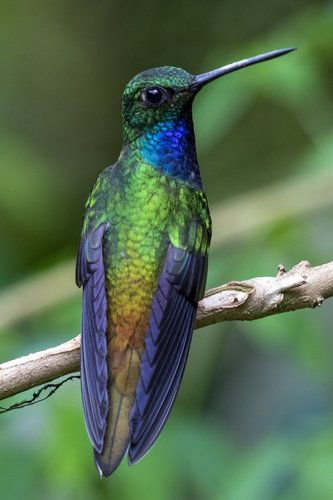 Green-backed Hillstar
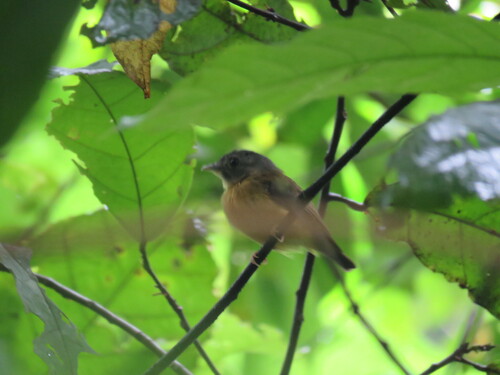 White-crested Spadebill
In short
The most reliable field mark to separate Green-backed Hillstar from White-crested Spadebill is overall structure: the hillstar is a slim, medium-large hummingbird with a long, straight bill and iridescent blue throat, while the spadebill is a small, round-bodied flycatcher with a huge, flat, broad bill and a distinctive white crown patch (often concealed). Juvenile plumages do not create confusion, as both species are similar to adults with only subtle differences. In flight or perched, the hillstar's white-edged tail and bronzy-green upperparts contrast sharply with the spadebill's russet-brown upperparts and ochraceous underparts. Habitat and behavior are also strong clues: hillstars hover and feed at flowers, spadebills perch quietly in the forest understory and sally for insects.
Identification tips
- Bill shape is the fastest check: Green-backed Hillstar has a long, straight, slender bill typical of hummingbirds; White-crested Spadebill has a very broad, flat, paddle-shaped bill with a black upper mandible and pale lower mandible. This is obvious even at a distance.
- Body structure: Hillstar is slim, elongated, and long-tailed; spadebill is compact, round-bodied, and short-tailed with a disproportionately large head.
- Tail pattern: Hillstar shows white outer tail feathers with bronzy central feathers; spadebill's tail is uniformly dusky brown and short.
- Upperparts color: Hillstar is bronzy-green above; spadebill is russet-brown above.
- Throat and breast: Hillstar has an iridescent blue throat and breast; spadebill has a white throat and bright ochraceous underparts.
- Crown patch: Spadebill may show a partially hidden white crown patch (smaller in females), never present in hillstar.
- Juvenile marks: Hillstar juveniles have buffy fringes on head feathers and a faint buffy malar, but otherwise resemble adults; spadebill juveniles are not described as differing from adults in field marks.
- Sex differences: Both species are sexually similar, but female hillstars are duller, and female spadebills have a smaller white crown patch.
- Flight style: Hillstar hovers and darts at flowers; spadebill perches and makes short, direct sallies for insects.
- Habitat: Hillstar is found in montane forests (mostly above 1,600 m); spadebill is a lowland/foothill understory specialist (mostly below 1,100 m).
- Perching behavior: Spadebill sits quietly, often low in the understory; hillstar is more likely to be seen at flowers or perching briefly between feeding bouts.
- Voice: Hillstar gives high, repeated 'tseee' or 'twit' notes; spadebill's calls are not described here but are unlikely to be similar.
- Leg color: Spadebill has pinkish-yellow legs and feet; hillstar's leg color is not described but is not a field mark.
- Range overlap: Both can occur in Colombia, Ecuador, and Peru, but rarely in the same microhabitat or elevation.
- Common pitfalls: Distant, backlit views may obscure the hillstar's blue throat or the spadebill's white crown patch; rely on structure and bill shape in poor light.
Size
White-crested Spadebill is slightly heavier (about 12 g) than Green-backed Hillstar (approx. 8.7 g), but the hillstar is longer (13–14 cm vs. 10.5–12 cm). In the field, the hillstar appears more elongated with a longer bill and tail, while the spadebill is compact, short-tailed, and big-headed. The spadebill's bill is notably broad and flat, unlike the slender, straight bill of the hillstar.
Plumage
-
Juveniles: Both species' juveniles resemble adults. Green-backed Hillstar juveniles show buffy fringes on head feathers and a faint buffy malar, but retain the bronzy-green upperparts, blue throat, and white-edged tail. Spadebill juveniles are not described in detail, but no evidence suggests they differ markedly from adults in field marks relevant to confusion.
-
Adults: Green-backed Hillstar has bronzy-green upperparts, a blue iridescent throat and breast, dull gray belly, and a tail with bronzy central feathers and white outer feathers edged dusky gray. The sexes are similar, with females slightly duller. White-crested Spadebill adults have russet-brown upperparts, a gray head with a dark crown, a partially hidden white crown patch (smaller in females), white throat, and bright ochraceous underparts. Their wings and tail are dusky brown. The spadebill's bill is strikingly broad and flat, with a black upper mandible and pale lower mandible.
-
Tail: Hillstar's tail is longer and shows white with bronzy central feathers; spadebill's tail is short, dusky brown, and never shows white.
Behaviour
Green-backed Hillstar is an active, hovering hummingbird, usually foraging at flowers in the lower and middle forest strata, sometimes defending feeding territories. It may occasionally sally for insects. In contrast, White-crested Spadebill perches quietly in the forest understory, making short sallies to catch insects, and is rarely seen at flowers. The spadebill's movements are more deliberate and less frenetic than the hillstar's. During display, spadebill males perform a whirring wing flight, but this is rarely seen.
Habitat
Green-backed Hillstar inhabits the interior and edges of mature montane and secondary forests, and shrubby slopes, mostly at 1,600–2,800 m elevation (lower in Peru). It is typically found near streams on the east slope of the Andes in Colombia, Ecuador, and NE Peru. White-crested Spadebill is a lowland and foothill species (sea level to 1,100 m), found in the understory of humid terra firme forests, especially on sandy soils, across a broad Amazonian and Guianan range. Overlap is possible only in foothill forests of Colombia, Ecuador, and Peru, but the hillstar is a montane species, while the spadebill is a lowland/foothill understory bird.
Voice
Green-backed Hillstar gives a continuous series of single, high 'tseee', 'tsing', or 'seeuw' notes, and a liquid 'twit' repeated in long sequences. White-crested Spadebill's vocalizations are not described here, but as a tyrant flycatcher, its calls are likely to be short, sharp, and less musical than the hillstar's. Vocalizations are not the most reliable separation in the field unless the hillstar's high, repeated notes are heard.
Green-backed Hillstar · White-crested Spadebill · My Tricky Birds